

How ICH M11 connects protocol authoring, structured information, and amendment control—and what clinical teams need to govern before the next change.
Clinical teams in the European Union now have a harmonised standard that addresses both protocol content and its electronic exchange. The ICH M11 guideline on the clinical electronic structured harmonised protocol came into effect in the EU on 11 June 2026. CHMP adopted it on 11 December 2025. The ICH Assembly adopted the guideline, template, and technical specification at Step 4 on 19 November 2025. FDA announced the final guidance in the Federal Register on 22 May 2026, 91 FR 30310, under docket FDA-2022-D-3054. FDA’s guidance describes the agency’s current thinking and provides nonbinding recommendations.
M11 comprises three connected documents. There is a guidance, a template, and a technical specification that defines harmonized terminologies and standardized data fields for electronic exchange of protocol information. Together, they address protocol organization, content, and the technical attributes needed for electronic exchange.
How the ICH M11 Template and Technical Specification Work Together
Sponsors have absorbed protocol templates before. The M11 template establishes common headings, content organization, and instructions for placing protocol information. Conformance is a review activity, and an experienced medical writer can address those elements with a well-built Word file and a checklist.
A technical specification adds another layer. It names the data elements, describes their data types, identifies permitted values where applicable, and defines technical attributes such as conformance and cardinality. Cardinality describes how many occurrences of an element are allowed. The specification covers individual data fields and blocks of text-based content. Consider the study design, the population criteria, the objectives and endpoints, and the schedule of activities. Their representation needs to support electronic exchange while preserving the meaning of the decisions they describe.
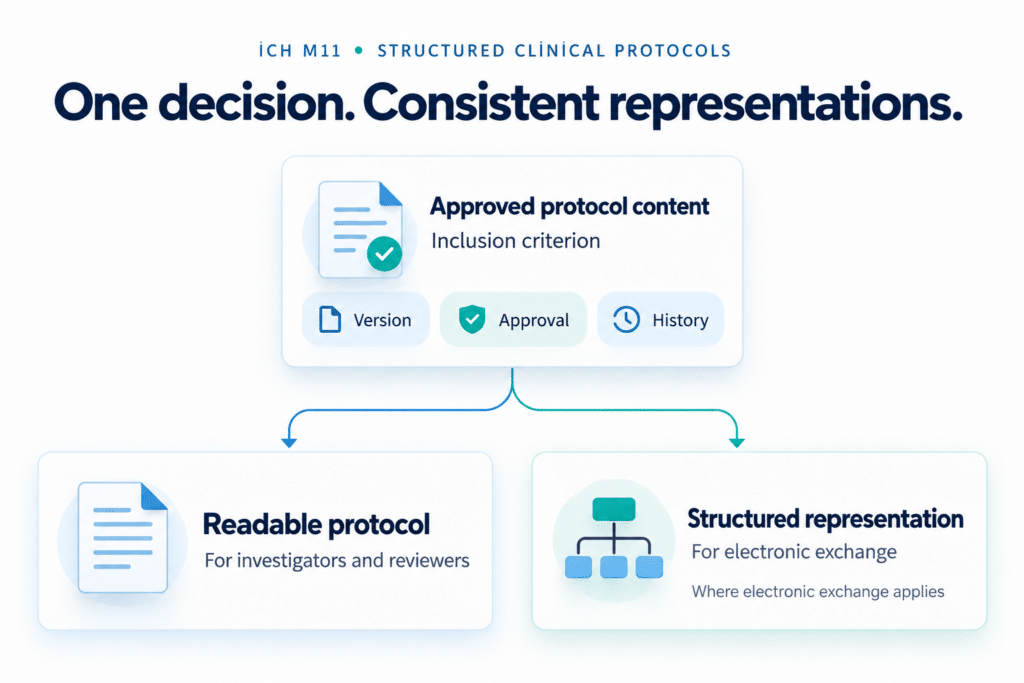
Those two dimensions coexist in M11. The protocol still has to read as a protocol for investigators, ethics committees, and reviewers. Where protocol content is exchanged electronically, its structured representation needs to remain consistent with the readable protocol, with submission arrangements determined by the applicable regional requirements. Sponsors who treat the template as the deliverable and the data as an export risk discovering that the export is where the inconsistencies surface.
The Failure Mode Is Transcription
Consider a document-first operating model. Writers author in the M11 template. Somewhere downstream, a data manager or a vendor populates the structured fields by reading the finished protocol. Where structured protocol information is exchanged, the populated fields need to reflect the approved protocol version.
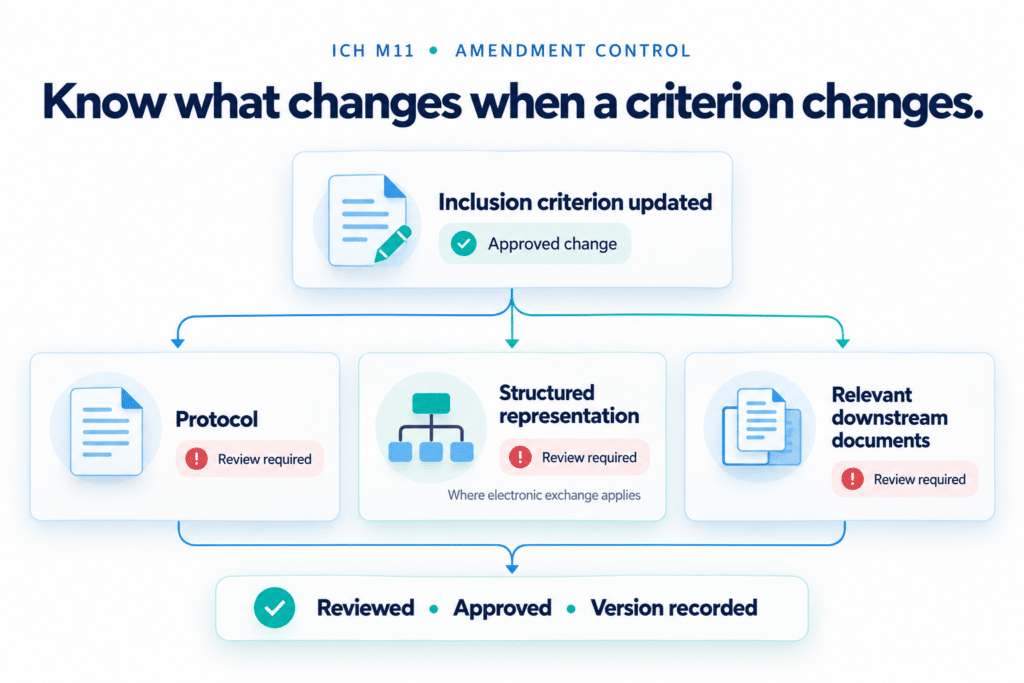
The weakness becomes more visible on amendment. A substantial amendment changing an inclusion criterion or an interim analysis now has to land in two places. The second landing depends on someone noticing. Multiply that by a program with several protocols sharing a core design, and by translations. Then add the downstream documents that restate the same design decisions: the investigator’s brochure, the statistical analysis plan, the clinical study report, and the registry posting. The number of places a single decision must remain true keeps growing. The mechanism for keeping it true stays manual.
The risk is a mismatch between what the approved protocol says and what the structured record says. A reviewer who queries the data could encounter a different representation of the same study decision.
Governing Structured Protocol Content Through Amendments
The alternative inverts the sequence. Author the decision once, as a governed content object with its own identity, permitted values, approval state, and audit history. Render the protocol document from it. Render the structured protocol representation from it. Reuse the same object in the investigator’s brochure and the clinical study report, where reuse is appropriate and traceable.
M11 leaves the processes for developing and maintaining a protocol outside its scope. This governed authoring model is an implementation approach for maintaining consistency as content changes.
That inversion only works if governance comes first. Structure without governance produces a tidier mess. Components become reusable, but nothing states which version is approved, for which protocol, at which amendment, and under whose authority. A defensible workflow retains evidence of what was approved, when, and by whom.
Docuvera is built for that order of operations. Its governance layer provides component-level version control, role-based access, review workflows, and audit history. When core content changes, dependent documents are flagged for review. Amendment becomes a controlled update to a governed object, followed by review of the affected artifacts. Docuvera’s clinical documentation solution supports governed reuse across protocols, investigator’s brochures, and clinical study reports. Producing the readable protocol and its structured representation from the same authoritative content gives sponsors a practical way to maintain consistency through amendments.
AI operates within that arrangement under defined permissions, source controls, and human review. Under Docuvera’s Hierarchy of Intelligence™, retrieval augmented reuse comes first, surfacing the approved component that already exists and is cleared for this study. Retrieval augmented transformation adapts an approved component into the required form and records the adaptation. Generation sits last, under human authorization, because a protocol is a regulatory commitment and the accountable author has to remain accountable. AI shortens the path to a defensible draft while the accountable author retains responsibility for verification and approval.
What to Check Before the Next Amendment
A useful diagnostic starts with where a design decision lives, once and authoritatively. It continues with what propagates when that decision changes, and what instead depends on a person remembering. It ends with whether the sponsor can produce, on request, the approved version of any protocol element at any point in the study’s history.
For ICH M11 implementation, put that diagnostic to work on one protocol. Inventory the content that will be exchanged, map it to the technical specification’s data elements and controlled terminology, and assign ownership for each mapping. Then test an amendment: change one approved criterion, identify the affected outputs, and verify that the readable protocol and structured representation retain the same meaning after review.
Teams that can answer all three will be better positioned to map approved protocol content to M11 and maintain consistency through amendments. Teams that cannot will spend the next amendment cycle discovering how many copies of one sentence they own.
For a deeper analysis of why document-based clinical documentation no longer holds under trial complexity, regulatory scrutiny, and interoperability demands, see Docuvera’s Clinical Documentation Guide.
Frequently Asked Questions
Sources
- Guidance: M11 Clinical Electronic Structured Harmonised Protocol; International Council for Harmonisation (91 FR 30310, 22 May 2026, PDF) — U.S. Food and Drug Administration, Docket No. FDA-2022-D-3054
- M11 Clinical Electronic Structured Harmonised Protocol: Guidance, Template, and Technical Specification — U.S. Food and Drug Administration
- ICH M11 guideline, clinical study protocol template and technical specifications — European Medicines Agency
- ICH M11 guideline on clinical electronic structured harmonised protocol (CeSHarP), Step 5 (PDF) — European Medicines Agency
- ICH M11 CeSHarP technical specification, Step 5 (PDF) — European Medicines Agency
- ICH M11 final guideline, adopted 19 November 2025 (PDF) — International Council for Harmonisation
- Governance Layer — Docuvera
- Clinical Trial Documentation — Docuvera
- AI-Powered Structured Content Authoring and Hierarchy of Intelligence™ — Docuvera
- Clinical Documentation Guide — Docuvera