
How Structured Content is Reshaping eCTD 4.0 & Lifecycle Submissions
Introduction: Why Regulatory Teams Are Shifting Toward Modular Content in eCTD 4.0 Submissions
Traditional document-based processes—where content is authored, reviewed, and submitted as static files—are increasingly giving way to modular, component-based submissions. Historically, regulatory submissions relied on paper submissions, but the introduction of the common technical document established a standardized format that paved the way for digital transformation in regulatory processes.
The growing complexity of global submissions and the rollout of eCTD 4.0 under the HL7 RPS framework is a huge catalyst of this forward momentum, which prioritizes structured data, interoperability, and modular reusability over static documents. eCTD 4.0 represents the latest evolution of the electronic common technical document, a format that has been widely adopted by regulatory authorities and regulatory agencies to support global harmonization of regulatory processes. Health authorities now expect greater transparency, faster updates, and precise traceability across the product lifecycle.
While modular content is not a new concept, its application within regulated submissions is entering a new era. Docuvera enables organizations to operationalize modular content—connecting authoring, review, and lifecycle management into a unified, compliant process that aligns with eCTD 4.0 requirements. For the industry, timely adoption of these new standards is essential to remain competitive and ensure ongoing compliance in an evolving regulatory landscape.
What Is Modular Content? Key Differences from Document-Centric Models
At its core, modular content is a structured approach to managing information. Instead of producing full-length documents for each submission, regulatory teams create smaller, reusable content modules—each representing a single piece of information, such as a manufacturing process, safety statement, or clinical summary. This approach enables flexible document granularity, allowing teams to manage content at different levels of detail to align with regulatory strategies and lifecycle traceability.
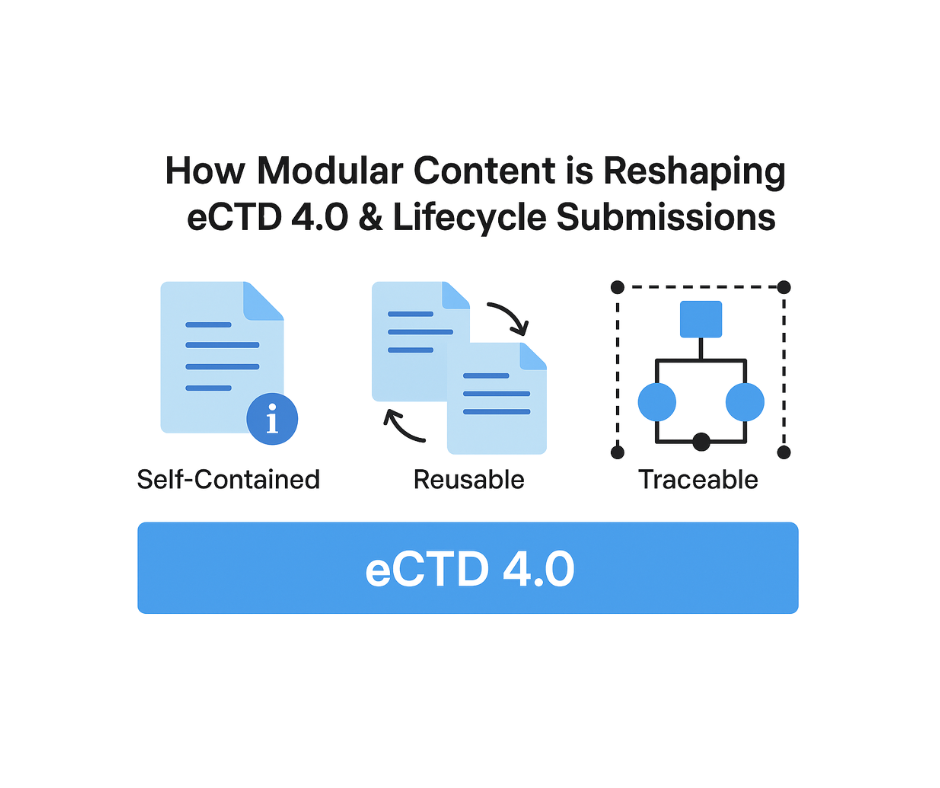
Each module is:
- Self-contained, with its own metadata, approvals, and version history
- Re-usable across multiple submissions, indications, and regions
- Traceable, ensuring visibility into where and how content is used
In contrast, document-centric models rely on static files that must be copied, reformatted, and re-reviewed with every submission cycle—creating redundancy and introducing risk. Traditional approaches often require managing multiple documents for a single update, whereas modular content enables updates to a single document or even replacing one document across submissions, simplifying lifecycle management and maintaining compliance.
Docuvera’s role is to make this modular approach practical and compliant for regulatory teams by functioning as a structured content management system that aligns authoring, metadata, and publishing for eCTD 4.0 submissions.
The eCTD 4.0 Evolution: How Structured Data and XML Metadata Enable Reuse
 The eCTD 4.0 standard (as defined by ICH M8 and HL7 RPS guidelines) fundamentally changes how data is represented and exchanged across global health authorities including the FDA, EMA, and PMDA. Unlike earlier versions that were document-driven, eCTD 4.0 introduces structured XML metadata, enabling more precise content management, tracking, and reuse.
The eCTD format has undergone significant technical advancements, with eCTD v4.0 representing the latest version and a major version update—the next major version after previous releases. Earlier versions relied on multiple XML files (such as regional XML, index XML, and study XML files), but eCTD 4.0 introduces structural changes and new technical requirements based on change requests from stakeholders. The implementation of eCTD 4.0 was a collaborative effort to develop a more flexible standard, with input from the International Council and other regulatory bodies. While future versions are anticipated, the current focus is on preparing for future submissions and new applications using this standard.
Study tagging files have been replaced by context groups and the concept of context, improving document organization. Controlled vocabulary and controlled vocabularies, adopted from authoritative sources, ensure consistency and traceability, while keywords, clear definitions, and a shared understanding of the standard are essential for effective regulatory communication. Sponsors can define their own terms within controlled vocabularies, providing more details and improvements for data driven submissions. The production pilot phase, including FDA’s involvement, highlights the importance of meeting regulatory requirements and regulatory review within the regulatory submission process.
Regulatory submissions now support a broader range of regulatory activities, with easier references, reference, and referencing of documents. Sponsors can submit and are submitting content more flexibly, streamlining the submission process and making it more efficient. The inclusion of supportive files, the importance of written documentation, and the move away from physical files and physical file submissions further modernize the process.
eCTD 4.0 now supports pharmaceuticals, drug applications, food additives, and medical devices—including products for human and human use—harmonized across different regions. The industry’s adoption of eCTD 4.0 advances global harmonization, with regulatory authorities, regulatory agencies, and sponsors all playing key roles in the review process.
Key eCTD 4.0 capabilities that support modular content include:
- Persistent identifiers: Every content element can be uniquely identified across submissions, allowing automated comparison and change tracking.
- Structured metadata: Each module carries contextual data—product, indication, and submission type—allowing it to be assembled into multiple submissions without rework.
- Improved lifecycle management: Authorities can see exactly which modules have changed, reducing redundancy and improving clarity during reviews.
This structure aligns perfectly with the modular content model. The content modules serve as the building blocks, while eCTD 4.0 provides the framework that enables reuse and traceability across global regulatory systems.
Docuvera bridges this gap—connecting structured authoring tools with metadata-driven content management so teams can confidently prepare eCTD 4.0-compliant submissions.
Benefits for Lifecycle Management: Reusability, Traceability, and Faster Updates
Operational and Compliance Impact
Implementing modular content in eCTD 4.0 delivers measurable benefits across the product lifecycle, especially in complex, multi-region submissions.
1. Reusability
Once a module is authored and approved, it becomes a reusable asset. eCTD 4.0 allows teams to create references to content modules, making it easier to reference and referencing the same information across multiple submissions and regulatory activities. Teams can leverage the same content—such as stability data or facility descriptions—across multiple submissions without reauthoring or reformatting. Docuvera simplifies reuse with dynamic linking and version control, ensuring consistent, compliant content across all markets.
2. Traceability
With granular metadata, every content module in Docuvera is traceable from creation through submission. When a change occurs—such as an updated specification or clinical summary—regulatory teams can instantly identify all sequences and markets affected. This level of traceability minimizes risk and strengthens compliance oversight.
3. Faster Updates
Because updates are managed at the module level, lifecycle maintenance becomes significantly faster. eCTD 4.0 simplifies the process of submitting updates, allowing teams to submit only the relevant modules instead of entire documents. Rather than reworking entire documents, teams only update relevant content modules—accelerating responses to agency requests, variations, or safety updates.
For global organizations managing dozens of active submissions, this modular structure reduces turnaround times dramatically—supporting faster access to markets and streamlined regulatory compliance.
Preparing Your Organization for the Modular Future
The transition to modular content in eCTD 4.0 is not just a technological upgrade—it represents a strategic shift toward data-driven, interoperable regulatory operations aligned with emerging standards from ICH and HL7. As agencies adopt structured data requirements and demand greater traceability, organizations relying on document-centric models will face growing inefficiencies and compliance risks.
Docuvera empowers life sciences companies to adopt modular content effectively. By combining structured authoring, metadata management, and lifecycle tracking, Docuvera makes modular content practical, scalable, and audit-ready.
The modular future is already here. The organizations preparing for it today—by aligning their processes, technology, and content strategies—will be the ones leading regulatory innovation tomorrow.
FAQs
The eCTD 4.0 standard, built on the HL7 Regulated Product Submission (RPS) framework, uses structured XML metadata and persistent identifiers to track content across submissions. This structure allows regulatory teams to reuse approved modules safely, ensuring consistency and transparency during lifecycle updates.
Docuvera provides a structured content management system purpose-built for regulated industries. It manages metadata, version control, and dynamic assembly of submissions—enabling regulatory teams to author, review, and reuse content efficiently while staying fully compliant with eCTD 4.0 and HL7 RPS standards.
While not explicitly mandated, modular content is strongly aligned with eCTD 4.0’s data-driven design. Health authorities such as the FDA, EMA, and PMDA increasingly expect traceable, structured submissions. Adopting modular content ensures future readiness as agencies continue to expand digital and structured-data requirements.
By managing reusable content components, teams can update individual modules—such as product details or stability data—without recreating entire documents. This approach supports faster responses to agency requests, reduces redundancy, and improves global submission synchronization across product lifecycles.
Structured authoring is the foundation of modular content. It standardizes how information is created and tagged, enabling components to be reused automatically in new submissions. When combined with eCTD 4.0’s metadata model, structured authoring ensures content consistency, interoperability, and compliance traceability.
