

For many years, pharma sustainability and regulatory functions ran largely separate agendas: ESG teams focused on Scope 3 emissions, material waste, and non-financial reporting, while regulatory teams focused on submission quality, labeling accuracy, and compliance timelines.
That separation is no longer tenable.
As regulatory operations become more digital, more global, and more lifecycle-driven, the mechanics of how regulated content is created, governed, and reused are beginning to show up directly in environmental performance. ESG impact is no longer confined to manufacturing processes or supply logistics alone. It is increasingly shaped by how information behaves across the regulatory lifecycle.
In particular, inconsistencies in how content is authored, reused, and updated across markets create downstream effects that are invisible in document-based workflows but material at enterprise scale.
This matters now because regulatory reporting frameworks such as the EU Corporate Sustainability Reporting Directive (CSRD) and the European Sustainability Reporting Standards (ESRS) are raising expectations for value-chain transparency, auditability, and Scope 3 disclosure, not just narrative intent
(European Commission – CSRD overview).
Many organizations are discovering that some of their most measurable environmental improvements are emerging not from new sustainability initiatives, but from better governed regulatory operations.
One of the clearest operational examples of measurable ESG improvements is pharmaceutical labeling.
The Hidden Carbon Cost of Today’s Labeling — and Its ESG Impact on Pharma
In 2023, Dobers, Gerbsch, Mandry, and Preut published one of the first comprehensive lifecycle assessments quantifying greenhouse-gas emissions associated with printed pharmaceutical package leaflets in Germany.
Their findings are instructive:
- 1.5–1.9 billion printed leaflets were dispensed in Germany in a single year
- Each leaflet generated approximately 7 g CO₂e (up to 8.8 g CO₂e for prescription products)
- National emissions totaled 11,600–13,700 tonnes CO₂e annually, comparable to the yearly emissions of 1,100–1,300 citizens
These emissions are embedded long before a leaflet reaches a patient: paper production, printing, logistics, packaging assembly, rework, and disposal all contribute. They are not edge cases or anomalies; they are the predictable outcome of document-centric labeling processes operating at scale.
Crucially, this footprint is not driven by clinical necessity. It is driven by how labeling content is authored, governed, and updated..
Digital Product Information Reduces Emissions — but Only with the Right Foundation
Lifecycle research shows that electronic product information (ePI/ePL) can reduce emissions by more than 90 percent, with average digital access generating roughly 0.2 g CO₂e per use, even under conservative assumptions.
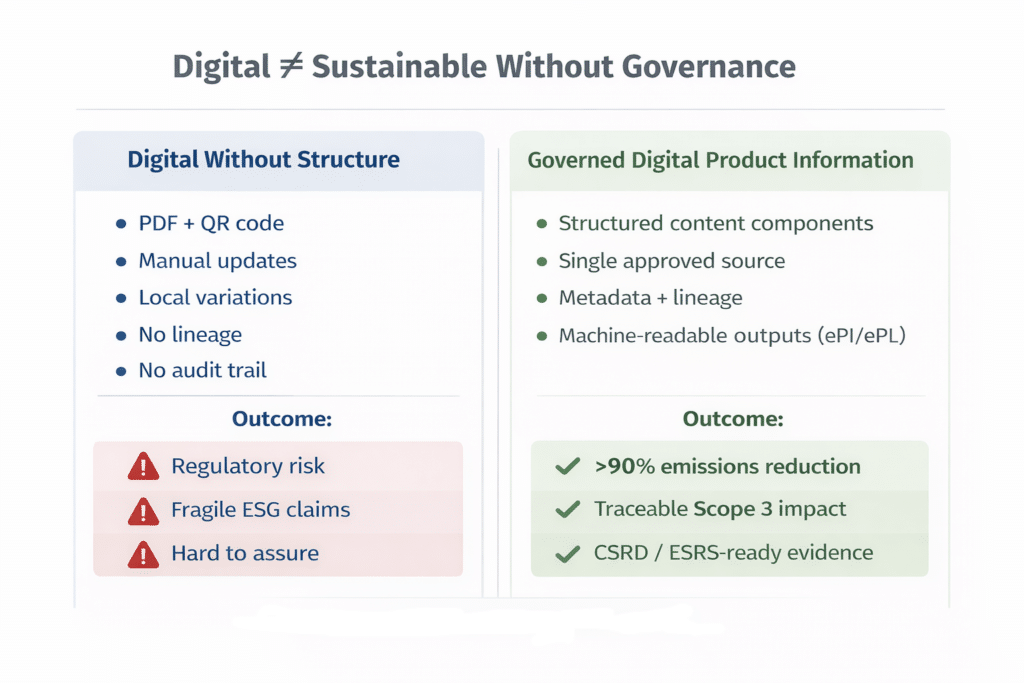
Industry pilots reinforce this direction. Global programs in markets such as Singapore, Japan, Canada, and the EU demonstrate that digital labeling can reduce environmental impact while improving update speed and access. The European Medicines Agency’s electronic product information (ePI) initiatives further support this regulatory trajectory toward machine-readable, lifecycle-managed content (European Medicines Agency – ePI).
But these outcomes are not achieved by PDFs and QR codes alone.
Digital labeling only scales safely when content is structured, governed, and traceable across its full lifecycle. Without that foundation, organizations trade paper waste for regulatory risk. ESG gains become fragile, difficult to measure, and hard to defend under assurance.
Quality Means More than Accuracy — It Means Governance and Context
In ESG reporting, accuracy is only one dimension of quality. Sustainability frameworks and regulators emphasize:
- Consistency: the same information must mean the same thing wherever it appears
- Traceability: organizations must explain where information came from and how it changed over time
- Context: the conditions under which information applies must be explicit
This aligns directly with long-standing regulatory expectations for data integrity. The U.S. Food and Drug Administration’s guidance on Data Integrity and Compliance With Drug CGMP makes clear that regulated data must be attributable, legible, contemporaneous, original, and accurate throughout its lifecycle
(FDA – Data Integrity Guidance).
Accuracy without consistency, traceability, and context is insufficient for either regulatory compliance or ESG assurance.
Structured content authoring embeds these qualities into the content itself. When data is governed at the point of creation—with explicit lineage, metadata, and auditability—downstream uses, including ESG reporting, become defensible rather than speculative.
AI and Automation Depend on Disciplined Data — not Magic Fixes
There is a common misconception that advanced analytics or AI will “fix bad data.” In practice, AI amplifies whatever data quality already exists.
If data is inconsistent or fragmented, AI may generate outputs that are plausible on the surface but lack regulatory defensibility, provenance, or ESG credibility.
Responsible AI use in regulated environments depends on governed inputs: authoritative sources, explicit reuse rules, preserved context, and auditable lineage. Without these controls, automation introduces ambiguity rather than removing it.
Regulatory Signals are Aligning with ESG Expectations
Across health authorities, expectations are converging on lifecycle transparency:
- The FDA emphasizes data integrity throughout the lifecycle of regulated information, not retrospective reconstruction (FDA – Data Integrity Guidance).
- CSRD and ESRS require companies to disclose not only emissions outcomes, but the governance mechanisms and data foundations used to calculate them
(European Commission – CSRD).
These frameworks demand demonstrable control, traceability, and repeatability. They reward disciplined operations, not aspirational claims.
Governed Structured Content Makes ESG Measurable and Defensible
When content is authored as structured, metadata-rich components, ESG teams gain:
- Traceable disclosures: operational changes tied directly to content behavior
- Auditability: sustainability claims backed by lineage and approval history
- Repeatability: measurable reductions that persist across updates and markets
- Alignment with regulators: transparency consistent with regulatory data-integrity expectations
This is ESG as an operational outcome, not a reporting exercise.
ESG and Regulatory Modernization are Converging
Sustainability and regulatory modernization are no longer parallel initiatives. Digital labeling, lifecycle governance, and structured content reuse sit at the intersection of both. Governed content enables:
- defensible ESG disclosures under CSRD/ESRS
- scalable ePI adoption
- consistent global updates
- machine-readable regulatory interactions
The Strategic Takeaway
Some of the most immediate, measurable, and defensible ESG gains in pharma are already inside regulatory operations.
Structured content is not an ESG program.
It is ESG infrastructure.
By embedding governance at the source, organizations allow sustainability, compliance, and speed to reinforce one another. Environmental performance improves not because of additional initiatives, but because information behaves predictably by design.
Organizations that recognize this shift move ESG from aspiration to accountability — and do so in a way that withstands regulatory scrutiny, audit, and assurance.
How Docuvera Enables ESG-Grade Governance Without Compromising Compliance
Docuvera provides the governed, structured content foundation that allows environmental gains from digital labeling to be measurable, repeatable, and defensible — without introducing regulatory risk.
Rather than treating ESG improvements as downstream reporting exercises, Docuvera embeds governance directly into how regulated content is created, approved, reused, and updated across the lifecycle. Each content component carries its approval status, lineage, market context, and reuse rules, ensuring that sustainability outcomes are tied to controlled operational behavior rather than manual estimation.
This governance-first approach enables organizations to:
- Scale digital product information (ePI/ePL) confidently by generating machine-readable outputs from approved, traceable content sources aligned with EMA digital product information initiatives (EMA – electronic product information)
- Reduce paper, rework, and recall-driven waste by eliminating uncontrolled duplication and late-stage reconciliation that drive unnecessary printing and logistics emissions
- Support CSRD / ESRS assurance expectations by providing auditable evidence of how operational changes in labeling and content reuse translate into Scope 3 reductions (European Commission – CSRD)
- Maintain regulatory integrity through embedded traceability consistent with data-integrity expectations articulated by global regulators (FDA – Data Integrity Guidance)
Importantly, Docuvera does not replace existing regulatory, labeling, or quality systems. It complements them by acting as the authoritative content governance layer that ensures information behaves consistently as it moves across submissions, markets, and lifecycle stages.
Top FAQs for How Structured Content Supports ESG in Pharma
Endnotes
- Dobers K., Gerbsch N., Mandry T., Preut A. Carbon footprint of package leaflets: Part 1. Pharm. Ind. 85, No. 11 (2023).
- Dobers K., Gerbsch N., Mandry T., Preut A. Carbon footprint of package leaflets: Part 2. Pharm. Ind. 86, No. 1 (2024).
- AstraZeneca. Electronic Product Information: Digitalising medicine information for patients (2024).
- European Medicines Agency. “Electronic Product Information (ePI) Initiative.” (2023–2024).
- GHG Protocol. “Corporate Value Chain (Scope 3) Standard.”
- European Commission. “Corporate Sustainability Reporting Directive (CSRD).” (2023); EFRAG. “ESRS Implementation Guidance.” (2023–2024).