

Introduction: AI in Regulated Content Management Meets Compliance in Life Sciences
Artificial intelligence (AI) is reshaping industries that rely on large volumes of structured and unstructured data, and nowhere is this transformation more sensitive than in regulated environments like life sciences and pharmaceuticals. AI in regulated content management refers to the use of machine learning (ML), natural language processing (NLP), and generative models—including generative artificial intelligence—to support the creation, review, and management of documentation required for regulatory submissions, labeling, and quality assurance.
The regulatory landscape for AI is rapidly evolving, with organizations needing to keep pace with new regulatory frameworks, global standards, and emerging AI regulations that impact compliance and responsible innovation. AI regulation, AI-related regulations, and the oversight of regulatory bodies are central to shaping compliance for AI in regulated content management.
Global standards and international organizations play a critical role in harmonizing approaches to AI oversight. The European Union, through initiatives like the EU AI Act, and the United Nations are key players in establishing comprehensive AI regulatory frameworks that influence global best practices.
In these contexts, compliance is not an afterthought—it’s a governing principle. Every word, citation, and change must be auditable and validated. AI introduces powerful new efficiencies but also tests the boundaries of control and transparency that regulators demand, making alignment with global standards and regulatory frameworks essential as organizations navigate compliance across different regions. Organizations must meet regulatory requirements and compliance obligations when deploying AI applications to ensure their processes adhere to legal and industry standards.
The goal is not to automate away expertise but to amplify it. AI can assist regulatory writers, reviewers, and quality specialists by handling repetitive or low-value tasks—like text extraction, terminology checks, and summarization—so human experts can focus on interpretation and strategy. The key lies in ensuring that AI outputs remain explainable, validated, and traceable, aligning with the same rigor applied to any other regulated system. Responsible AI development and the deployment of AI applications must be guided by ethical principles and compliance with regulatory standards.
Key Use Cases: Summarization, Translation, and Content Quality Checks
1. Generative AI for Intelligent Summarization
Regulatory and clinical documents are often hundreds of pages long, dense with data and precise terminology. AI summarization models, as part of generative AI services, can distill these into concise, scientifically accurate overviews—accelerating reviews and supporting decision-making. Organizations providing or utilizing generative AI services must comply with regulatory requirements, including legal obligations, registration, risk classification, and content moderation, especially in jurisdictions such as China.
In regulated settings, however, summarization must never obscure or alter meaning. For high risk documents—such as those subject to the EU AI Act or US state laws—summarization requires additional scrutiny and compliance with stricter regulatory standards. The most effective solutions use traceable summarization, linking each AI-generated summary directly to its source material so reviewers can verify accuracy. To enhance transparency and compliance, implicit labels are embedded in the metadata of AI-generated summaries, supporting regulatory requirements for content labeling. This not only saves time but also preserves the integrity of the evidence trail.
2. Contextual Translation
Global markets demand multilingual submissions, patient information leaflets, and product labels. Conventional translation tools may produce fluent text but lack regulatory nuance—potentially altering the meaning of safety-related terms or dosage instructions. This is especially critical for medical devices, where translated documentation must meet strict regulatory requirements to ensure patient safety and compliance.
AI-driven translation engines trained on domain-specific corpora can bridge this gap, improving consistency while reducing turnaround times. Pairing automated translation with human linguistic review ensures both precision and compliance with regional standards such as those from the EMA and FDA, as well as translation and labeling standards defined by international organizations like the G7, UN, Council of Europe, and OECD. In China, the National Medical Products Administration plays a key role in overseeing translation and labeling standards for medical and healthcare products, enforcing compliance and ensuring regulatory requirements are met.
3. Automated Content Quality Checks
Quality control is one of the most repetitive but critical steps in regulated documentation. AI can automatically flag inconsistencies, detect deviations from controlled vocabularies, and identify formatting or versioning errors. However, the use of AI also introduces the risk of ai errors, which can have unintended impacts such as reputational harm or misuse by malicious actors. Automated quality checks must therefore adhere to regulatory standards and incorporate risk assessment protocols to ensure compliance and provide oversight to mitigate these risks. These capabilities reduce manual review cycles while enhancing reliability across complex content ecosystems.
Platforms like Docuvera’s regulated content management system are helping define how these capabilities integrate directly into the regulated content lifecycle, ensuring AI-driven efficiencies coexist with compliance requirements like validation, traceability, and full audit logs.
Regulatory Caution: Ensuring Validation and Auditability of High Risk AI Systems
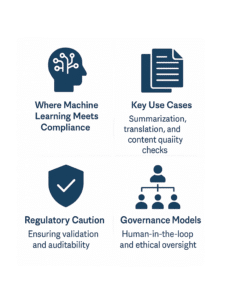
In a regulated context, innovation must always move at the speed of validation. Agencies such as the FDA, EMA, and MHRA are clear that systems affecting regulated data must remain validated, documented, and auditable throughout their lifecycle. The EU AI Act further introduces comprehensive regulatory obligations for AI systems operating in the EU, requiring organizations to address legal, governance, and risk management criteria as part of their compliance strategy. In China, the Cyberspace Administration and other relevant authorities oversee the implementation and enforcement of AI regulations, including the requirement to conduct security assessments to ensure compliance with national security interests and local laws.
For AI, this means:
- Defined Intended Use: Each AI model must have a clearly documented purpose aligned to a specific regulatory function.
- Validation and Testing: Models should undergo rigorous validation using frameworks such as GAMP 5 or ISO/IEC standards, with results reproducible and independently reviewable.
- Controlled Change Management: When AI models evolve or retrain, versioning and change control must ensure continuity of compliance.
- Auditability: Every AI-driven output—summaries, translations, quality flags—should retain metadata linking it to inputs, algorithms, and user decisions.
- Security Assessment: As part of the validation process, organizations must conduct security assessments to meet regulatory compliance requirements. Security assessments are mandated by relevant authorities to ensure AI tools adhere to cybersecurity laws and protect national security.
Without these safeguards, AI risks becoming a “black box,” incompatible with the transparency regulators expect.
Organizations leading in this space, including Docuvera, emphasize validation by design—embedding AI features within compliant infrastructures rather than layering them on top. This ensures that even as automation expands, every decision remains traceable and defensible, and regulatory compliance is maintained throughout the AI system lifecycle.
Governance Models: Human-in-the-Loop and Ethical Oversight
AI governance in regulated industries extends beyond validation—it encompasses ethical, operational, and human dimensions. Human oversight is essential in AI governance models, ensuring that experts monitor, audit, and intervene in AI systems to prevent bias and harmful outcomes. The prevailing model is human-in-the-loop (HITL), where AI assists but never replaces expert oversight, guided by principles of responsible development and trustworthy AI for ethical oversight. Regulatory frameworks such as the EU Artificial Intelligence Act set specific requirements for AI governance and oversight, defining obligations for providers and deployers to ensure compliance, risk management, and contractual clarity.
Human-in-the-Loop Review
HITL ensures accountability by keeping experts central to all critical decisions. When AI suggests a summary, translation, or quality check, a human reviewer validates or corrects the output. Over time, this feedback loop strengthens both accuracy and trust.
Transparency and Accountability in AI
Transparency means every AI decision can be explained, audited, and replicated. To enhance transparency, AI systems should be designed with clear labelling of AI-generated content and comprehensive record-keeping to ensure users understand how decisions are made and outputs are produced. Accountability requires clear ownership of AI-driven outcomes, supported by robust documentation and model management policies.
Ethical Oversight
AI governance also demands attention to data integrity, bias prevention, and privacy. Ensuring data privacy and personal information protection in the training data used for AI models is critical, as lawful sourcing, transparency, and compliance with data privacy regulations are essential for ethical AI deployment. Life sciences data often includes sensitive patient information; models must be trained and deployed under strict confidentiality and fairness principles.
Emerging standards—such as the ISO/IEC 42001 AI management framework—will likely become benchmarks for responsible AI governance. Organizations that build ethics into their compliance models today will be better positioned for the regulatory expectations of tomorrow.
Future Outlook: How AI Will Shape Next-Generation Document Ecosystems
The document ecosystems of the future will look very different from today’s static, linear workflows. As the evolving regulatory landscape continues to shape the pharmaceutical and life sciences industries, organizations will require a comprehensive framework to ensure compliance and support ongoing AI innovation in regulated content management. AI will drive a shift toward modular, intelligent content architectures, where information is linked, validated, and reusable across submissions, products, and regions.
1. Content Reuse and Knowledge Graphs
AI will enable automated linkage between related content—connecting a clinical finding to its mention in a label, or aligning a submission section with past regulatory responses. Knowledge graphs will create a single source of truth across the enterprise, supporting continuous learning and insight.
2. Predictive Compliance under the EU AI Act
As AI models mature, they will begin to identify risk areas before they become audit findings. Implementing a robust risk management framework can further support predictive compliance by providing structured standards for identifying, mitigating, and managing risks associated with AI-driven processes. Predictive analytics could flag inconsistencies, outdated references, or potential regulatory nonconformities, helping teams act proactively rather than reactively.
3. Continuous Validation Pipelines
In the near future, validation itself will evolve. Continuous integration and validation frameworks—similar to those in software engineering—will keep AI systems compliant dynamically, not just at static release points. Compliance teams will play a critical role in maintaining continuous validation and ensuring ongoing regulatory adherence.
These advancements point to a new paradigm: regulated content that is intelligent, dynamic, and continuously trustworthy. Organizations adopting AI in regulated content management with transparency and validation today will define the operational and compliance models of the next decade.
Conclusion: Responsible Innovation Through Compliance
AI in regulated documentation offers extraordinary potential, but it demands equally extraordinary discipline. Comprehensive AI law and AI legislation play a critical role in shaping responsible innovation, ensuring that technological progress aligns with regulatory expectations. Success lies in coupling technological ambition with compliance-minded execution—treating AI not as a disruptor, but as a tool that strengthens the quality, consistency, and traceability of regulatory content.
When designed with validation, auditability, and governance at its core, AI becomes not a risk but a catalyst for a smarter, safer, and more responsive regulatory ecosystem. Encouraging AI innovation within the boundaries of compliance and legal frameworks is essential for sustainable progress in regulated industries. The future of regulated content management is not just automated—it’s accountable.