

Is Your Organization Ready for AI-Powered Structured Content?
Pharmaceutical companies are at a crossroads. Regulatory authorities are accelerating the shift toward structured, digital-first submissions with initiatives like IDMP and eCTD 4.0. At the same time, internal pressure to streamline workflows, eliminate redundancies, and reduce compliance risk has never been higher.
AI-powered structured content authoring (AI-SCA) offers a clear way forward—enabling content reuse, automating metadata, and reducing review burdens. But here’s the reality: even the best platform won’t succeed if the organization isn’t prepared to adopt it.
AI and structured content readiness is about more than IT infrastructure. It’s about culture, governance, and leadership alignment. Do authors understand modular content? Can reviewers work without full linear narratives? Are executives committed to funding change? These questions determine whether AI-SCA becomes a cornerstone of transformation—or another stalled initiative.
This diagnostic checklist is designed to help you take stock of your current state across five critical pillars of adoption. Whether you find yourself checking “Ready” or “Needs Work,” the goal isn’t perfection. It’s clarity—so you know where to start, how to build momentum, and how to move confidently toward a digital regulatory future.
Readiness vs. Needs Work: Why Both Matter
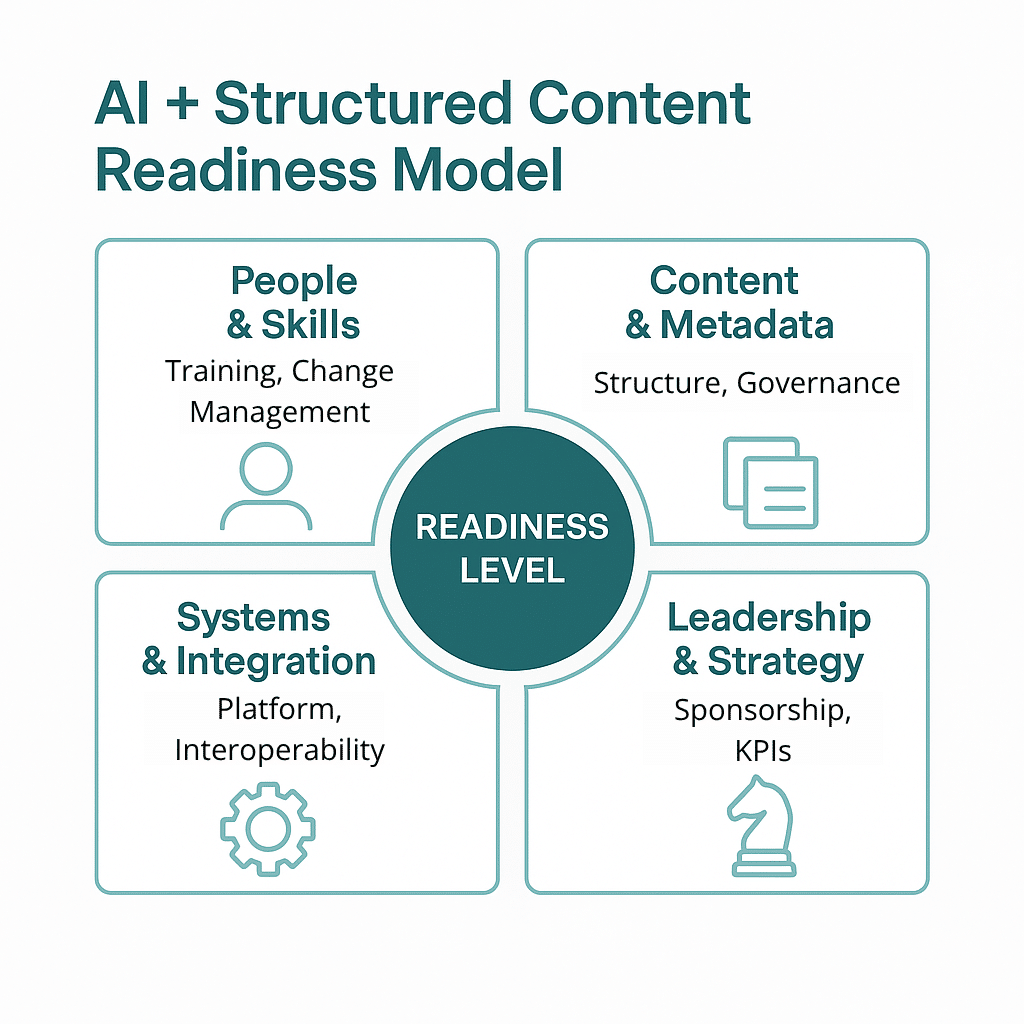
Before we hop into the checklist, it’s important to understand what it means to be \”ready\” for AI-SCA. Many organizations assume they need to be “fully ready” before adopting structured content. The truth is more nuanced—and waiting for perfection can actually slow progress.
- If you’re already “ready” in certain areas, you don’t need to overhaul everything at once. You can begin with targeted pilots—such as streamlining safety narratives or automating regional adaptations—and start proving value. These quick wins build credibility with stakeholders and free up resources for the longer-term transformation.
- If you’re still in “needs work” territory, that’s not a blocker—it’s a map of where to focus your change management. Gaps in governance, culture, or metadata hygiene are common. Identifying them early helps avoid frustration later, when a new system is live but adoption stalls because reviewers still expect linear documents, or metadata is too patchy to drive reuse.
Think of it as preparing the soil before planting. AI-SCA isn’t just a tool you switch on. It’s an ecosystem that touches people, processes, and technology. Without healthy foundations, the benefits—faster submissions, cleaner reuse, predictive QA—won’t take root.
And here’s where the risk comes in:
- Rushing in without readiness often leads to stalled adoption. Teams default back to Word and email, leaving the new system underused. That’s wasted investment.
- Skipping metadata governance results in chaos—content blocks exist, but no one can find, trust, or confidently reuse them. This undermines both compliance and efficiency.
- Ignoring culture and reviewers can create bottlenecks. If reviewers insist on full linear documents, modular workflows collapse under pressure.
- Waiting too long isn’t safe either. Regulatory initiatives like IDMP and eCTD 4.0 are moving forward, and health authorities will expect structured, validated data. Delay risks last-minute fire drills or noncompliance.
The good news is that no organization starts from zero. Every “needs work” indicator is an opportunity to mature. The key is balancing urgency (because regulators won’t slow down their digital mandates) with preparedness (ensuring your internal systems and culture are ready to absorb the change). Leaders who acknowledge both sides are the ones who scale AI-SCA successfully.
1. People and Culture
The biggest barrier to SCA adoption is not technology—it’s mindset. Authors and reviewers must learn to trust modular content instead of linear documents. Without this shift, even the best system will face resistance.
Ready
- Authors understand modular content and reuse principles.
- Reviewers accept modular content without full narratives.
- Cross-functional champions advocate for change.
Needs Work
- Reviewers demand traditional, linear documents.
- Content reuse is seen as risky rather than efficient.
- Teams have little awareness of versioning or metadata.
How Docuvera helps: The platform presents structured content in a document-like view, easing reviewer concerns. Built-in collaboration and audit trails provide reassurance that reuse is controlled and compliant.
2. Content Structure and Reuse
Without structured, reusable content, AI-SCA has nothing to work with. The goal is a central content library where SmPCs, CCDS, protocols, and other documents share common modules, reducing duplication and error.
Ready
- Content is reused across SmPCs, PIs, CCDS, etc.
- A central content library or template set is in place.
- Redundant language has already been identified.
Needs Work
- Reuse happens via copy/paste.
- No system tracks where content is reused.
- Phrasing is inconsistent across regions or products.
How Docuvera helps: By mapping relationships across documents, Docuvera makes reuse visible and traceable. AI recommendations flag the best-fit modules, helping teams stop the cycle of manual copy/paste.
3. Metadata and Governance
Metadata is the engine of structured content. Without consistent tagging and lifecycle governance, reuse breaks down, traceability is lost, and compliance risk rises.
Ready
- Metadata is consistently applied at the content-block level.
- Governance policies track versioning and approvals.
- Lifecycle rules are enforced.
Needs Work
- Metadata exists only at the document level (if at all).
- No standard tagging rules across teams.
- No audit trail for content use.
How Docuvera helps: AI auto-tagging reduces metadata burden and enforces governance. Lifecycle tracking shows exactly where each module is used, when it was last updated, and by whom.
4. Systems and Integration
SCA cannot live in a silo. To scale, it must connect with RIM, DMS, and publishing workflows. Without integration, structured content risks becoming yet another bottleneck.
Ready
- RIM/DMS systems support structured authoring and XML outputs.
- Metadata syncs across content and submission platforms.
- Review and submission workflows are digital and traceable.
Needs Work
- Submissions rely on PDF bundles and email handoffs.
- Authoring is Word-based with no integration.
- Metadata cannot move across systems.
How Docuvera helps: Docuvera was built for interoperability. APIs connect structured content with existing RIM/DMS landscapes, so companies don’t have to rip and replace existing systems to move forward.
5. Executive Sponsorship
AI-SCA isn’t just a regulatory operations upgrade—it’s a digital transformation. Without executive alignment, adoption risks being underfunded, siloed, or deprioritized.
Ready
- SCA is tied to digital transformation KPIs.
- Execs in regulatory and IT sponsor adoption.
- The business case links SCA to speed, scale, and compliance.
Needs Work
- SCA is treated as a niche initiative.
- No roadmap ties SCA to IDMP, eCTD 4.0, or global mandates.
- Ownership of structured content is unclear or siloed.
How Docuvera helps: We work with leadership teams to connect SCA to strategic goals: faster submissions, stronger compliance, and global scalability. Our approach blends technology with change management.
Preparing for the Shift
Readiness is not about being flawless—it’s about being aware. If you’re checking more “needs work” boxes, that’s not a reason to delay—it’s your roadmap. Every gap you identify is a step toward a more resilient, compliant, and scalable future.
But urgency matters, too. Regulatory initiatives like IDMP and eCTD 4.0 are not slowing down, and health authorities are moving decisively toward structured, digital-first submissions. Waiting until everything is perfect only increases the risk of noncompliance, fire drills, or wasted investment when change eventually becomes unavoidable.
The organizations that succeed with AI-SCA recognize this balance. They don’t wait for perfection, nor do they rush headlong without preparing the ground. They start small—piloting a high-value use case—while steadily addressing the cultural, metadata, and governance foundations that allow AI-SCA to scale across the enterprise.
With the right partner, this isn’t just about adopting new software. It’s about creating an ecosystem where people, processes, and technology reinforce each other. That’s how structured content becomes more than a compliance tool—it becomes the foundation for speed, accuracy, and agility in a digital regulatory world.
Docuvera helps organizations strike that balance—moving quickly enough to meet external mandates, while ensuring your internal systems and teams are ready to embrace the change. Learn more by getting in touch with our team.