

Core Company Data Sheet (CCDS)
What is the CCDS?
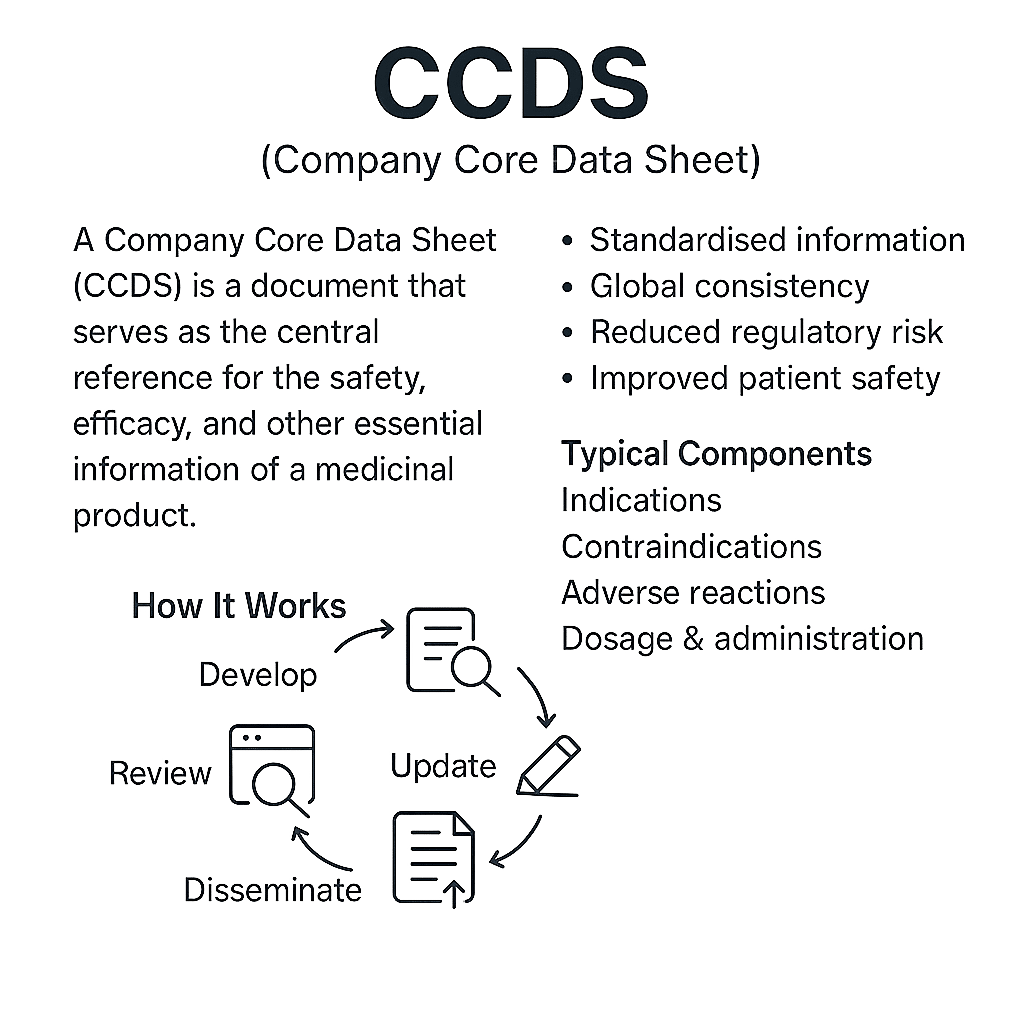
The Core Company Data Sheet (CCDS) is a company-owned, globally harmonised reference document that contains the approved safety, efficacy, and product information for a medicinal product.
It serves as the master source from which all country-specific labels (such as the EU’s SmPC, the USPI, and ePI) are derived.
The CCDS is not submitted directly to health authorities; instead, it is an internal governance tool to ensure that every local label reflects the same core safety profile and clinical information, with only region-specific variations as required by regulators.
Why it Matters in Pharma Today
- Regulatory alignment — Maintains a consistent safety and efficacy profile across all markets, minimising the risk of discrepancies that could lead to regulatory observations or enforcement.
- Change control — Provides a structured process for introducing new clinical data, safety findings, or manufacturing changes into global labeling.
- Global compliance — Supports harmonisation efforts by the WHO and facilitates simultaneous label updates across multiple jurisdictions.
- Structured content reuse — When built as component-based content, a CCDS allows targeted updates to propagate automatically into all dependent labeling formats (SmPC, USPI, ePI) without manual re-authoring.
- Faster updates — Reduces the time from core safety signal detection to updated labels in all affected markets.
Global Landscape
| Region/Body | Governing Entity | Adoption Status / Timeline |
| WHO | World Health Organization | Promotes CCDS use as best practice for international labeling harmonisation. |
| EU | EMA & National Agencies | CCDS not mandated but often referenced in SmPC update negotiations. |
| US | FDA | Not formally recognised, but core data used to support labeling supplements. |
| ICH | ICH E2C / E2E Guidelines | Aligns safety data management with CCDS principles. |
How CCDS Works in a Component-Based Authoring Model
Author — Draft the core product profile, covering all relevant sections: composition, indications, contraindications, warnings, dosage, pharmacology, adverse events.
Govern — Internal review by safety, clinical, regulatory, and quality teams to approve core content.
Adapt — Apply country-specific variations (e.g., regulatory phrasing, approved indications, local safety statements).
Publish — Export to regional label templates (SmPC, USPI, ePI) in both human-readable and structured content formats.
Maintain — Update CCDS promptly when new safety or clinical data emerges, initiating controlled updates to all derived labels.
Example: CCDS in Practice
- A new adverse event is identified in post-marketing surveillance → CCDS Section 4.8 updated → triggers corresponding updates in all derived SmPCs, USPIs, and ePIs.
- A new indication is approved based on trial data → CCDS updated → local teams adapt to meet country-specific submission requirements.