

Clinical Study Report (CSR)
What is the CSR?
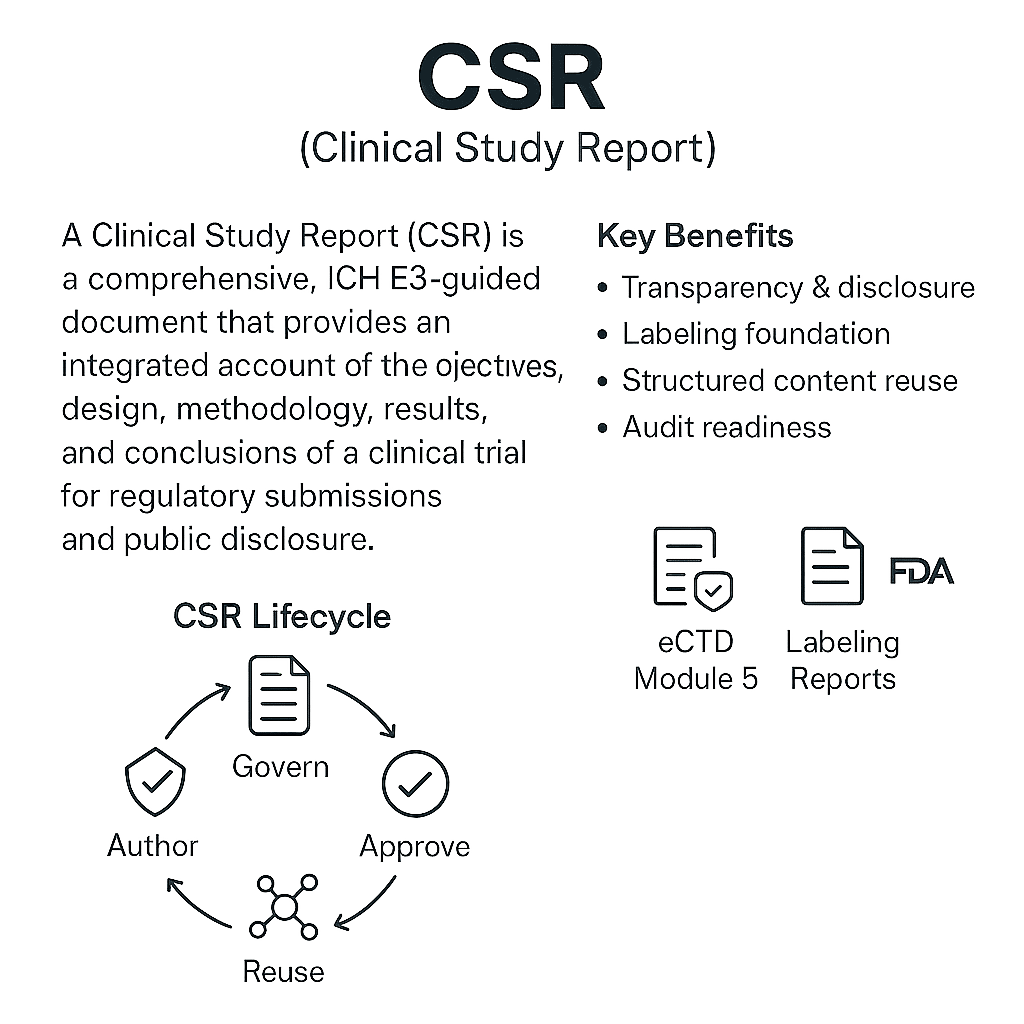
The Clinical Study Report (CSR) is a comprehensive regulatory document that provides a complete, integrated account of the objectives, design, methodology, results, and conclusions of a clinical trial.
It is prepared according to the ICH E3 guideline and forms a key component of regulatory submissions for marketing authorisation, variations, and label updates.
The CSR contains both narrative summaries and detailed data listings, integrating statistical analyses with clinical interpretations to provide regulators with a full understanding of a study’s conduct and outcomes.
Why it Matters in Pharma Today
- Regulatory approval — Serves as the primary evidence package for demonstrating safety and efficacy in marketing applications.
- Transparency — Increasingly subject to public disclosure, with redacted versions published by agencies such as EMA and Health Canada.
- Labeling foundation — Clinical results and safety findings in the CSR often drive updates to the CCDS, SmPC, USPI, and ePI.
- Structured content opportunity — In a component-based authoring environment, CSR sections (e.g., adverse events tables, efficacy summaries) can be reused in multiple regulatory and safety documents.
- Audit readiness — Provides an authoritative record of trial conduct, essential in inspections and litigation contexts.
Global Landscape
| Region/Body | Governing Entity | Adoption Status / Timeline |
| Global | ICH E3 | Defines CSR format and content requirements. |
| US | FDA | Requires CSRs for NDAs, BLAs, and supplements. |
| EU | EMA | Requires CSRs for marketing authorisations and publishes anonymised versions. |
| Japan | PMDA | Requires CSRs in accordance with ICH E3; local adaptations possible. |
| Canada | Health Canada | Requires CSRs and publishes public versions as part of transparency initiatives. |
How the CSR Works in a Component-Based Authoring Model
Author — Assemble all study data, analyses, and narratives into a structured format following ICH E3 guidance.
Govern — Review with clinical, biostatistics, medical writing, and regulatory teams to ensure accuracy, completeness, and compliance.
Approve — Finalise for submission as part of a regulatory package (e.g., eCTD Module 5).
Publish — Submit to regulators; prepare redacted version for public release where required.
Reuse — Map relevant CSR components to CCDS, labeling, IB, DSUR, and risk management plans.
CSR Core Sections (per ICH E3)
- Title Page
- Synopsis
- Table of Contents
- List of Abbreviations and Definitions of Terms
- Ethics
- Study Administrative Structure
- Introduction
- Study Objectives and Purpose
- Investigational Plan
- Study Patients
- Efficacy Evaluation
- Safety Evaluation
- Discussion and Overall Conclusions
- Tables, Figures, and Graphs
- Reference List
- Appendices (including protocol, statistical analysis plan, case report forms)