

Knowledge-aided Assessment & Structured Application (KASA)
What is KASA?
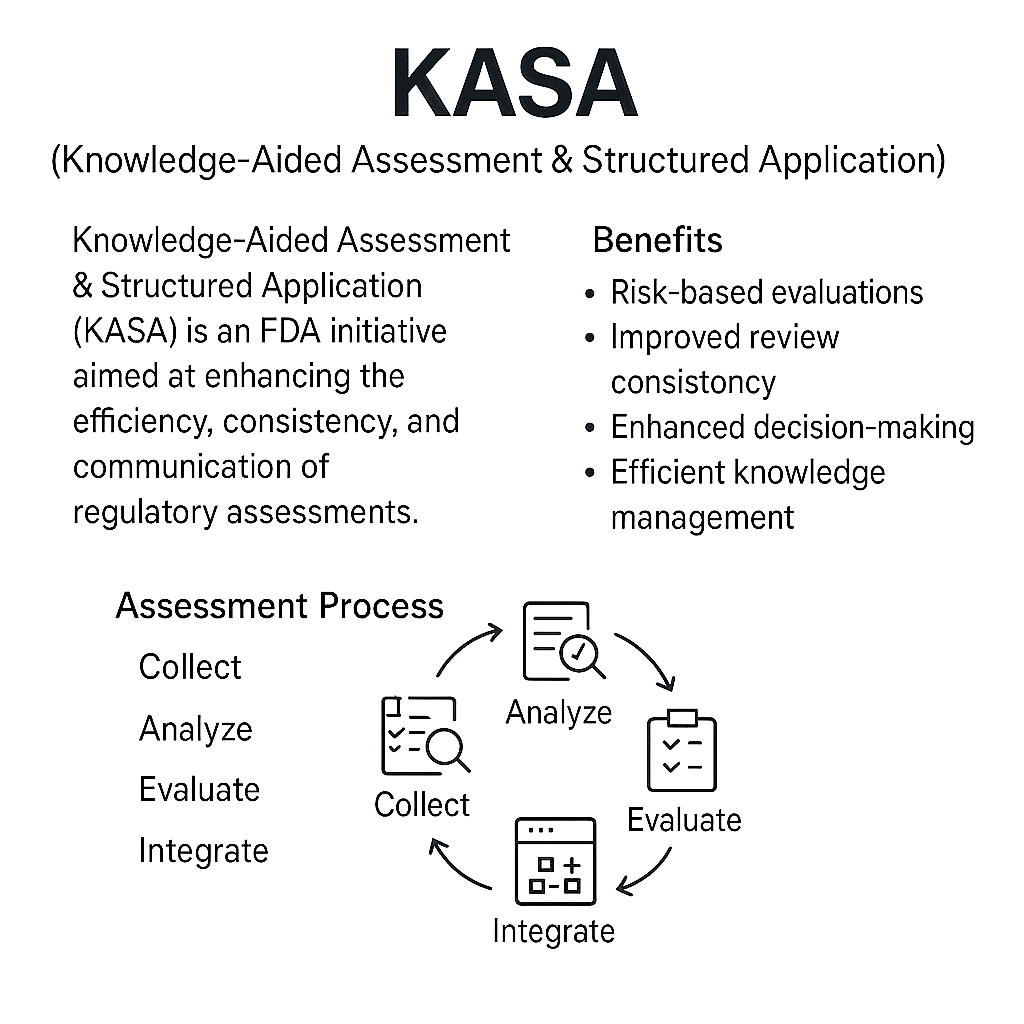
The Knowledge-aided Assessment & Structured Application (KASA) is an FDA-led regulatory framework designed to improve the quality, efficiency, and consistency of Chemistry, Manufacturing, and Controls (CMC) assessments for drug products.
Rather than relying solely on narrative documents, KASA captures structured, machine-readable data elements about a product’s manufacturing process, control strategy, and quality attributes, enabling data-driven regulatory evaluations.
KASA represents a significant step toward a risk-based, knowledge-managed assessment model, where regulatory reviewers and applicants operate from the same structured data foundation.
Why it Matters in Pharma Today
- Improves regulatory efficiency — Enables faster, more consistent assessments by structuring and standardising CMC data.
- Supports risk-based decision-making — Regulatory reviewers can assess product and process risk with greater transparency.
- Facilitates lifecycle management — Structured CMC data can be updated and reassessed without resubmitting full dossiers.
- Integrates with global initiatives — Aligns with trends like eCTD 4.0 and ICH Q12 for structured, lifecycle-based CMC management.
- Enhances data reuse — Structured data can be mapped to internal quality systems, manufacturing records, and regulatory submissions.
Global Landscape
| Region/Body | Governing Entity | Adoption Status / Timeline |
| United States | FDA (CDER & CBER) | KASA pilot programs underway for certain product types (e.g., solid oral dosage forms). |
| Global Context | ICH Q12, PQ-CMC | KASA principles align with global structured CMC assessment initiatives. |
| Potential Adoption | Other agencies (e.g., Health Canada, EMA) | Observing FDA implementation and may adopt similar frameworks. |
How KASA Works in a Component-Based Authoring Model
Author — Capture CMC information (manufacturing process, control strategy, critical quality attributes) as structured data fields rather than free text.
Govern — Apply business rules and validation checks to ensure completeness, accuracy, and compliance with FDA data requirements.
Assess — Regulatory reviewers analyse structured data using FDA’s KASA platform, comparing against quality standards and product-specific risks.
Approve — Structured data becomes part of the approved dossier, linked to ongoing lifecycle management.
Maintain — Update structured fields when manufacturing changes occur, triggering re-assessment of risk and quality impacts.
Example: KASA in Practice
- Process change — Manufacturer switches a critical raw material supplier → KASA CMC fields updated → FDA automatically re-assesses related process controls and risks.
- Control strategy optimisation — Change in analytical method validation triggers targeted updates without resubmitting the full Module 3 of eCTD.