

Answer with Clarity. It’s time to eliminate the countless upfront hours spent finding what already exists.
Ask a reviewer or a medical writer where the week actually goes. A surprising share of it goes to finding. Locating the approved statement, then confirming it is the one that still governs. Opening three drives and a prior submission to see which paragraph was used last time. Messaging a colleague to ask whether a response was ever cleared, and whether it is still valid. The writing, when it finally begins, is often the fastest part of the day.
This is the quiet reality of pharma content reuse and regulated content work, and it rarely shows up in any plan. The task everyone budgets for is authoring. The task that consumes the time is retrieval and verification.
The hidden hours
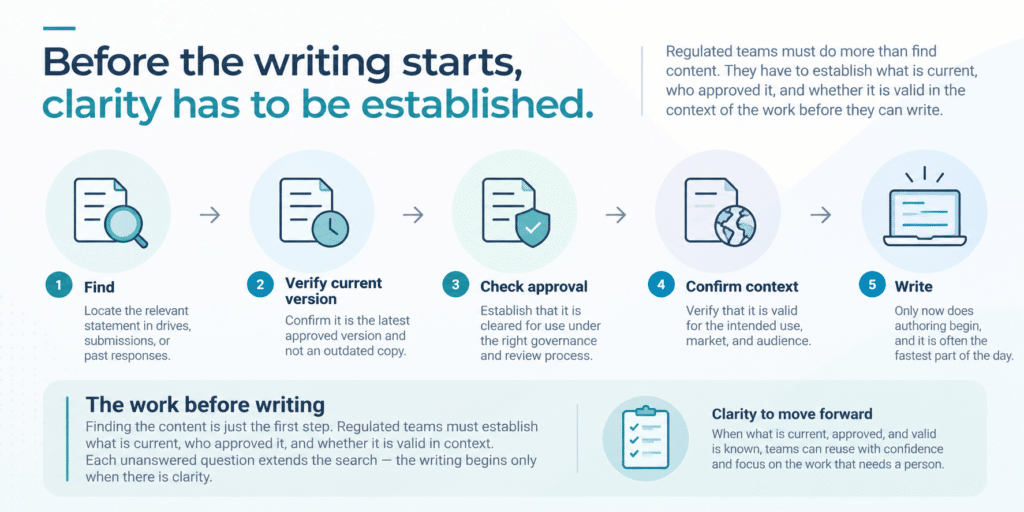
Finding the statement is only the beginning. Regulated work also requires teams to establish which version is current, who reviewed and approved it, and whether it applies to the work in front of them. Those requirements are explicit in current clinical guidance. ICH E6(R3), adopted in 2025, says essential trial records should be identifiable and version controlled and that storage systems should support identification, version history, search, and retrieval.
That is where the hours accumulate. A regulated author who finds a statement still has to establish whether it is the current approved version and whether it remains valid in context. Each unresolved question extends the search and the effort. The work begins only when those questions have a clear answer.
The same principle appears across regulated information management. FDA guidance addresses controlled documentation and revision within pharmaceutical operations, while European Medicines Agency guidance calls for approved, identifiable, and version-controlled processing methods and access to information needed for verification.
When clarity is missing, teams often return to work that has already been done. They re-author and re-review answers that are materially identical to answers already approved, because the prior approval cannot be established clearly enough to rely on it. Response cycles stretch. Reviewers absorb work they have effectively done before. And every parallel copy that gets created in the meantime is one more version that can drift away from the approved source over time.
Why the hunt is built in
The hunt persists because storing meaning inside documents makes authority harder to see.
When an approved statement is governed only inside a document, its authority remains tied to that container. The same statement, reused in another document or adapted for another market, becomes a separate copy with no reliable link back to the source. There is no single source of truth that holds the authoritative version and knows everywhere it is used. So the only way to establish what is current is to go looking, compare what surfaces, and reconstruct the answer by hand. The larger the estate and the more reuse it carries, the longer that takes and the less clear the result becomes.
A governance layer, like Docuvera, built around governed content components changes that model by maintaining version control, reuse relationships, metadata, and lineage at the content level.
Clarity, in this environment, is operational infrastructure. It is the precondition for everything downstream. Reuse depends on it, because you cannot safely reuse what you cannot clearly identify. Speed depends on it, because the organization first needs to know which source governs. Any productivity claim that skips the question of clarity is resting on sand.

What clarity requires for governed reuse
Clarity means that, at any moment, a person can know three things without an investigation. What the current approved version of a statement is. Whether it is valid in the context they are working in. And whether an approved version already exists that they can reuse rather than recreate.
Those capabilities have to exist in how content is governed at the source. Authority has to sit with the statement itself, as a governed, reusable content component carrying its own version history, ownership, metadata, and validity conditions. Reuse relationships have to be known to the system, so the current version and its uses are visible. When those conditions hold, retrieval becomes direct. The answer to “is there approved language for this” arrives as a fact instead of requiring an afternoon of investigation. Docuvera’s content governance approach applies version control, audit history, metadata, and traceability at the component level.
Answer with Clarity: See how governed clinical content makes the current approved version easier to identify and reuse.
Where the hunt ends
This is what a governed content foundation is designed to provide. Approved content becomes a set of known, reusable components whose current status the system maintains. A person can retrieve what is current and cleared for use with its governing context intact. What is current, approved, and available to reuse is visible at the point of work.
For medical information, that means a response can draw on approved language that is known to be current, reducing the need to recreate language that has already passed review. For clinical teams, it means content authored once can be reused across study startup and submission assembly with its approval intact. And it all rests on the governance layer that keeps authority, reuse, and lineage coherent across the lifecycle.
AI can shorten the path further by pointing people toward approved content that already fits. Docuvera’s governed AI approach keeps AI-assisted work connected to governed content, metadata, source lineage, and human review. The result is a clearer path to the current answer while its governing context remains visible.
When the current version is always known, the hunt ends, and the hours it took come back to the work that actually needs a person. Clarity is knowing, without having to look.
Frequently Asked Questions
Sources
- International Council for Harmonisation. ICH E6(R3) Guideline for Good Clinical Practice. Final version adopted January 2025. ICH E6(R3) guideline
- U.S. Food and Drug Administration. Q7A Good Manufacturing Practice Guidance for Active Pharmaceutical Ingredients. FDA guidance
- European Medicines Agency. Guidance on good manufacturing practice and good distribution practice: Questions and answers. EMA guidance
- Docuvera. Clinical Trial Documentation Software for Regulated Study Content. Clinical Trial Documentation
- Docuvera. End-to-end Content Governance Platform for Regulated Content. Governance Layer
- Docuvera. Automated Medical Content Authoring Platform for Scientific Content. Medical Information
- Docuvera. Modular Content Pharma Strategies for Scalable Content Reuse. Multi-Use-Case Structured Content
- Docuvera. AI Regulatory Content Software for Pharma Regulatory Teams. AI-Powered Structured Content Authoring