

By Kenneth Gutiérrez, Director of Product
What EMA ePI maintenance requirements mean for labeling operations, PLM portal statuses, and ongoing content governance
A labeling team that submits its first electronic product information package to EMA’s Product Lifecycle Management portal has not closed a project. It has opened one. EMA’s guidance for applicants on how to submit ePI in centralised procedures is precise about where the work actually sits. The document, reference EMA/199350/2026, is dated 1 September 2026, while EMA’s ePI overview page lists it as first published on 4 September 2026. The agency notes that it is published ahead of ePI go-live and becomes applicable at that date, in line with the ePI roadmap.
That sequencing matters. Nothing here is enforceable yet, and the requirements are already written down. Submission of ePI stays voluntary until the general pharmaceutical legislation takes full effect. Maintenance does not work that way once a company participates and its ePI is published.
The guidance states the obligation directly. Once an ePI has been published, the applicant owns keeping it aligned with the latest approved product information through subsequent procedures. Regulatory Focus reported the scope on 8 September: Annex I, Annex II, and Annexes IIIA and IIIB. Other annexes to the European Commission decision sit outside it. Applicants still submit the product information annexes in the eCTD.
Read those facts together and the operating picture changes. The eCTD annexes and the ePI become two outputs of one approved body of content, produced on the same procedural clock, held in different systems. Nothing in the guidance derives either one from the other. Reconciliation is the applicant’s job, on every variation, every renewal, and every transfer, for as long as the product stays authorized.
For broader background on the mandate, common standard, and phased rollout, see EMA ePI Requirements: What the Mandate Means for Content Operations.
Status Is a Regulatory State, Not a Workflow Flag
The guidance treats PLM portal status as a controlled attribute with consequences. EMA considers an ePI submitted only when three conditions hold at once. It sits in Submitted status. Its content matches the final Annex I, II, IIIA, and IIIB for the corresponding procedure. And the known procedure number has been entered in the correct field. An ePI submitted with an initial marketing authorization application may remain in Draft at that initial timepoint. For every other procedure type and required timepoint, it must reach Submitted. Applicants may also use Draft while editing between those required timepoints.
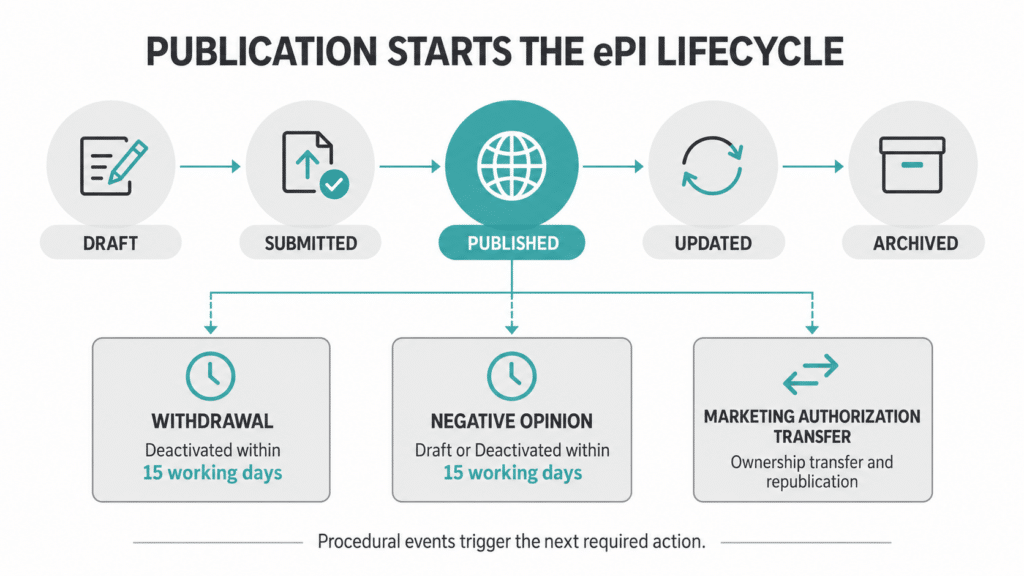
The exit conditions carry clocks. EMA may notify an applicant that an application or authorization has been withdrawn. The applicant must then move the relevant ePIs in Submitted status to Deactivated within 15 working days. After a negative CHMP opinion for a post-authorization procedure, the applicant must move related ePIs out of Submitted status within 15 working days, to Draft or Deactivated. A re-examination request suspends that choice until the final outcome, and an unfavorable final outcome restarts the 15-working-day clock to Deactivated. The applicant must also make sure the refused procedure number does not appear in the procedure number field of any other ePI.
Two details deserve attention from anyone modeling this. A published ePI stays published in the repository and available through the API after the related Submitted records are deactivated following withdrawal, and archived earlier versions remain as they are. Deactivation governs the record going forward; it does not retract what the public and downstream systems already hold. Transfers work the same way. The transferee opens a ticket with the EMA Service Desk. EMA then publishes the ePI associated with the transferee, but only after the Commission decision granting the transfer.
None of this is formatting. These are state transitions with named triggers, named owners, and counted deadlines. They attach to content that also has to stay identical to a document filed somewhere else.
Where Document-Centric Labeling Breaks
A labeling function that runs on documents will meet these obligations by assigning them to people. Someone checks that the ePI matches the approved annexes after each procedure. Someone watches for withdrawal and opinion notifications and starts a manual countdown. Someone remembers which procedure numbers are live in which ePI records.
That works until volume arrives. A product family with several strengths and presentations, moving through overlapping Type IA, Type IB, and Article 61(3) submissions, produces many concurrent states. For Type IA/IAIN, Type IB without linguistic review, and Article 61(3) without linguistic review, the guidance requires ePI submission with the procedure application. For other post-authorization procedures, including those with linguistic review, the updated ePI is submitted with the final PI translations. The failure is rarely a wrong word in a leaflet. It is a correct leaflet that nobody propagated, or a deactivation that nobody executed on day 14.
Voluntary participation makes this harder, not easier. Companies piloting ePI on a subset of products run two operating models at once. The pilot products are the ones carrying the new obligations.
What the Obligation Actually Requires
Meeting EMA’s requirements reliably at scale calls for single-sourcing with governance attached. One approved statement of the product information, authored and version-controlled once, rendered into the eCTD annexes and into the ePI. Status changes driven by procedural events rather than by memory. An audit trail that can show, for any date, which ePI version corresponded to which approved PI and under which procedure.
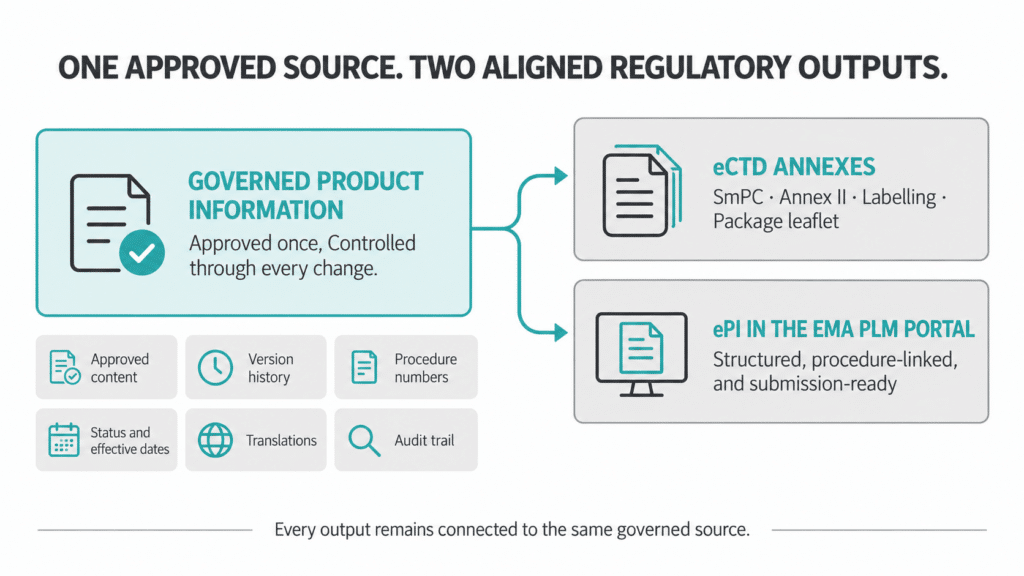
This is where Docuvera’s governance-first global labeling model applies directly. Docuvera treats labeling content as governed components with enforced relationships to procedure records. A single approved change propagates to every rendition that depends on it, and leaves evidence of having done so. Status, effective dates, and procedure identifiers are attributes of the content object, not annotations in a tracker. Teams publish two outputs from one governed source instead of maintaining two copies and comparing them.
AI belongs in that governed structure, subordinate to it. Under the Hierarchy of Intelligence™, retrieval augmented reuse comes first: the system surfaces the approved component that already exists and is cleared for this context. Retrieval augmented transformation renders it into the required output form. Generation sits last and stays under human authorization, because a regulator’s question about an ePI is a question about provenance, not fluency. AI here assists provability. It does not replace the review that makes the content defensible.
This article provides operational analysis of EMA’s published guidance and is not legal or regulatory advice.
EMA has published its roadmap, and the guidance becomes applicable at go-live. Some teams will treat the interval as a chance to fix their content model rather than to produce one more file type. For those teams, the mandatory phase becomes a configuration change.
Teams can use Docuvera’s EU ePI Readiness Self-Assessment to evaluate their content architecture, metadata, structured authoring, governance, and organizational readiness.
Prepare for the ePI lifecycle across markets and languages. Download the white paper, Utilizing AI-Powered Structured Content Authoring for Global ePI Compliance.
Frequently Asked Questions About EMA ePI Maintenance Requirements
Sources
This analysis prioritizes primary EMA materials for regulatory requirements, dates, statuses, and procedural deadlines. Regulatory Focus is included as a secondary industry source. Docuvera resources are identified separately as internal background or further reading.
- Guidance for applicants on how to submit ePI in centralised procedures (EMA/199350/2026, PDF) — European Medicines Agency
- Electronic product information (ePI), EMA overview page — European Medicines Agency. Lists the guidance as first published 04/09/2026 and states it becomes applicable at ePI go-live.
- EMA issues guidance on submitting ePI ahead of upcoming requirement — Ferdous Al-Faruque, Regulatory Focus (RAPS), 8 September 2026
- Electronic product information (ePI) roadmap (PDF) — European Medicines Agency, first published 20 March 2026
- European Medicines Regulatory Network ePI Implementation Guide — Official technical implementation guide for the EU ePI Common Standard
Written by

Kenneth Gutiérrez
Director of Product | Docuvera
Read more from Kenneth →
View all blogs →
Connect on LinkedIn