

Answer with Certainty. When the question is which statement governs, the answer should already exist, not be rebuilt under pressure
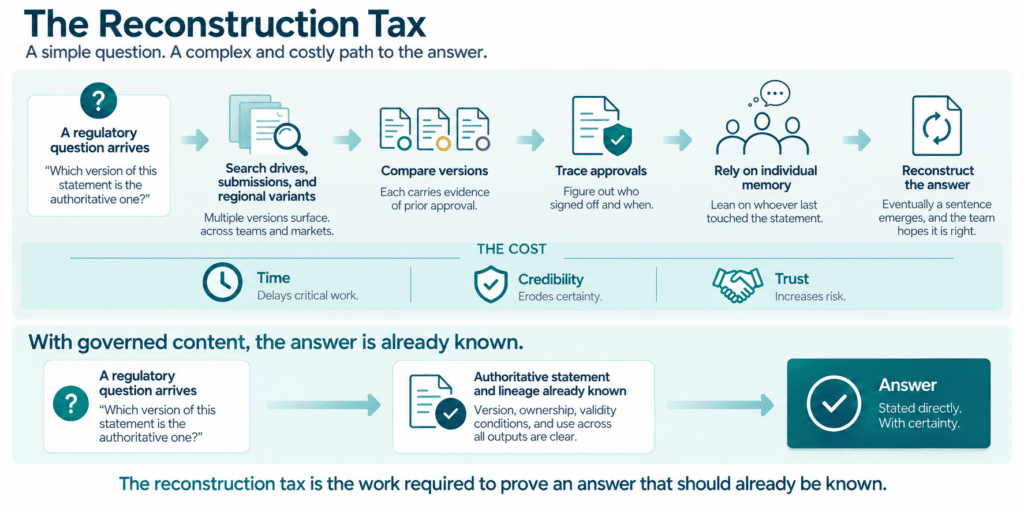
Regulatory content governance is tested the moment a simple question has to be answered with certainty. A regulatory query arrives. It asks a simple thing: which version of this statement is the authoritative one? In many organizations, that question does not produce an answer. It produces a search.
Teams open shared drives, prior submissions, regional adaptations, and legacy templates. Several versions surface. Each carries evidence of prior approval. None can be confidently named as the record that governs. So people reconstruct. They compare artifacts, trace who signed off, and lean on the memory of whoever last touched the statement. Eventually a sentence emerges, and the team hopes it is right.
That exercise deserves a name: the reconstruction tax. In regulatory content governance, it is the recurring effort to establish which statement is current, which version governs, where it appears, what changed, and who approved it. The answer usually exists somewhere in the content estate. The cost is getting to it. That cost is paid every time the question is asked, and it is paid in the currency regulated organizations can least afford: time, credibility, and trust.
Why the tax is structural
The scramble can look like a diligence problem, something tighter process discipline could fix. The reconstruction tax is the predictable result of regulatory content governance operating at the level of the document rather than the level of the statement.
In a document-first world, approval attaches to an assembled artifact. A label, a dossier section, a safety narrative is reviewed and approved as a whole. The individual statements inside it inherit that approval by association. When one of those statements is later reused, copied into another document, adapted for a market, or carried into a new submission, it travels without a mechanism to preserve its authority, its validity conditions, or its ownership. Approval was granted once, in one context. Reuse spreads it into many contexts where its standing is no longer explicit.
Metadata is supposed to hold that authority together. In practice it is often incomplete, inconsistently applied, or treated as advisory. Ownership for ongoing accuracy blurs as content crosses teams and regions. The estate grows faster than the governance around it, and the gap is invisible until a question forces it into view.
Industry benchmarking points the same way. Genpact, citing Gens & Associates’ 2024 World Class RIM Study, reported that only about one in ten organizations considered their regulatory data good enough to support the systems built on top of it. The investment in technology is high. The readiness of the underlying data lags well behind it. The finding sits within the broader shift in regulatory information management toward connected, governed data rather than isolated document repositories.
The firm’s more recent work sharpens the point. In its 2025 Operational Excellence and World Class RIM Study, released publicly in April 2026, Gens & Associates concluded that mature data governance and clear data accountability, more than artificial intelligence, distinguish the organizations positioned for the changes ahead. The same study found a telling asymmetry: 71 percent of organizations apply a structured approach to technology change, while only 47 percent apply the same rigor to process or data change. Companies are disciplined about the systems and casual about the data those systems carry. The reconstruction tax is what that imbalance costs at the moment of inspection.
The regulatory standards are moving toward more structured information as well. FDA’s PQ/CMC program is developing structured data standards for selected eCTD content, while the European Medicines Regulatory Network’s ePI Implementation Guide defines how HL7 FHIR is used to generate electronic product information.
What it takes to answer without reconstruction
The goal is to remove the search altogether. Answering a high-stakes question directly requires three conditions to be true before the question is ever asked.
Authority has to be explicit, and it has to sit at the unit where reuse actually happens. If authority still lives implicitly inside documents or the latest approved artifact, it will keep eroding as reuse accelerates. The authoritative record must be the statement itself, not the container it happened to ship in.
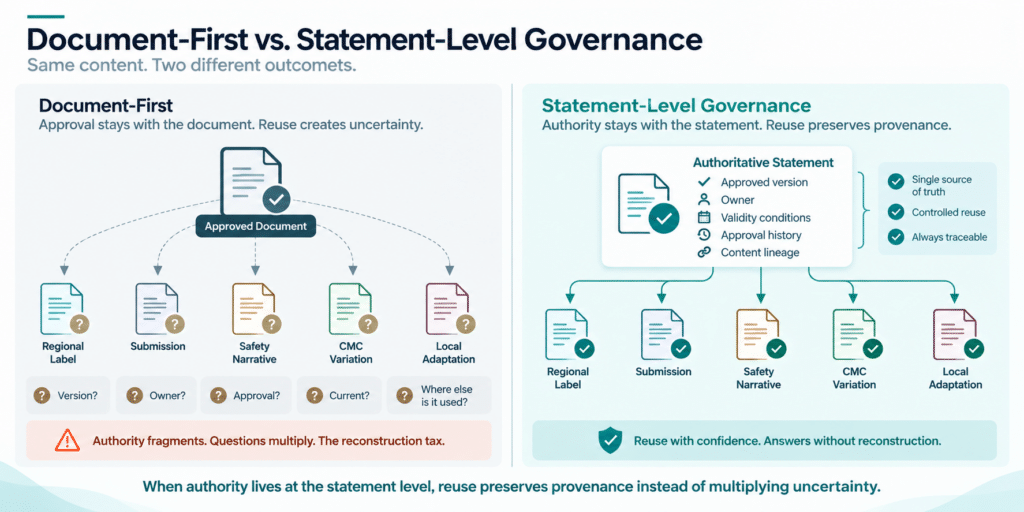
Lineage has to be preserved across time, localization, and reassembly. For any statement, the organization should be able to show where it originated, who approved it, what it has become through controlled change, and everywhere it is currently used. That content lineage is the standing record that makes an audit answerable. It exists before the audit begins.
And the source has to be single and governed. That is the single source of truth: one authoritative version of each statement, with controlled reuse across every output, so that consistency is a property of the system rather than the outcome of manual reconciliation.
There is a clean test for whether these conditions hold. Can the organization answer a query directly from the system, without reconstruction, without explanation, and without reliance on any one person’s knowledge? If the answer is yes, governance is taking hold. If the answer is no, risk is quietly accumulating, one reused statement at a time.
Know which statement governs before the question is asked.
See how Docuvera turns governed content into answers teams can trust.
From search to statement
This is the problem a governance-first structured content platform is built to solve. The authoritative record becomes the statement itself, held once with its ownership, version, and validity conditions attached and reused only under control. Every place it appears refers back to that one record, so the version that governs is a fact the system holds, ready to be stated rather than worked out.
Because those relationships are known, the questions that once triggered a search return answers: which version governs, where it is used, what changed and when, and who approved it. Docuvera makes that lineage demonstrable under inspection, the practical difference between reducing regulatory risk and absorbing it. AI-assisted structured content authoring has a place here only inside the governed record. It can surface where versions diverge and point to the approved one, and it never decides which is authoritative.
When the query arrives, the authoritative version is already known, and the organization states it plainly. Certainty is what remains once the reconstruction is gone.
Answer with Certainty across every market and every label.
See how Docuvera keeps approved content governed, traceable, and ready for controlled reuse. See what creates certainty
Frequently Asked Questions
Sources
1. Genpact. “Regulatory information management in life sciences.” Citing Gens & Associates, 2024 World Class RIM Study.
2. Gens & Associates. “2025 Operational Excellence and World Class Regulatory Information Management Study Whitepaper.” April 3, 2026.
3. Gens & Associates. “Gens & Associates’ new World Class RIM study identifies ‘secret recipe’ for Regulatory functions’ ‘future readiness’ — and it has little to do with AI.” April 15, 2026.
4. U.S. Food and Drug Administration. “Pharmaceutical Quality – Chemistry, Manufacturing & Controls | PQ/CMC.”
5. European Medicines Regulatory Network. “Electronic Product Information (ePI) Implementation Guide,” version 1.0.0, active September 17, 2026.