

Why global medical information responses drift across markets, channels, and partners—and what governed content changes
A medical information team receives the same scientific question three times in one quarter. It arrives from a physician in the United States, a hospital pharmacist in Germany, and an affiliate inquiry desk in Japan. Three responses go out. Each is scientifically defensible. Each was assembled by a trained professional from approved source material. Each is consistent with the label that governs its own market.
Now place the three responses side by side. The safety qualifier appears in two of them. The dosing caveat is phrased three different ways. One cites a study the others omit. One carries a sentence that traces to a label version superseded four months ago.
No one authored these incorrectly. The divergence emerged from the way the content base is organized, which is why it recurs. At portfolio scale, this becomes a medical information content management problem. Reviewer diligence does not prevent it, and adding reviewers does not slow it down.
Where medical information content divergence accumulates
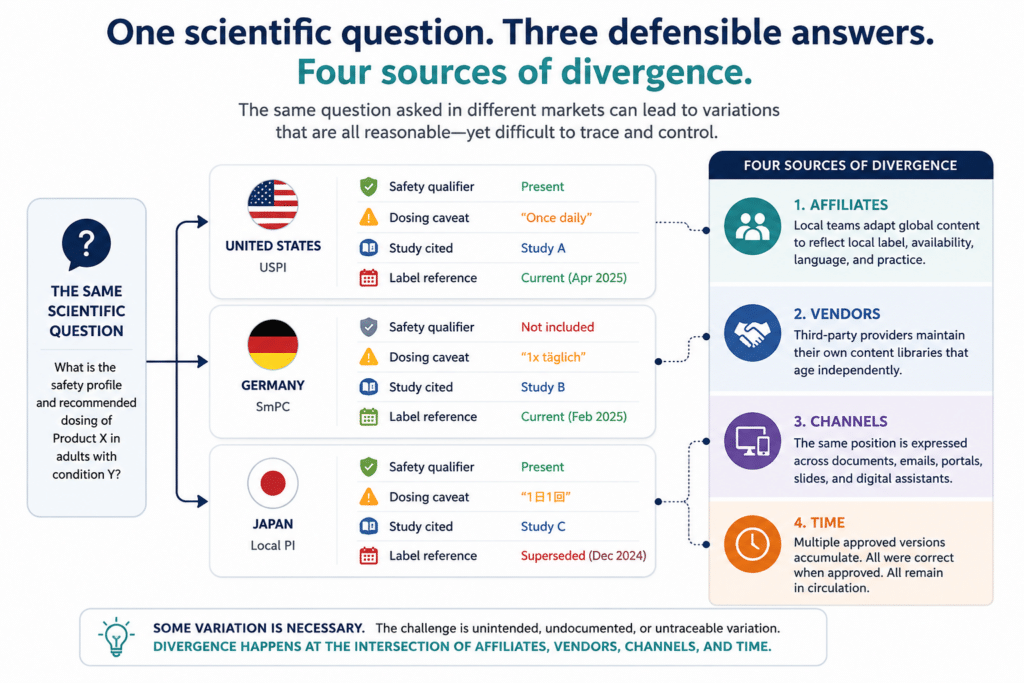
Medical information content diverges along four surfaces at once, and each surface is invisible to the others.
Affiliates. Local teams adapt global content for legitimate reasons. Product availability differs. Labels differ. Reimbursement context differs. A German response that reflects the SmPC and a US response that reflects the USPI should not be identical. The problem is that the adaptation is performed on a copy, so the relationship between the global statement and the local variant exists only in the memory of the person who made it. Current phactMI/MILE guidance describes this global-to-local relationship through global response documents (GRDs) and localized scientific response documents (SRDs), with localization documented.[6]
Vendors. Many large organizations route first-line inquiries through third-party call centers or outsourced medical information providers. Those partners maintain their own working libraries. Content enters their environment at a point in time and stays there.
Channels. The same scientific position is expressed in a standard response document, an email reply, a slide used by field medical teams, a portal page, and increasingly a self-service assistant. Each channel has its own production path, and each path creates another artifact.
Time. Multiple approved responses on the same topic accumulate. All were correct when approved. All remain in circulation. Nothing in the system marks one as superseding another.
Any one of these surfaces is manageable in isolation. Together, across a portfolio and a global footprint, they produce a content base in which the number of live variants of a given scientific statement is unknown to the function that owns it.
Why the document model produces medical information content divergence
In document-based medical information content management, the unit of authority is the file. A response is approved as a whole object, and reuse happens by copying that object and editing it. The copy carries no relationship to its source once it is saved.
This has a specific consequence. Similarity is invisible to the system. Two responses that answer the same clinical question are, to the repository, two unrelated files with different names. There is no attribute connecting them, no shared component underneath them, no component-level version control, and no way to assert that they say the same thing.
That is why the question “where else does this statement appear” is answered with a search rather than a query. Search returns what it can match on filename, metadata, and full text. It returns most of the affected content. It does not return the response a vendor localized eighteen months ago, or the paragraph an affiliate rewrote in a second language, or the slide that lifted three sentences into a field medical deck.
Teams compensate through practice. They centralize approval, publish core content sets, and re-review broadly when anything upstream changes. Those measures raise the floor. They do not change the underlying architecture, because the content base still stores copies rather than governed statements. Divergence continues to be generated at the same rate, and the organization absorbs the cost of finding it later.
Where the exposure lands
Medical information sits close to a regulatory boundary, which is what converts an internal consistency problem into an external one.
FDA’s December 2011 draft guidance on unsolicited requests describes recommendations for firms responding to unsolicited requests for off-label information, including that responses to private unsolicited requests should be truthful, non-misleading, accurate, balanced and responsive to the specific question.[1] The January 2025 final guidance addresses a different category: certain firm-initiated communications of scientific information on unapproved uses to healthcare providers.[2] FDA currently marks that guidance as not for current implementation pending OMB’s decision on its information-collection provisions. Both documents reinforce the importance of accurate scientific communication, but they should not be treated as the same regulatory framework.
The safety perimeter compounds this. Under EMA’s good pharmacovigilance practices, Module VI, reports of suspected adverse reactions that are not related to an organized data-collection system and are notified through medical enquiry or product information services are considered spontaneous reports.[3] That places adverse-reaction information received through medical information channels within established pharmacovigilance collection and reporting processes.
For pharmacovigilance, accountability does not transfer with the work. EMA states that a marketing authorization holder may subcontract pharmacovigilance activities to third parties but retains ultimate responsibility for the pharmacovigilance system.[7] The IFPMA Code of Practice addresses a different boundary: its consistency requirement applies to promotion, while individual non-promotional correspondence responding to a specific question sits outside that promotional context.[4] That distinction matters here. The obligations attached to a medical information response therefore have to be assessed against the approved product information, applicable law and regulation, pharmacovigilance requirements, and the organization’s controlled procedures. Professional standards for the function reinforce the same quality boundary. MAPS Medical Information guidance addresses the function’s strategy and operations across multiple geographies,[5] while the phactMI Medical Information Code of Practice calls for responses that are evidence-based, balanced, accurate, current, non-promotional, and subject to review and approval.[8]
Then there is inspection readiness. The content model has to support narrow and specific questions. Where else is this language used. Who approved it, and on what date. What changed when the label changed. A document library can produce the file. It cannot reliably produce the set.
What a governed medical information content model changes
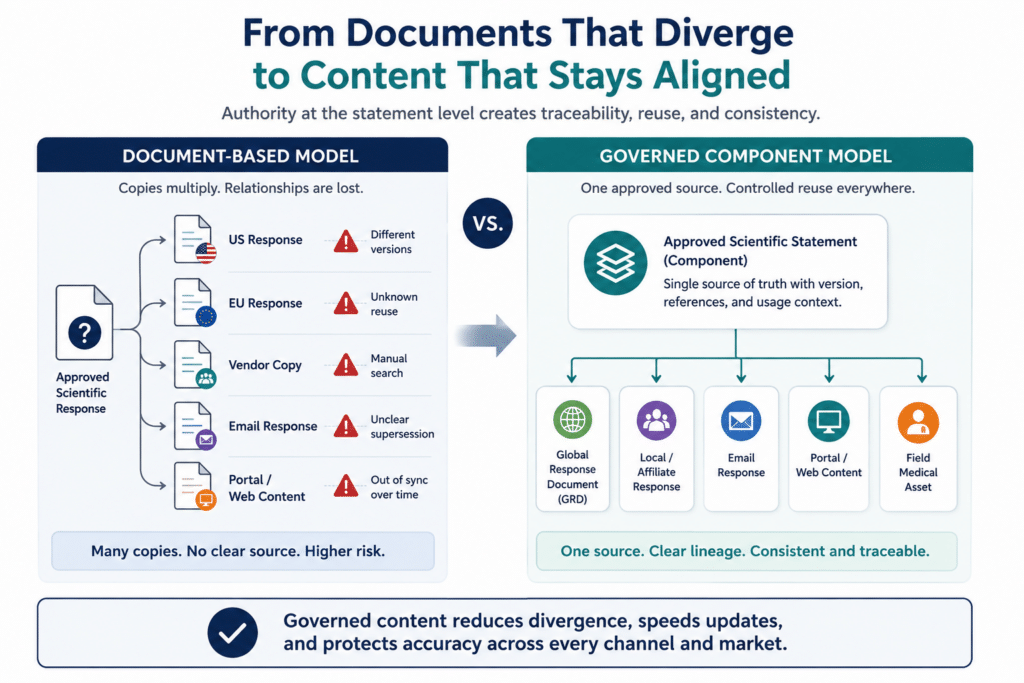
For medical information content management, the requirement that follows is architectural. Authority has to sit at the level where reuse actually occurs, which is the statement rather than the response document. Localization has to be a controlled derivation from that statement rather than an untracked edit to a copy. And the question of scope has to be answerable as a query.
That is the model Docuvera applies to medical information content. Scientific response content is authored as governed, modular components, each carrying approval status, version lineage, source references, and usage context. A global core response set is maintained centrally, and affiliates apply region-specific adaptations that remain traceable to the component they derive from. Content is published to delivery channels from the same governed source, so a portal, a letter, and a field medical asset inherit the same statement rather than reproducing it.
The operational difference shows up when something upstream moves. A labeling or safety change identifies the affected response components directly, along with every downstream instance and locale. Review is scoped to what actually changed. In one documented implementation, Docuvera reports that Eli Lilly Global Medical Information achieved 65 percent component reuse in its first year of component authoring.[9]
AI governance in medical information belongs inside this boundary rather than in front of it. Applied to a divergent content base, an assistant can retrieve competing versions of the same scientific statement, introducing that existing variance into downstream outputs. Applied to governed components, retrieval is constrained to approved, human-reviewed content, transformation is auditable, and generation is the last resort rather than the default. Human review remains a condition of output in every case.
The measure of medical information content management is not how good the responses are on the day they are approved. It is whether the function can state, on demand, how many versions of a given scientific statement are in circulation, where they sit, and which label version each reflects. In a document base, that is a research project. In a governed component model, it is a query.
Frequently Asked Questions
Source note: Regulatory references in this article link to primary FDA and EMA materials. Industry-practice references link to IFPMA, MAPS, phactMI and MILE materials. Statements specific to Docuvera and the Eli Lilly implementation link to Docuvera’s published platform and customer materials.
Sources
- U.S. Food and Drug Administration. “Responding to Unsolicited Requests for Off-Label Information About Prescription Drugs and Medical Devices.” Draft Guidance for Industry, December 2011.
- U.S. Food and Drug Administration. “Communications From Firms to Health Care Providers Regarding Scientific Information on Unapproved Uses of Approved/Cleared Medical Products: Questions and Answers.” Final Guidance for Industry, January 2025.
- European Medicines Agency and Heads of Medicines Agencies. “Guideline on good pharmacovigilance practices (GVP), Module VI: Collection, management and submission of reports of suspected adverse reactions to medicinal products,” Rev. 2.
- International Federation of Pharmaceutical Manufacturers & Associations. “IFPMA Code of Practice.” 2019 edition.
- Medical Affairs Professional Society. “Standards & Guidance: Medical Information.”
- phactMI and Medical Information Leaders Europe. “Best Practices for Medical Information Global Response Documents from phactMI and MILE.” Published January 20, 2026.
- European Medicines Agency. “Pharmacovigilance system: questions and answers.” Section 3, Subcontracting pharmacovigilance activities.
- phactMI. “Medical Information Code of Practice.”
- Docuvera. “Leading change from Traditional to Component Authoring.” Presented by Cecil Lee, Global Customer Information Knowledge Management Advisor, Eli Lilly and Company.