

What a change control record proves, and what an inspector increasingly wants to see
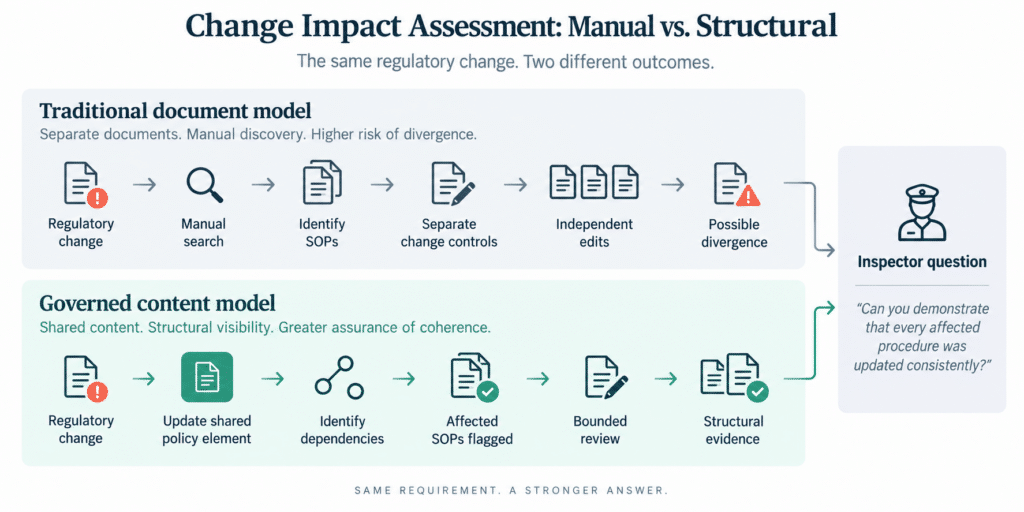
A health authority inspector, midway through a GMP site inspection, asks a question. For this GxP requirement that changed in the most recent guidance update, can you demonstrate that every procedure referencing it was updated consistently?
The quality team has an answer ready. Change control was executed for each affected SOP, and the records are available.
That answer addresses a narrower question than the one asked. The inspector wants to know whether the content is now consistent. Does the requirement, as it appears in every affected procedure, say the same thing in every place it appears?
In a GMP document control model, those are two separate questions. model, those are two separate questions. The first is answerable from the change control record. The second requires either a manual review of every affected document or a governance system that holds the answer structurally. Whether the second is answerable from the system depends on whether shared content relationships are modeled structurally.
What GMP document control does and does not govern
GMP document control in a GxP environment is a compliance-critical capability. 21 CFR § 211.100 requires written production and process control procedures, including changes, to be drafted, reviewed, and approved, and requires those procedures to be followed. Version history is tracked, approval events are recorded, effective dates are enforced, and distribution is managed.
The requirements go further than version control, and the wording is worth reading closely. EU GMP Chapter 4 states that documents should have unambiguous contents and be uniquely identifiable. It requires that relationships and control measures for master documents, official copies, data handling, and records be stated. It requires that documents in the quality management system be regularly reviewed and kept up to date. It requires that an inventory of documents in the quality management system be maintained.
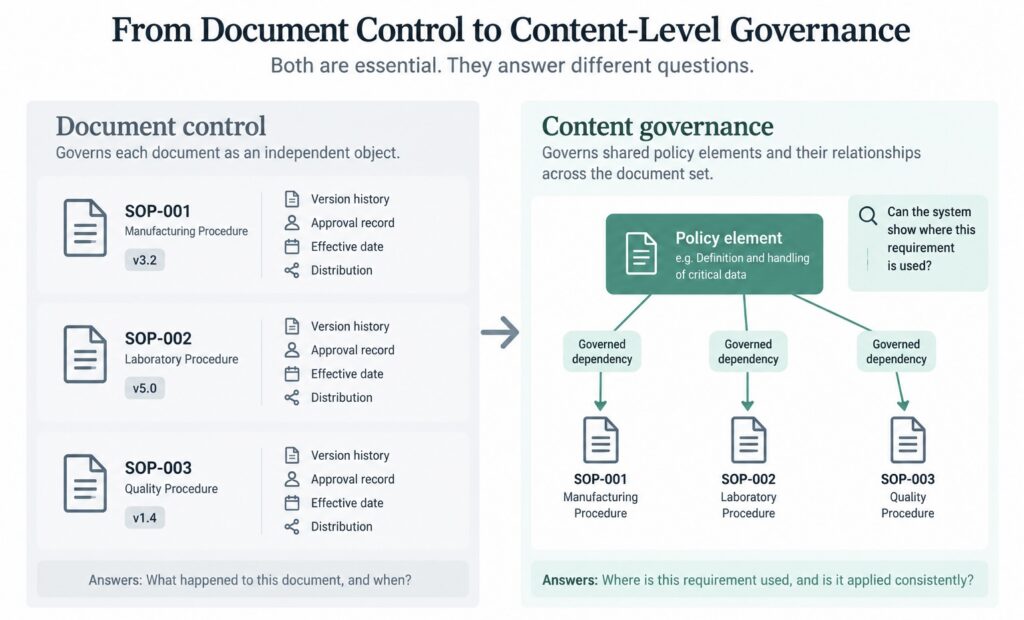
Every one of those requirements operates on a document. Unambiguous content is assessed within a document. Stated relationships cover a master and its copies. Periodic review is scheduled per document. The inventory catalogs documents. The policy elements those documents contain are not themselves inventoried, related, or reviewed as governed content components.
That distinction is where inconsistency lives. A single policy element appearing in 15 procedures exists as independent text in each. Change control tracks that each document was revised. It does not enforce that the revisions produced consistent wording, interpretation, or application. Each change control event runs on its own timeline. The revision language is authored separately. The reviewer for each document confirms the internal consistency of that document.
Coherence here does not mean identical wording everywhere. Variation in how a policy applies to different operational contexts is appropriate and expected. Coherence means the underlying policy element is encoded consistently across every procedure that operationalizes it. The test is whether those encodings would produce consistent outcomes under inspection review.
Where SOP inconsistency accumulates
SOP inconsistency is rarely the product of inadequate review or weak authoring. It is the product of an architecture that maintains independent text instances of shared policy elements. Two illustrative scenarios show how it accumulates.
Regulatory policy change. A guidance update revises how organizations define and document critical data. The quality team identifies 15 affected procedures across manufacturing, laboratory, clinical, and quality operations. Each is revised through its own change control event. Each revision is authored by the owner of
that procedure, working from the guidance text and the prior version. Sixteen months later, an auditor reviews three of the 15. Two characterize the critical data definition differently. Neither characterization is wrong. They are simply not the same. The auditor records an inconsistency finding. The quality team cannot explain the divergence structurally, because no structural record exists linking each procedure’s wording to a shared policy statement. There is only a change control record showing that each was updated.
SOP harmonization across sites. A manufacturer with three production sites is harmonizing cleaning validation procedures. The target is a single global policy with site-specific operational appendices. A shared cleaning validation principle must appear consistently in all three master procedures. It is incorporated through each site’s own authoring and review process. Two years later, a variation filing for a new product at Site 2 requires updating the cleaning validation approach. Site 2’s procedure is revised. The team later finds the principle now reads differently at Site 2 than at Sites 1 and 3, which were never identified as
affected. No content-level change impact assessment existed to identify them. The shared principle lives as independent text in each procedure rather than as a governed component with tracked dependencies.
Both scenarios are operationally recognizable. Both come from the same structural gap. Neither is a process failure.
The GMP inspection traceability gap
What the guidance actually requires
Precision matters here. The authorities cited here do not state an explicit requirement for content-level coherence across an SOP library. The expectation surface is narrower, and stating it exactly is more useful than overstating it.
ICH Q10 names knowledge management as one of two enablers of an effective pharmaceutical quality system, alongside quality risk management. ICH Q8/Q9/Q10 Questions & Answers (R5), updated October 30, 2024, asks in Knowledge Management Q&A 5 whether regulatory agencies expect a formal knowledge management approach during inspections. The answer is no. There is no regulatory requirement for a formal knowledge management system. The same answer states that knowledge from different processes and systems is expected to be appropriately utilized.
Inspector-facing guidance takes a comparable position on data. PIC/S PI 041-1, section 5.1.1, in force since July 2021, notes that there may be no legislative requirement to implement a data governance system. It then makes the operative point. Absence of one may indicate uncoordinated data integrity systems, with potential for gaps in control measures.
That is the pattern quality leaders should register. The governance layer is not mandated. Its absence is read as a risk indicator.
Where the requirements are heading
Direction of travel is documented rather than inferred. In July 2025 the European Commission and PIC/S opened consultation on EudraLex Volume 4. The package covers a revised Chapter 4 on documentation, a revised Annex 11, and a new Annex 22. The Chapter 4 draft makes risk management principles central and integrates them within a data governance system. That system covers the accuracy, integrity, availability, and legibility of documents across paper, digital, and hybrid formats. The draft also requires documentation to remain complete and readable throughout its lifecycle.
Status matters for planning. As of September 2026, consultation closed in October 2025. The current EudraLex Volume4 page still lists the January 2011 Chapter 4 and Annex 11 versions, while the 2025 consultation page continues to present Chapter 4, Annex 11, and Annex 22 as draft guidelines. The EMA GMDP Inspectors Working Group work plan targets the fourth quarter of 2026 for delivering final text to the Commission on all three. The stated purpose for Chapter 4 and Annex 11 is to assure data integrity in the context of GMP. The same work plan schedules inspector training on the revised texts across 2026 through 2028.
FDA’s data integrity guidance calls for meaningful, risk-based strategies to manage data integrity risks, while the EMA GMP and GDP questions and answers on data integrity describes data integrity as a fundamental requirement of the pharmaceutical quality system and says the approach to risk management should be integrated into that system.
Structural evidence and its limits
What separates two organizations facing the same GMP document control question is the form of the answer. A change control record proves an event occurred. Structural evidence proves the outcome of that event is consistent with every related outcome. The operational difference appears at inspection time: can the relationship be queried directly, or must it be reconstructed from individual records?
Public inspection data does not quantify cross-document SOP inconsistency
MHRA publishes GMP inspection deficiency data by finding category, while FDA publishes annual inspection-observation datasets identifying the areas of regulation cited on system-generated Form FDA 483s. Neither dataset isolates cross-document SOP inconsistency. MHRA’s public GMP deficiency page currently lists 2019 as its latest GMP deficiency dataset. The available public data leaves the exposure unquantified.
What content governance adds to the quality system
Content governance operates as an architectural layer alongside GMP document control and the quality management system. Its role is to govern relationships at the level of shared content. That layer holds the relationship between shared policy elements and the procedures that reference them.
Operationally, a shared policy element exists once, as a governed content component with explicit relationships to every procedure that operationalizes it. When the element changes, every dependent procedure is identified through the governance layer rather than through manual search. Review is triggered at the level appropriate to each procedure, with the change to the source component visible to the reviewer as the bounded scope of that review.
The assertion the quality team can make afterward is different in kind. Every procedure in the library that references this policy encodes it consistently, and the governance record holds the evidence structurally. When an auditor asks the provenance question, the answer comes from a query rather than from a narrative assembled out of change control records and version archives.
Docuvera’s Quality & SOP solution applies this governance architecture to quality documents and SOPs on the same foundation it applies to global label coherence and CMC lifecycle content. The structural failure mode is identical across regulated content types. A shared statement held as independent text in many documents will diverge over time, whether that statement is a contraindication, a manufacturing control, or a data integrity principle.
The question for quality leadership is narrow. When an inspector asks whether a requirement is applied consistently across the procedure library, does the answer come from the system or from people reconstructing it?
Frequently asked questions
Sources
- European Commission. “EudraLex Volume 4, Good Manufacturing Practice, Chapter 4: Documentation.” January 2011. health.ec.europa.eu
- European Commission. “Stakeholders’ Consultation on EudraLex Volume 4 Good Manufacturing Practice Guidelines: Chapter 4, Annex 11 and New Annex 22.” July 7, 2025. health.ec.europa.eu
- International Council for Harmonisation. “ICH Q10 Pharmaceutical Quality System.” Step 5, June 2008. ema.europa.eu
- International Council for Harmonisation. “Q8/Q9/Q10 Questions & Answers (R5).” Last updated October 30, 2024. database.ich.org
- Pharmaceutical Inspection Co-operation Scheme. “Good Practices for Data Management and Integrity in Regulated GMP/GDP Environments (PI 041-1).” In force July 1, 2021. picscheme.org
- U.S. Food and Drug Administration. “Data Integrity and Compliance With Drug CGMP: Questions and Answers.” December 2018. fda.gov
- European Medicines Agency. “Guidance on good manufacturing practice and good distribution practice: Questions and answers.” Data integrity section, August 2016. ema.europa.eu
- U.S. Government Publishing Office. “21 CFR § 211.100: Written procedures; deviations.” ecfr.gov
- U.S. Food and Drug Administration. “Inspection Observations.” fda.gov
- Medicines and Healthcare products Regulatory Agency. “Good manufacturing practice inspection deficiencies.” Current public statistics page; latest listed GMP deficiency dataset: 2019. gov.uk
- European Medicines Agency. “The 3-year work plan for the Inspectors Working Group.” GMDP Inspectors Working Group, January 2026 to December 2028. March 23, 2026. ema.europa.eu
- European Commission. “EudraLex Volume 4 — Good Manufacturing Practice Guidelines.” Current EudraLex landing page. Accessed September 2026. health.ec.europa.eu