

Why data governance for AI in pharma will determine which pharmaceutical organizations turn AI pilots into reliable regulatory operations
Large pharmaceutical organizations have spent several years and considerable budgets on AI pilots. The results have been uneven. In a midyear review published by Pharmaceutical Technology on July 13, 2026, regulatory data expert Remco Munnik of Arcana offers a plain explanation. AI readiness in pharma remains limited by the governance, consistency, and ownership of the underlying data.
Munnik’s framing is direct. “AI only works when the underlying data governance is solid.” The observation is not new to anyone who has tried to point a model at a dossier estate. It is worth restating because it reorders the priorities most enterprise programs assume.
AI Readiness in Pharma Starts With Governed Data
Munnik notes that IDMP-driven data governance frameworks are expanding across the industry. EMA is implementing IDMP through a phased program covering substance, product, organisation, and referential master data, collectively known as SPOR. Yet inconsistent standards, unclear ownership, and uneven quality controls continue to limit what AI can deliver. The pattern is consistent. Where data is structured, owned, and quality-controlled, AI has something to reason over. Where data is fragmented or poorly controlled, teams must perform more manual review to establish which information is authoritative.
This matters more as the regulatory system itself moves toward structured data. Munnik points to the Regulatory Optimisation Group, a cross-functional HMA group that brings together regulatory, business, IT, agency, and industry expertise to improve EU regulatory-network operations. A face-to-face workshop in June outlined that process, with further sessions planned after the summer. The direction of travel is a shift from document-based submissions toward structured database updates, with tangible progress targeted for 2027, according to Munnik’s midyear account.
Read that alongside the AI question and the sequence becomes clear. Regulators are building toward submissions that are database-driven rather than document-driven. AI value depends on structured, governed data. The same foundation serves both. Teams that build it are preparing for the regulatory future and enabling AI at the same time.
The same governance priorities appear in the joint FDA–EMA Guiding Principles of Good AI Practice in Drug Development. The principles emphasize standards, a clear context of use, data governance and documentation, risk-based performance assessment, lifecycle management, and human-centered design.
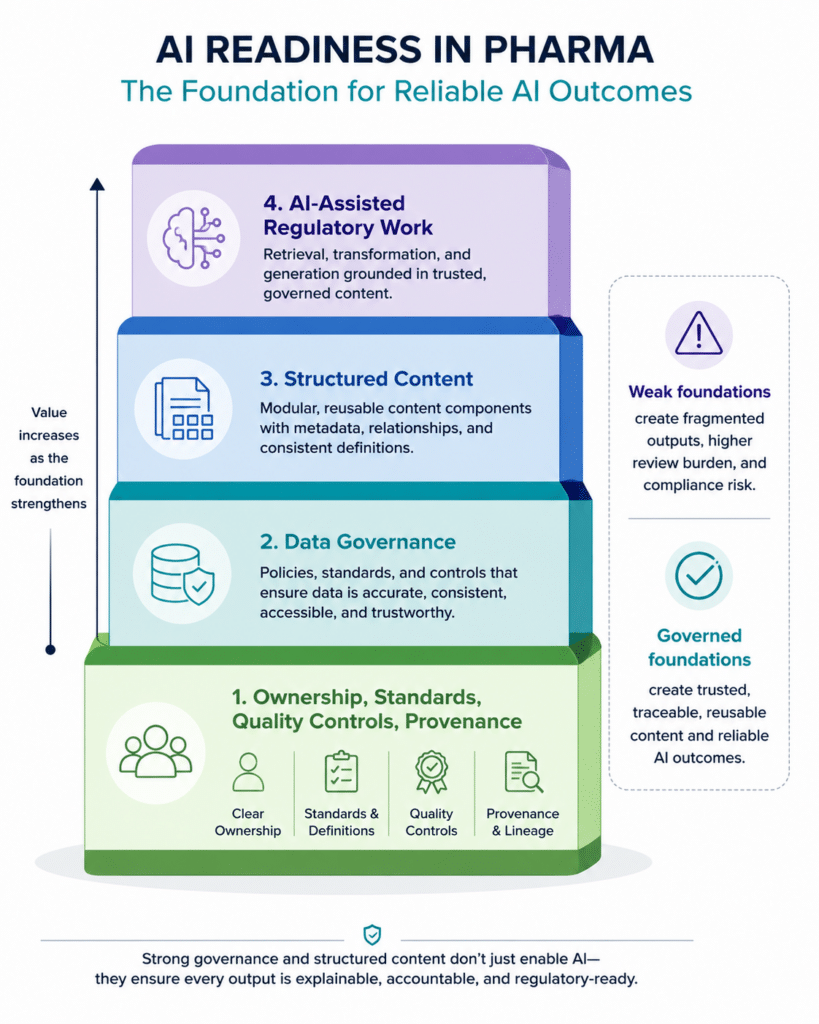
Data Governance Is the Foundation for AI in Pharma
For content and regulatory teams, the operational takeaway is uncomfortable but useful. Making AI valuable begins with the unglamorous discipline of defining standards, assigning ownership, and enforcing quality at the point of authoring. Governance is the prerequisite. Structure is the mechanism that expresses it. AI-assisted intelligence follows from that foundation.
This is also why assistance to provability is the most durable framing of AI in regulated content. Docuvera’s Hierarchy of Intelligence™ ranks AI use by its dependence on governed content. Retrieval-Augmented Reuse, or RARe, draws on approved, structured content that already exists. Retrieval-Augmented Transformation, or RAT, adapts that governed content to new contexts. Retrieval-Augmented Generation, or RAG, generates from retrieved sources. Each rung depends on the quality of the content beneath it. None substitutes for human regulatory judgment.
Docuvera builds for that dependency directly. Its structured content authoring approach treats regulatory content as governed, component-level data with clear ownership and version history. That approach addresses the fragmented systems, inconsistent definitions, ownership gaps, and quality-control weaknesses Munnik identifies. When content is structured and governed at authoring time, AI assistance has a traceable source to work from. Every output can then be tied back to an approved element.
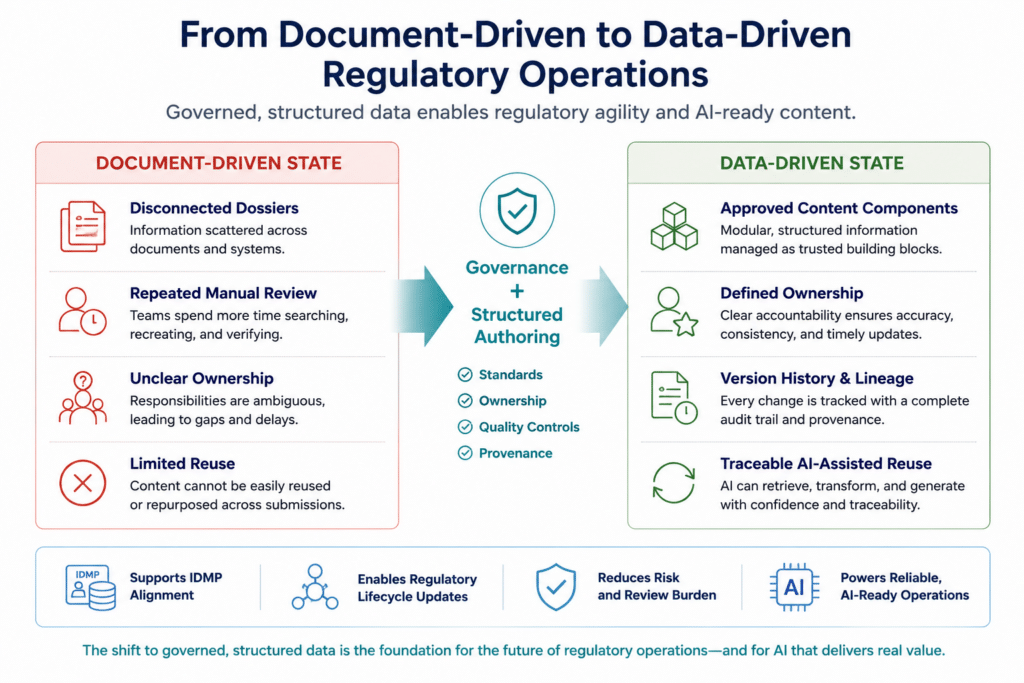
The Reality Check Worth Keeping
Munnik’s midyear message clarifies the order of operations for AI investment. Organizations seeing slow returns are encountering the accumulated effects of data that was never governed. The organizations best positioned to see returns are treating governed, structured content as the foundation. That foundation comes ahead of the model, ahead of the pilot, and ahead of the 2027 regulatory shift already in motion.
For a closer look at structured content authoring as the governed input layer for AI-assisted regulatory work, see Docuvera’s resources on governance-first structured content.
Frequently Asked Questions
1. What does AI readiness in pharma mean?
AI readiness in pharma is the ability to apply AI within an operating environment where the relevant data and content have defined ownership, consistent standards, documented provenance, quality controls, and an established context of use. Human oversight, risk-based evaluation, and lifecycle management are also central to the joint FDA–EMA principles for good AI practice in drug development.
2. Why is data governance important for AI in pharma?
Data governance determines which information is authoritative, who owns it, how it is maintained, and how its quality is controlled. Munnik identifies inconsistent standards, unclear ownership, fragmented systems, and uneven quality controls as continuing constraints on meaningful AI adoption in pharmaceutical organizations.
3. What role does IDMP play in pharma AI readiness?
IDMP provides standardized structures for identifying and exchanging medicinal-product information. EMA is implementing these standards through substance, product, organisation, and referential master-data services. This gives regulatory and digital processes more consistent definitions and a stronger basis for interoperable data exchange. Docuvera provides additional context on the relationship between IDMP and governed structured content.
4. How does structured content support governed AI?
Structured content manages regulated information as identifiable components with associated metadata, ownership, approval status, version history, and lineage. This gives AI-assisted workflows clearer source boundaries and gives reviewers a traceable path back to approved content. Docuvera’s Hierarchy of Intelligence™ applies this foundation by prioritizing approved reuse before transformation or generation.
5. How are FDA and EMA approaching AI governance in drug development?
FDA and EMA have jointly published ten guiding principles that industry and product developers can consider when using AI in drug and biological-product development. Their framework covers human-centered design, risk-based approaches, standards, context of use, multidisciplinary expertise, data governance and documentation, model development, performance assessment, lifecycle management, and clear communication.