

How medical information content management can preserve consistency, traceability, and control as evidence, labels, and safety information evolve.
A Medical Information specialist opens a query on a Tuesday morning. A physician wants the mechanism of action for a compound, and a new Phase III study has been published. The specialist finds the last approved response on the topic, folds in the new data, and sends it.
Three weeks later, a colleague receives a similar query. She starts from a different prior response. She makes slightly different choices about which data to include and how to characterize the evidence. She sends it.
Both responses are accurate. Neither is authoritative over the other. The physician who received the responses cannot know that. The organization cannot demonstrate that the difference does not matter.
This is the routine operating condition for Medical Information content management in a document-based model.
The Medical Affairs Professional Society describes Medical Information as a function that provides trusted clinical and scientific product information to healthcare professionals, patients, and caregivers.
The structural source of inconsistency in Medical Information content management
The source of inconsistency in Medical Affairs content is architectural. In a document-based model, writers create similar content repeatedly from independent starting points. They work from prior responses, their own expertise, and whatever approved data they can locate. No structural mechanism requires that two responses on the same topic derive from the same controlled statement.
This is why the problem resists process solutions. A team can add reviewers, tighten templates for standard response documents (SRDs), and document authoring standards. None of that changes the fact that each response begins from a separate origin. The content base grows organically. Pieces accumulate with no lineage between them and no shared governance layer beneath them.
The consequence is specific. A document-based function cannot guarantee that two responses on the same topic are consistent, because nothing in its structure requires them to be.
Where content authority breaks down across the Medical Information lifecycle
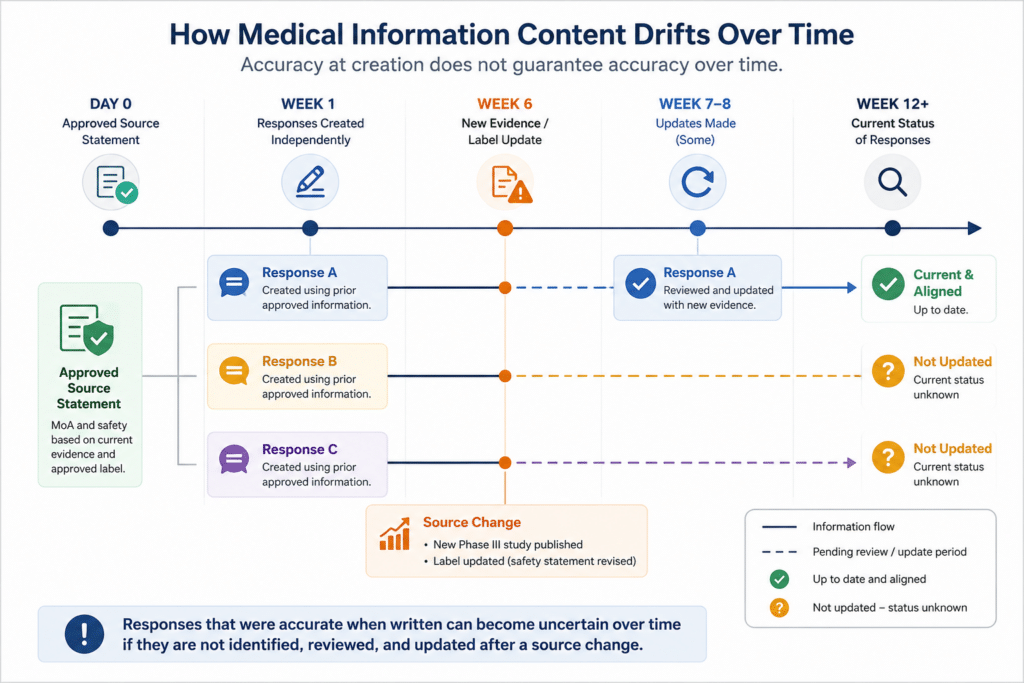
Content that was accurate at creation does not stay accurate on its own. Clinical evidence evolves. Labels are revised. Safety information changes. Each change raises the same question: which existing responses now reference information that is out of date?
In a document-based model, answering that question requires a manual impact assessment. Someone searches the content library. They identify affected files by title, memory, or keyword. They edit each one in sequence. Then they hope the list was complete.
Each step in that sequence can fail. A search misses files that use different terminology. A reviewer forgets a response authored two years earlier. A specialist who knew which letters referenced which study has since left the team. When that person goes, the knowledge goes with them.
Consider a concrete case. A product label is updated to revise a safety statement. In a document model, the team searches for affected Medical Information responses and identifies them by title or recollection. It edits each one independently and trusts that nothing was overlooked. The responses that are missed stay in circulation. They were accurate when written. Their current status is unknown.
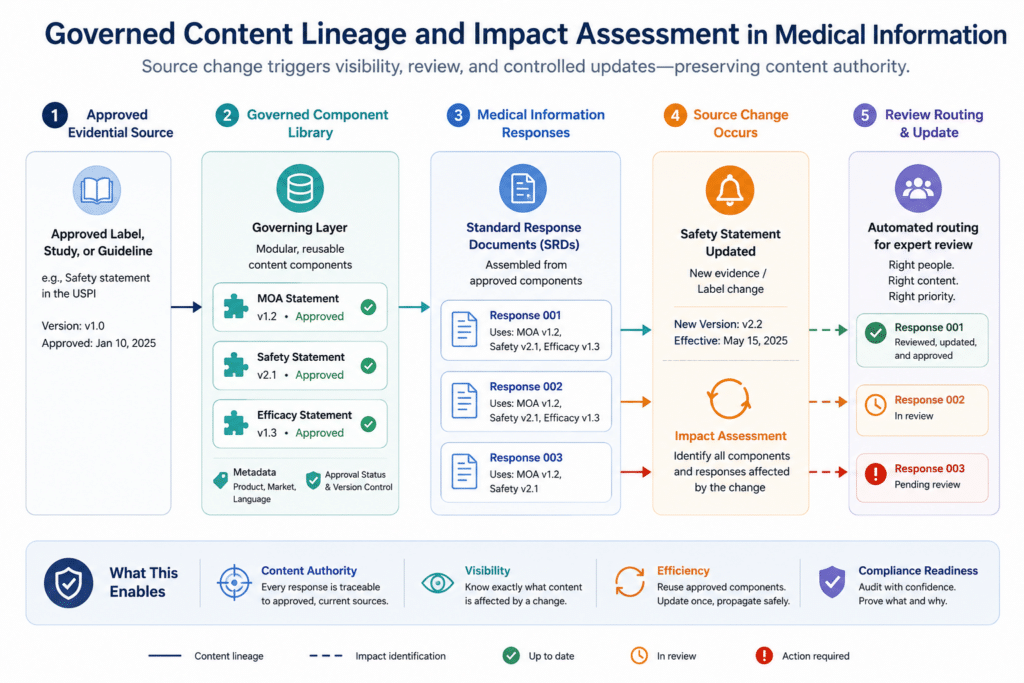
The structural alternative uses governed modular content. Each component carries explicit lineage and metadata linking it to the data it references. When a source statement changes, component-level impact assessment can identify every governed component that references it. The update then moves through review rather than recall.
The Compliance Dimension
Medical Affairs content operates close to a regulatory boundary, making source currency and communication scope critical. In the United States, FDA’s December 2011 draft guidance on unsolicited requests for off-label information recommends that responses be tailored to the specific question and provide truthful, balanced, non-misleading, non-promotional scientific or medical information. It also recommends that responses be generated by medical or scientific personnel independent from sales or marketing.
FDA’s January 2025 final guidance on scientific information on unapproved uses addresses a separate context: certain firm-initiated communications of scientific information on unapproved uses to healthcare providers. It states that those communications should be truthful and non-misleading and should present the information needed to evaluate the scientific information’s strengths, weaknesses, validity, and clinical utility. FDA currently marks the guidance “Not for Current Implementation—see PRA Statement in section VI.”
In the European Union, Directive 2001/83/EC excludes from its advertising provisions correspondence, possibly accompanied by non-promotional material, needed to answer a specific question about a particular medicinal product. The Directive also requires medicinal-product advertising to comply with the Summary of Product Characteristics and requires promotional documentation sent to prescribers to be accurate, up to date, verifiable, and sufficiently complete.
Document-level version control confirms which version of a file is current. It leaves a separate question unresolved: whether the statements inside that file remain consistent with approved data after a label change.
The exposure becomes concrete during inspection. An auditor asks whether every Medical Information response that references a specific safety statement has been updated since the label was revised. In a document model, the honest answer is a qualified one: we believe so. A governed component model answers the same question through a metadata-driven impact assessment, producing a traceable set of affected content.
This is a bounded claim. Document-based Medical Affairs operations are not inherently non-compliant. They compensate for a structural gap with process discipline. That compensation holds under stable conditions. It weakens at scale and under the pressure of frequent change.
What a governed component model changes in Medical Information
Governing Medical Affairs content at the component level changes what the function can assert about its materials throughout the content lifecycle. The gain is content authority.
In a governed model, approved clinical claims, mechanism of action statements, safety information, and product-specific responses exist as governed components. Each carries explicit lineage to its evidential source, along with metadata for product, market, language, version, and approval status. Docuvera’s Medical Information solution builds this control into the architecture of the content itself through structured content authoring.
When a governed component is updated, the platform can flag dependent responses for review. Review is triggered at the appropriate level, while source-to-response lineage remains intact through the Docuvera governance layer.
AI-assisted structured content authoring operates inside these boundaries. The system can prioritize retrieval and reuse from the governed component library, with AI-assisted contributions remaining transparent, reviewable, traceable, and subject to human oversight. The AI accelerates assembly and drafting within governed limits. Approval remains a human governance decision.
With the governance model configured and followed, the function can make a more precise assertion: governed responses derive from approved, current, and traceable sources. When a source changes, dependent content can be identified and routed for review through lineage and impact awareness.
Reusable governed components can also reduce repeat authoring and repetitive re-review by allowing approved content to be used across responses and updated consistently. That efficiency follows from the governed model; content authority remains its purpose.
This separates a Medical Affairs function that manages content authority structurally from one that relies on process discipline. Process discipline narrows the operational gap while leaving the architectural gap in place. The question for any Medical Affairs leader is which of those two positions the function occupies today, and whether it can prove which one on demand. A governed component platform such as Docuvera exists to make the structural position the default one. The answer to that question then becomes a query rather than a hope.
Frequently Asked Questions
1. Does this problem apply only to large Medical Affairs organizations?
The structural problem applies at any volume. At smaller scale, proximity masks it. The team is small enough that informal knowledge fills the governance gap. The risk surfaces when a key person leaves, the portfolio grows, or a data update requires broad content review. Informal compensation fails at that point.
2. Doesn’t a strong review process catch inconsistencies before responses go out?
Review catches inconsistencies visible at the time of authoring. Post-creation drift begins later, when underlying data changes and a previously approved response is not updated in parallel. Authoring review alone cannot identify every affected response across the library.
3. How is a governed component library different from a response-template library?
A template library provides a starting structure. A governed component library adds controlled derivation, lineage to referenced data, component-level version status, and impact assessment when underlying data changes. Those controls reside in the content architecture rather than in the discipline of the person using the template.
4. What should trigger a Medical Information content review?
A review should be triggered when the evidence or approved source behind a response changes. Common triggers include label revisions, new clinical data, updated safety information, changes in treatment guidelines, or the retirement of a cited source. In a governed component model, those triggers can be tied to the affected components and routed to the appropriate reviewers through impact assessment.
5. Can AI maintain Medical Information content authority on its own?
No. AI can help retrieve approved content, assemble responses, identify related components, and accelerate drafting. Content authority still depends on governed sources, clear lineage, approval status, and human review. The value of AI increases when it operates within those controls rather than across an open-ended content environment.
Sources
- U.S. Food and Drug Administration. Responding to Unsolicited Requests for Off-Label Information About Prescription Drugs and Medical Devices. Draft guidance, December 2011. Draft—not for implementation.
- U.S. Food and Drug Administration. Communications From Firms to Health Care Providers Regarding Scientific Information on Unapproved Uses of Approved/Cleared Medical Products: Questions and Answers. Final guidance, January 2025.
- European Union. Directive 2001/83/EC on the Community code relating to medicinal products for human use, consolidated version dated January 1, 2025, Articles 86, 87, and 92.
- Medical Affairs Professional Society. Standards & Guidance: Medical Information.
- Medical Affairs Professional Society. Modular Content in Medical Affairs: The Foundation of Omnichannel Engagement.
- Docuvera. Structured Content for Scalable, Compliant Medical Information.
- Docuvera. Governance Layer — the Strategic Advantage.
- Docuvera. AI-Powered Structured Content Authoring.
- Docuvera. What Is Structured Content Authoring in Pharma?.
- Docuvera. Utilizing AI-Powered Structured Content Authoring for Global ePI Compliance