

By Kenneth Gutiérrez, Director of Product
The operating model shift from flat documents to governed, reusable product information.
For decades, product information has lived as a document. The summary of product characteristics, the package leaflet, and the label existed as formatted files, revised version by version, region by region. That model is now reaching its limit.
The European medicines regulatory network has adopted the EU Common Standard for electronic product information, or ePI. The standard is based on Fast Healthcare Interoperability Resources, or FHIR, which defines data formats, elements, and an application programming interface for exchanging electronic health records. The draft EMA ePI implementation roadmap phases voluntary implementation by therapeutic area. Vaccines go first in the fourth quarter of 2026. Oncology products follow in the first half of 2027, with voluntary go-live for all Centrally Authorised Products planned for the second half of 2027. National roll-out timelines are to be defined separately following readiness assessment.
ePI does not travel alone. It sits alongside the ISO Identification of Medicinal Products, or IDMP, standards, which provide standardized data elements and structures for medicinal products, substances, dose forms, routes of administration, packaging, and other regulated product information. EMA is implementing these standards through its substance, product, organisation, and referential, or SPOR, master-data services. In June 2026, EMA released a public beta of its Product Management Service, or PMS, API, providing external access to structured, machine-readable product data. The direction is unambiguous. Product information is becoming data, not documents.
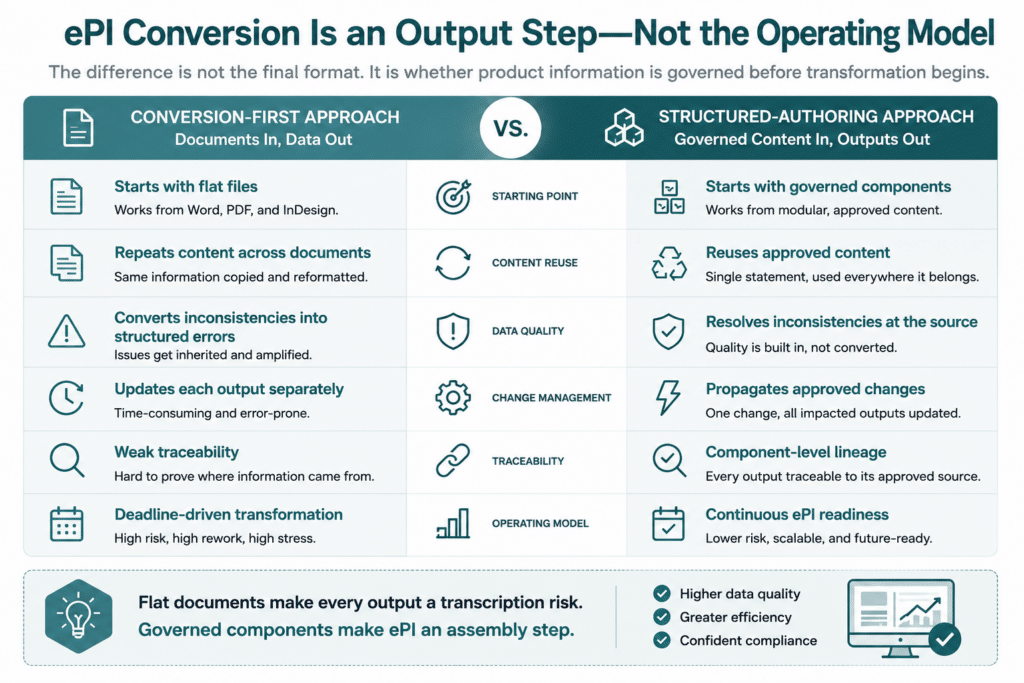
The Failure Mode Is Treating ePI Implementation as Formatting
Many teams will approach ePI as a conversion project. Take the existing PDF leaflet, restructure it into FHIR, and submit. That approach misreads the change. ePI is not a new file format for the same document. It is a shift to semi-structured, machine-readable product information that can be handled and exchanged across systems. EMA’s draft ePI roadmap makes the transition model explicit: applicants will initially author or upload ePI through the Product Lifecycle Management, or PLM, Portal alongside current Word/PDF submissions, and once a product’s information is electronic, it is expected to remain electronic through subsequent variations.
The risk in the formatting mindset shows up later. A team that converts flat documents under deadline pressure inherits every inconsistency already buried in those documents. Duplicate statements, version drift between regions, and untraceable claims do not disappear in conversion. They become structured, machine-readable errors that propagate faster.
There is a second risk. ePI and IDMP describe the same product from different angles. If the content feeding them is not built on a single, governed definition, the label, the regulatory data, and the safety record can diverge. One standardized product definition should feed labeling, regulatory, and safety outputs at once. That only works if the content is modular and data-centric from the start.
For US-headquartered sponsors with EU portfolios, the requirement is regional, but the operating-model impact is global: EU product information still has to stay aligned with global labeling and connected regulatory and safety systems.
The Requirement Is Structured Content Authoring Before the Deadline
The reform timeline raises the stakes. Political agreement on the revised EU pharmaceutical legislation was reached in December 2025. EMA expects the adopted acts to enter into force in 2026, followed by a transition period through 2028, when the legislation becomes applicable. The draft ePI roadmap aligns the current voluntary rollout with those upcoming legal requirements. The voluntary window now is the preparation window. Teams that wait convert under pressure. Teams that prepare author in structure first.
Readiness starts with a clear view of the current state. Docuvera’s EU ePI Readiness Self-Assessment benchmarks 36 points across content architecture, metadata, structured authoring, FHIR validation, governance, and organizational readiness.
Structured content authoring is the prerequisite here, not an enhancement. Each element of product information exists as a discrete, governed component. A statement approved once is reused wherever it belongs, across the SmPC, the leaflet, and the label. When the source is modular, generating an ePI output is an assembly step, not a rewrite. When the source is a flat document, every output is a fresh transcription risk.
Docuvera was built for exactly this problem. As a governance-first structured content authoring platform purpose-built for pharma, it treats product information as structured regulatory data, not files to reformat. Governance is the prerequisite. Structure is the mechanism. Intelligence is the result. A single governed content source can feed ePI-ready content, labeling outputs, and connected regulatory and safety systems, with each component traceable to its approved source. Where AI assists, it operates on that governed content under human review. That operating model puts reuse ahead of generation. The output stays defensible because the input was governed.
Readiness starts with a clear view of the current state. Docuvera’s EU ePI Readiness Self-Assessment benchmarks 36 points across content architecture, metadata, structured authoring, FHIR validation, governance, and organizational readiness.
The Takeaway: Product Information Is Moving From Documents to Data
ePI and IDMP are often filed under compliance deadlines. The deeper change is architectural. Product information is moving from documents to data, and the organizations ready for it will be the ones that already author in structure. Structured content authoring is not the nice-to-have that follows the mandate. It is the prerequisite that determines whether the mandate is manageable.
For a fuller view of how structured authoring prepares labeling teams for the ePI transition, see our white paper on AI-powered structured content authoring for global ePI compliance.
Frequently Asked Questions
1. What is electronic product information (ePI)?
Electronic product information, or ePI, is the authorised product information for a medicine—including the summary of product characteristics, package leaflet, and labelling—created using the EU ePI Common Standard. It is designed for electronic handling and distribution through websites, digital platforms, and print.
2. How is ePI different from a PDF product-information document?
A PDF presents product information as a formatted page. ePI represents that information in a harmonised, semi-structured format that systems can process, exchange, and display. Converting a PDF into ePI may produce a compliant output, but it does not resolve duplicate content, regional inconsistencies, weak traceability, or disconnected source data.
3. What is the relationship between ePI and ISO IDMP?
ePI and ISO IDMP describe the same medicinal product from different but connected perspectives. ePI structures the authorised information communicated to healthcare professionals and patients. ISO IDMP standardizes the data used to identify medicinal products, substances, dose forms, routes of administration, packaging, and related entities.
4. How do SPOR and PMS support ISO IDMP implementation?
EMA is implementing ISO IDMP through its substance, product, organisation, and referential master-data services, collectively known as SPOR. The Product Management Service, or PMS, supports the management and exchange of structured medicinal-product data. Together, these services provide the standardized data foundation needed to identify products consistently across regulatory processes.
5.Why is structured content authoring necessary for ePI?
Structured content authoring manages product information as governed, reusable components rather than repeated passages inside separate files. This allows approved content to be traced, updated, and reused across the SmPC, package leaflet, labelling, and other outputs. When the source is structured, ePI generation becomes an assembly step rather than another manual transcription process.
6. Does FHIR replace the SmPC, package leaflet, or labelling?
No. FHIR does not replace the authorised content or the regulatory documents represented in ePI. It provides the technical structure used by the EU ePI Common Standard so that product information can be represented and exchanged electronically while retaining its regulated meaning.
7. Can an existing document-management system make an organization ePI-ready?
Document management can control files, versions, and approvals, but ePI readiness also requires governance at the content-component and data level. Teams need consistent terminology, metadata, reusable content, source traceability, and controlled relationships between product information and regulatory master data. Without that foundation, document conversion can carry existing inconsistencies into machine-readable outputs.
8. How can pharmaceutical teams assess EU ePI readiness?
An ePI readiness assessment should examine more than the ability to produce a FHIR-formatted output. Teams also need to evaluate their content architecture, metadata, structured-authoring capabilities, validation processes, governance model, and organizational preparedness. Docuvera’s EU ePI Readiness Self-Assessment evaluates those areas across 36 readiness points and provides a downloadable report with prioritized next steps.
Sources
- European Medicines Agency, Electronic product information (ePI)
- European Medicines Agency, Electronic product information (ePI) roadmap
- European Medicines Agency, Data on medicines (ISO IDMP standards): Overview
- European Medicines Agency, Substance and product data management services
- European Medicines Agency, Reform of the EU pharmaceutical legislation
- Docuvera, Structured Content for ePI Compliance
- Docuvera, AI-Powered Structured Content Authoring
- Docuvera, End-to-End Content Governance Platform for Regulated Content
- Docuvera, Utilizing AI-Powered Structured Content Authoring for Global ePI Compliance
Written by

Kenneth Gutiérrez
Director of Product | Docuvera
Read more from Kenneth →
View all blogs →
Connect on LinkedIn