

Answer with Authority. The moment a statement’s standing is challenged, no one is there to explain it. The proof either exists in the record, or it does not.
A regulated statement is only as strong as what it can show about itself: where it came from, who approved it, how it changed, and everywhere it is used. In regulated content management in pharma, that evidence has to live in the record behind the statement, reachable by someone who was not present when the work was done. Where the record holds it, the standing holds; where the record is silent, no signature or force of assertion supplies what is missing.
A statement’s standing does get challenged, and rarely on notice. A regulator raises a written question during assessment of an application or a variation. An affiliate disputes which version of a claim governs its market. A reviewer, or a new owner inheriting a file, asks on what basis a statement is still valid. An inspector asks on site, or a regulator requests the records remotely and reviews them from documents alone. In a dispute, counsel asks the same thing in harder language.
The setting changes each time. The demand does not. Prove this statement is what it claims to be. Show where it came from, who approved it, how it has changed, and everywhere it is used today.
That demand is the real test of authority. It is met only when the organization can establish a statement’s standing from evidence that already exists, on demand, to someone who was not in the room when the work was done.
Signaling authority is not the same as holding it
Document-first estates tend to announce authority rather than hold it. A statement is marked authoritative by a title suffix, a status field, an approval stamp, or a folder named final. Those markers signal standing. They do not evaluate context, dependencies, or concurrent reuse, so authority ends up governed socially rather than structurally. It rests on convention and on the memory of the people who maintain it.
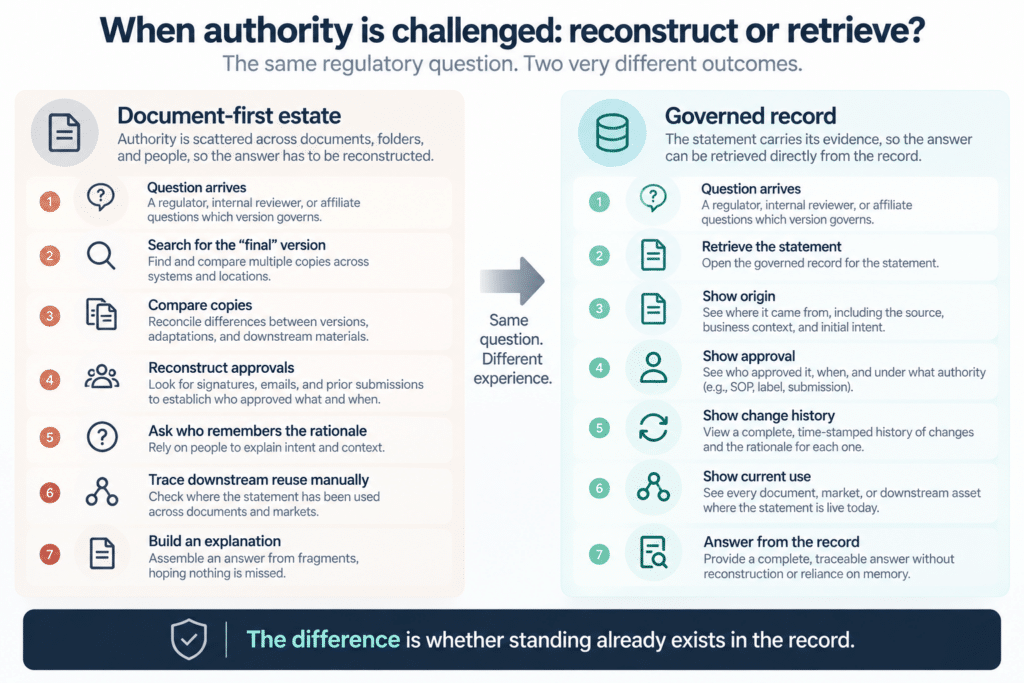
The weakness stays hidden until something tests it. A question arrives asking which version of a statement is authoritative. Several versions surface, each carrying evidence of prior approval, and none can be confidently named as the record that governs. Teams reconcile historical submissions, local adaptations, and downstream materials, and reconstruct intent from the fragments. The organization is not proving its position. It is assembling an argument for it.
Attribution is the smallest unit of authority, and regulators treat it as foundational. FDA’s Electronic Source Data guidance states that source data should be attributable, legible, contemporaneous, original, and accurate (ALCOA), and FDA’s CGMP data-integrity guidance applies the same ALCOA attributes to complete, consistent, and accurate data. EMA likewise maps the ALCOA principles to existing EU GMP requirements. Failures such as uncontrolled access or changes without a traceable history cut against FDA requirements for authorized access and secure, computer-generated, time-stamped audit trails that do not obscure previously recorded information. The pattern underneath those failures is constant. When standing cannot be traced through the record itself, it does not hold, however confidently it is asserted.
That is why the person in the room matters less than it seems. Authority that depends on someone being available to explain it is advocacy, not authority. When that person has moved on, or the review happens remotely against the documents alone, the standing has to be present in the record or it is not present at all.
What it takes to hold authority across the regulated content lifecycle
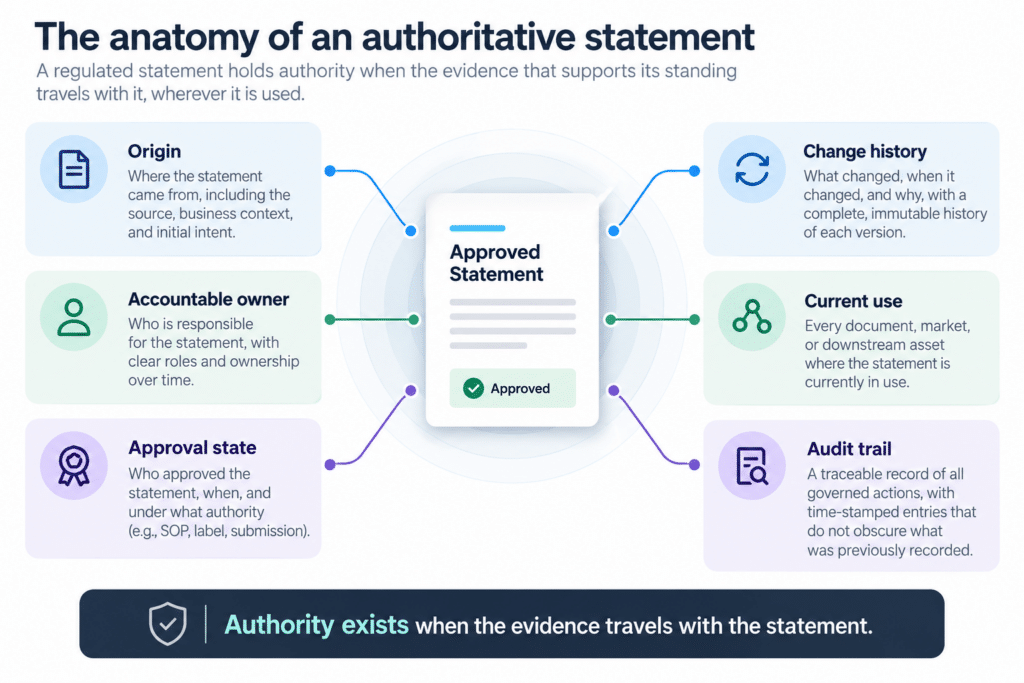
Holding authority requires making it explicit and anchoring it where reuse actually happens, at the statement itself rather than the document that once carried it. If authority stays implicit inside approved artifacts, it erodes as reuse spreads, because each reuse creates another copy whose standing is a matter of inference.
Anchored properly, each statement carries its authority as an inherent part of what it is. Its origin. Its approval state, and the person accountable for it. The rationale for every change it has been through. And everywhere it is currently used. For electronic records in scope of 21 CFR Part 11, that history has to be preserved through secure, time-stamped audit trails so changes do not obscure previously recorded information. And it has to be queryable at the level of the statement, so standing is retrieved rather than rebuilt.
The test is the same regardless of who is asking or why. Can the organization prove a statement’s standing directly from the system, without reconstruction, without narrative explanation, and without relying on any one person’s memory? If yes, authority is a property the organization holds. If no, every challenge becomes a reconstruction, and the outcome depends on who is available and how well the assembly goes that day.
Know before the question arrives. See the critical questions a governed content foundation should let your organization answer. Find the Answer →
The record that stands on its own
This is what a governance-first foundation is built to hold. Each approved statement carries its own record: its origin, its owner, its version history, and an immutable account of everywhere it has been used. That record is queryable at the level of the statement, so standing is retrieved rather than argued. The questions that used to trigger an argument return answers instead: where a statement originated, how it changed, who is accountable for it, and everywhere it is live.
For quality documentation and SOPs, that means a statement’s standing is demonstrable rather than defended. For the broader work of reducing regulatory risk, it means the organization can hold its position under challenge from any direction, in person or on paper. Where a statement was drafted with AI help, its standing still rests on the governed record behind it. The joint FDA-EMA principles issued in January 2026 similarly emphasize documented provenance, traceability, and verifiability for AI-related data and decisions in GxP contexts. The assistance is traceable to an approved source, or it carries no authority at all.
When a statement’s standing is challenged, nothing has to be built. The record was there before the question, and it speaks without help. Authority is standing the record can show on its own.
Answer with Authority. See how governed quality documentation and SOPs make the evidence behind approved content traceable when scrutiny arrives. See how →
Frequently Asked Questions
Sources
Editorial note: Regulatory references in this article were checked against current FDA, U.S. federal regulation, European Commission, and EMA source materials. Product-specific statements describe Docuvera’s documented content-governance capabilities.
- U.S. Food and Drug Administration. “Electronic Source Data in Clinical Investigations: Guidance for Industry.” September 2013. Defines ALCOA, including attributable, and addresses the reliability, integrity, and traceability of electronic source data.
- U.S. Food and Drug Administration. “Data Integrity and Compliance With Drug CGMP: Questions and Answers.” December 2018. Addresses data integrity under drug CGMP and the ALCOA attributes.
- Electronic Code of Federal Regulations. “21 CFR § 11.10 — Controls for Closed Systems.” Requires, where applicable, authorized access controls and secure, computer-generated, time-stamped audit trails, with changes that do not obscure previously recorded information.
- European Medicines Agency. “Guidance on Good Manufacturing Practice and Good Distribution Practice: Questions and Answers.” Maps ALCOA principles to existing EU GMP requirements.
- European Commission. “EudraLex Volume 4, Annex 11: Computerised Systems.” Section 9 addresses audit trails for GMP-relevant changes and deletions, including reasons for changes or deletions and review of audit-trail records.
- U.S. Food and Drug Administration. “Conducting Remote Regulatory Assessments: Questions and Answers.” Final guidance. Addresses FDA’s use of remote regulatory assessments, including requests for records in advance of or in lieu of inspection.
- U.S. Food and Drug Administration and European Medicines Agency. “Guiding Principles of Good AI Practice in Drug Development.” January 2026. Includes data governance and documentation principles addressing provenance, traceability, and verifiability.