

Answer with Evidence. Being aligned across markets is a claim until the moment you can show it.
Global labeling harmonization depends on being able to trace an approved core position across every market where it appears.
Try a short exercise with one approved statement. Take a dose, a contraindication, or a core safety phrase, and produce, from your systems, every place it currently lives across markets and documents, with proof of the current wording in each market and the governed reason for any permitted difference. How quickly that answer comes, and how much of it rests on someone’s recollection rather than the system, is the real measure of whether the organization is aligned or merely assumes it is.
In a document-first estate, the exercise can become a reconstruction task, and the struggle is the point. Being aligned and being able to show you are aligned are separated by a gap that stays invisible until someone asks for the proof.
Why global labeling alignment is usually an assumption
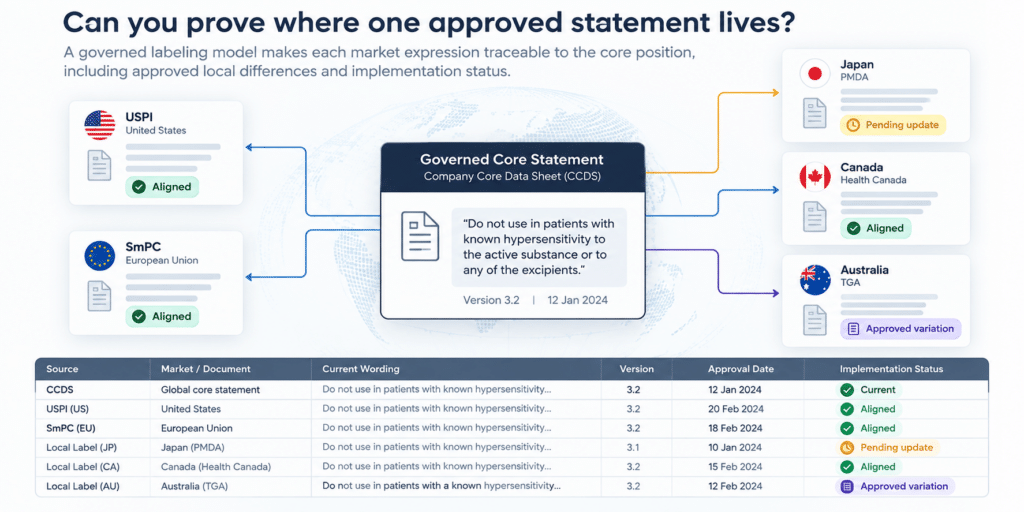
Approval scatters a statement rather than settling it. Global labeling harmonization depends on maintaining the relationship between that core position and every approved local expression. A company holds its core position in a Company Core Data Sheet, the internal reference used to prepare national labels, including the SmPC, the USPI, and their equivalents. Published research on CCDS development and maintenance describes the CCDS as the company’s reference position while noting that national labels may differ because of local authority requirements or findings from individual markets. Review the published CCDS research on PubMed
When a safety signal is confirmed, the company updates that core position and communicates the change to affiliates for inclusion in local labels. Inconsistencies emerge between markets when those updates are not synchronized, or when some regions adopt the change while others lag. Research examining safety-labeling updates across jurisdictions identifies differences in regulatory requirements, timing, and interpretation as contributors to misalignment. Review the safety-labeling alignment research
Each of those local labels was approved. That is exactly why the drift is hard to see. Nothing looks wrong at the level of any single document. The problem exists only in the relationships between them, in whether forty individually approved labels still express one core truth, and those relationships are the thing a document-first estate does not track. So the organization says it is aligned because it has no evidence to the contrary, which is not the same as having evidence that it is.
When explanation stops being enough
In document-based review, differences can often be addressed through narrative explanation. The operating context is changing. EMA’s electronic product information (ePI) work uses a FHIR-based common standard, while FDA uses Structured Product Labeling (SPL) for structured information exchange and is developing structured-data standards through initiatives such as PQ/CMC. As regulatory information becomes more structured and machine-readable, differences can be exposed at the data or field level rather than only inside complete documents. The burden shifts from explaining differences after the fact to preventing them in governed content, and from asserting coherence to demonstrating it.
For organizations preparing for that environment, structured labeling and product information creates a more direct connection between governed source content and formats such as SPL and ePI.
In that environment, “we believe our markets are aligned” is a weak position. What holds up is the ability to show it: to produce, on demand, the current state of a statement everywhere it lives, and the record of when and where each market reached alignment. Evidence, not assurance.
Proof as a property of the system
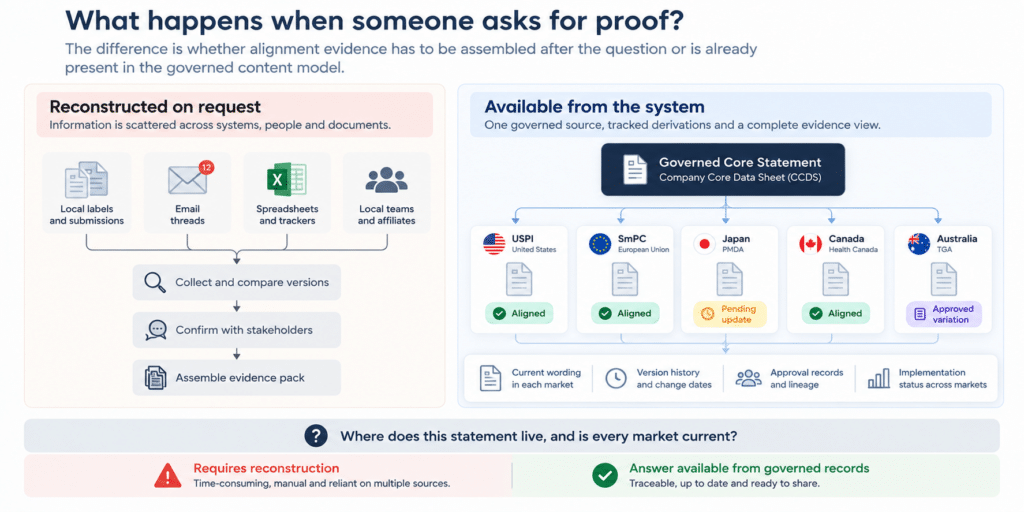
Demonstrable alignment is not a report an organization compiles when asked. It is a property of how content is governed, present before the question. Three things make it real.
There has to be one governed source for the core statement, so there is a single truth for every rendering to match against. Every local expression has to be a tracked derivation of that source, so the full set of renderings is visible together rather than scattered across systems that do not reference one another. And there has to be lineage that records not just what each label says but when and where alignment was achieved, so the proof carries dates and destinations rather than confidence.
With those in place, the opening exercise inverts. The map of where a statement lives and whether every instance agrees is not reconstructed on request. It is already held, and it can be put in front of a regulator, an auditor, or the board without a scramble to assemble it.
Can your organization answer the alignment question from the system itself?
Explore how governed information supports defensible answers across regulated content in Answer.
Where that proof comes from
A governance-first approach to core labeling is built to produce exactly this. Docuvera governs the core position as a component and renders each market’s label from it, so a local label is a traceable expression of one source rather than a separate copy that happens to have been approved. The relationships between renderings are recorded as the content is built, which means alignment can be shown rather than assumed, with the timing and reach of every update visible. Docuvera’s global-labeling materials describe component-level management of core content and local implementations with traceability across formats and markets. See Docuvera’s global labeling approach
Resting on the governance layer, that turns cross-market coherence from a belief into a demonstrable fact, which is the practical substance of reducing regulatory risk across a portfolio. Docuvera describes component-level version control, timestamps, content lineage, role-based access, and controlled reuse as capabilities of that governance layer. Review Docuvera’s content-governance capabilities
Where AI assists, it works inside those governed bounds, with AI-assisted contributions connected to source content, lineage, and human review. Docuvera documents those controls as part of its governed AI authoring capability. See the documented AI governance approach
An approved statement spread across forty markets is a claim until the day someone asks you to prove it still holds everywhere. Govern it, and that day is any day, because the proof is produced, not assembled. Answer with evidence.
See what makes the evidence defensible.
Explore the governance, auditability and enterprise controls behind Answer with Evidence.
Frequently Asked Questions
Sources
- Hammad TA, Sabrdaran S, Heim J-M. Achieving synchrony: bridging the gap between pharmaceutical companies and regulators on safety labeling updates. Frontiers in Drug Safety and Regulation. 2024. Read the published article
- Current Challenges in Labelling for Generic Medicinal Products: Company Core Data Sheet (CCDS) Development and Maintenance. Pharmaceutical Medicine. 2020. PubMed record
- European Medicines Agency. Electronic product information (ePI). EMA states that the EU ePI Common Standard is based on FHIR and supports harmonised electronic information on medicines within the EU. EMA ePI guidance
- European Medicines Regulatory Network. Electronic Product Information Implementation Guide. The implementation materials define FHIR resources and structured examples for ePI. EMRN ePI Implementation Guide
- U.S. Food and Drug Administration. Structured Product Labeling Resources. FDA identifies SPL as an HL7-approved document markup standard adopted as a mechanism for exchanging product and facility information. FDA SPL resources
- U.S. Food and Drug Administration. Pharmaceutical Quality – Chemistry, Manufacturing & Controls (PQ/CMC). FDA states that the initiative aims to develop structured data standards and a data-exchange standard for PQ/CMC information. FDA PQ/CMC initiative
- Docuvera. Global Labeling Software Pharma Teams Use for Compliance Management. Docuvera Global Labeling
- Docuvera. Governance Layer – the Strategic Advantage. Docuvera Governance Layer
- Docuvera. AI-Powered Structured Content Authoring. Docuvera governed AI authoring
- Docuvera. Technology & Security. Docuvera documents role-based access, audit trails, validation alignment, and security controls used to support regulated content operations. Docuvera Technology & Security