In early September, the European Medicines Agency (EMA) published guidance on how applicants should submit electronic product information (ePI) during centralized procedures. The scope is deliberately narrow. It covers Annex I, Annex II, and Annexes IIIA and IIIB, and it does not address the other annexes to the European Commission decision. Applicants still file the product information annexes in the eCTD. Submitting ePI itself remains voluntary until the general pharmaceutical legislation takes full effect, as Regulatory Focus reported. EMA says the guidance becomes applicable at ePI go-live, which its draft roadmap phases in for centrally authorized products from Q4 2026.
Voluntary is the word most likely to send this guidance to the bottom of a labeling team’s queue. The obligations attached to a published ePI argue against that. They are specific, dated, and in force from go-live.
The Core Obligation in the EMA ePI Guidance Is Alignment
Once an ePI has been published, the applicant carries the obligation to keep it aligned with the latest approved product information. That obligation extends to any translations submitted alongside it. During the voluntary phase, EMA accepts ePI in English alone and treats translations as optional, while expecting all-language submission to become mandatory. It also changes the nature of the work. Producing an ePI once is a project. Holding it aligned across every subsequent variation, renewal, transfer, and Article 61(3) submission is a standing operating condition.
The submission timing table makes the coupling concrete. A marketing authorization application (MAA) applicant submits ePI at the same time as the procedure application. When submitting a change, the ePI goes in with the final PI translations. The same timing applies to Type IA and IAIN variations, Type IB variations, Article 61(3) submissions, transfers of marketing authorization, and other post-authorization procedures.
EMA also sets three conditions before it treats an ePI as submitted. The ePI must sit in Submitted status in the Product Lifecycle Management (PLM) Portal. Its content must match the final Annexes I, II, IIIA, and IIIB filed for the corresponding procedure. The known procedure number must appear in the procedure number field. Only MAAs may rest in Draft status; every other procedure and timepoint must be Submitted.
The Failure Mode in ePI Lifecycle Management Is Divergence Nobody Notices
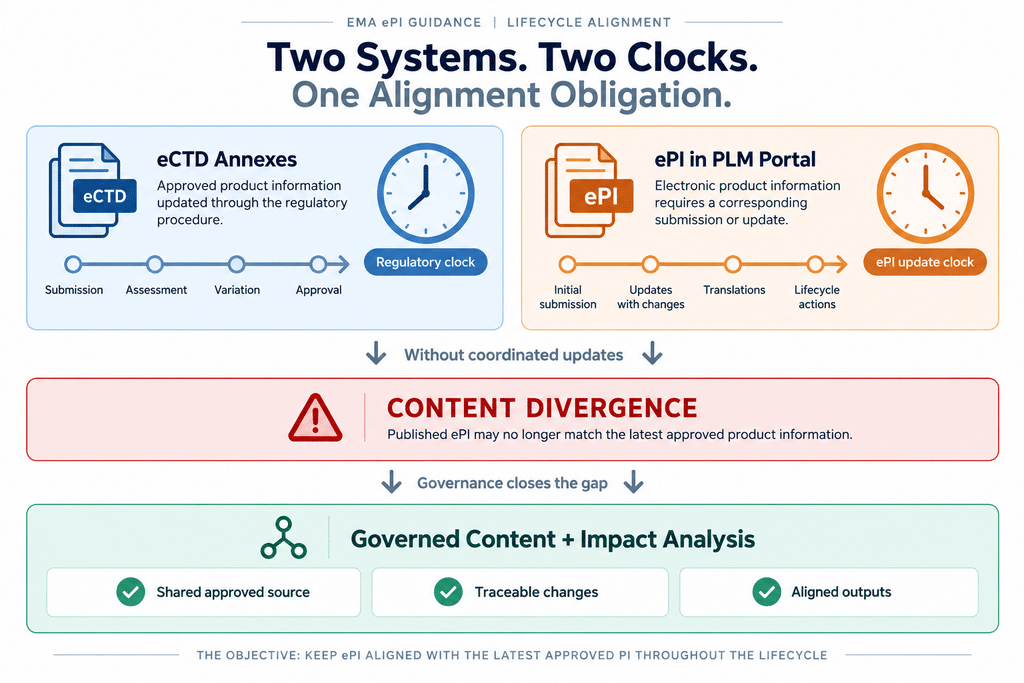
Two representations of the same product information now exist in two systems on two clocks. The eCTD annexes move with the procedure. The ePI moves when a person updates it. Nothing in that arrangement prevents the two from disagreeing. Alignment depends on someone remembering, in the right week, across every affected language.
Lifecycle Clocks for Withdrawal, Refusal, and Transfer
The lifecycle edges, including suspension, withdrawal, refusal, and transfer, are where the exposure concentrates. EMA requires the ePI owner to move ePIs from Submitted to Deactivated within 15 working days once a withdrawal has been notified to the agency. After a negative CHMP opinion, the applicant must move related ePIs out of Submitted status within 15 working days, to either Draft or Deactivated. If the applicant requests a re-examination, the ePI may hold any status pending the final outcome. If that outcome is unfavorable, the 15-working-day clock to Deactivated applies. The applicant must also keep the refused procedure number out of the procedure number field of any other ePI.
Transfers carry their own sequence. The transferor and transferee follow a defined set of steps. The last is a Service Desk ticket asking EMA to move the ePI into the transferee’s custody. EMA publishes the transferee’s ePI after the Commission decision granting the transfer.
None of this is difficult for one product in one language. Across a portfolio in every EU language, plus Icelandic and Norwegian, with variations in flight, it is a reconciliation exercise with a regulatory deadline attached.
Keeping ePI Aligned Starts With Governance
If the ePI must always match the latest approved PI, the PI cannot live in a document whose authoritative copy is a file. It has to exist as governed content, held once, where every statement carries its approved source. Each rendering is then generated from that source, including the ePI built to the FHIR-based EU ePI Common Standard.
Benchmarking data supports the emphasis on governance over systems. Gens & Associates examined this in its 2025 Operational Excellence and World Class RIM study. Explicit accountability for data accuracy was an organizational strength in only four of 59 participating organizations. Those four reported an aggregate data quality confidence score of 93%, against 50% for the rest. Across more than a decade of research cycles, the firm reports no correlation between top performers and any particular software vendor or system strategy. What separates them is the organizational and process layer beneath the technology.
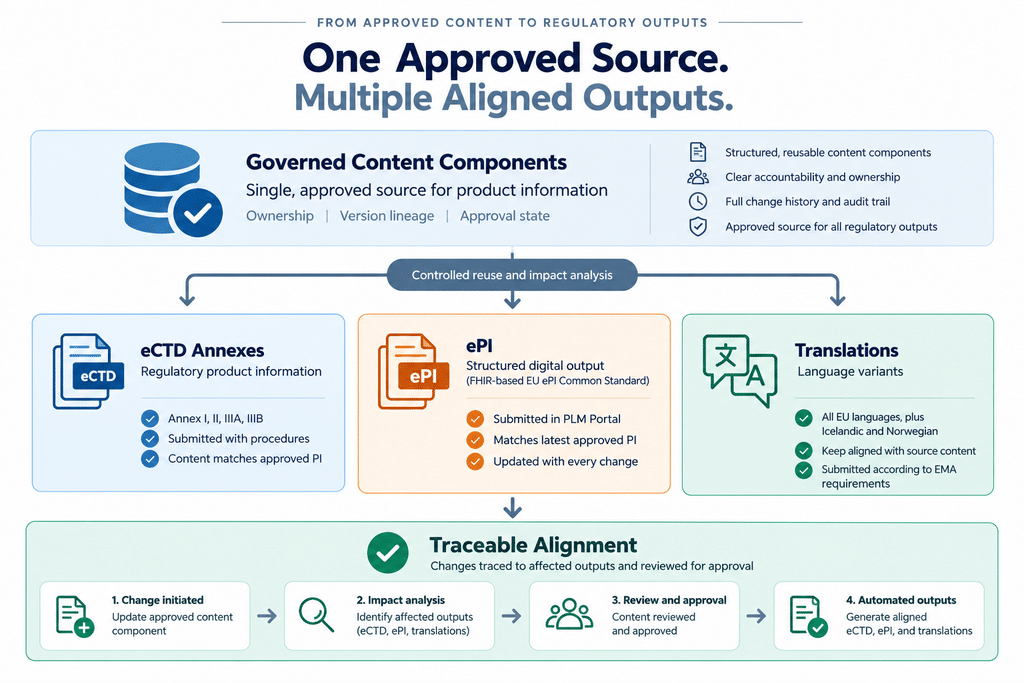
Docuvera starts at that layer. Product information is authored as governed components, each carrying explicit ownership, version lineage, and approval state. One approved component can then serve the eCTD annex, the ePI, and every translation derived from it. In documented customer deployments, Docuvera reports reuse of up to 80% of labeling content across CCDS, SmPC, USPI, and ePI outputs. When a variation changes a component, the platform identifies each place that component is in force. An alignment obligation becomes controlled change propagation, with impact analysis showing every affected rendering. Status and provenance travel with the content, which is what makes the 15-working-day clocks auditable.
The intelligence question follows the same order. Docuvera’s Hierarchy of Intelligence™ places Retrieval Augmented Reuse (RARe) first, Retrieval Augmented Transformation (RAT) second, and Retrieval Augmented Generation (RAG) last. Reuse of an approved component is provable, because the component carries its own approval record. Generation is not provable on its own; it produces text a qualified reviewer must still assess and authorize. For ePI alignment, reuse is the operation that matters, and it is available only where content is already structured and governed.
The EMA ePI guidance asks labeling teams to guarantee that two published representations of the same product information never disagree. That guarantee depends on governance first. Structure is how it gets delivered. Teams that build it during the voluntary phase will meet the mandatory phase with the program already running.
For a fuller treatment of how structured authoring supports global ePI compliance, read Utilizing AI-Powered Structured Content Authoring for Global ePI Compliance. For the roadmap view of the same mandate, see When EMA Says Go: What the ePI Mandate Actually Requires From Your Content Operations.
Frequently Asked Questions
Sources
- EMA issues guidance on submitting ePI ahead of upcoming requirement – Regulatory Focus (RAPS), Ferdous Al-Faruque, 8 September 2026. Primary reporting on the 1 September guidance: scope limited to Annexes I, II, IIIA and IIIB; voluntary status; alignment obligation; submission timing table; three conditions for Submitted status; 15-working-day Deactivated clocks for withdrawal and negative opinion; transfer sequence.
- Guidance for applicants on how to submit ePI in centralised procedures (EMA/199350/2026) – European Medicines Agency (primary source document, PDF, first published 4 September 2026).
- Electronic product information (ePI) – European Medicines Agency, ePI overview and annex scope.
- Electronic product information (ePI) roadmap [DRAFT] – European Medicines Agency, first published 20 March 2026. Source for phased go-live of centrally authorized products from Q4 2026.
- Update on Electronic Product Information (ePI) – European Medicines Agency, Industry Stakeholder Platform presentation, 24 November 2022. Source for the FHIR-based EU ePI Common Standard.
- Reform of the EU pharmaceutical legislation – European Medicines Agency. Source for the 2028 applicability date of the new pharmaceutical legislation.
- Why Are Life Science Companies So Poorly Prepared For RIM’s Future? – Steve Gens, managing partner, Gens & Associates Inc., Pharmaceutical Online guest column, 11 May 2026. Source for the four-of-59 data accountability finding, the 93% versus 50% data quality confidence gap, and the no-correlation-with-vendor finding.
- 2025 Operational Excellence and World Class RIM Study – Gens & Associates Inc., underlying study (59 participating organizations).