Answer with Control. The impact of a variation should be visible before it is filed, not discovered after.
Post-approval change management begins with knowing what a CMC change touches before it is filed.
A manufacturing change feels finished the moment the science is settled and the wording is agreed. Finished, though, asks something more demanding: that the organization knows every dossier, submission, and market the change reaches. In most estates that knowledge is the part still missing when the change is already drafted.
Ask a CMC lead what a proposed change affects, and the honest answer is rarely quick. It requires an investigation. Which specifications the change touches. Which control strategies and stability claims depend on the affected statement. Which dossiers already contain it, in which markets, and which submissions in progress will need to reflect it. Until that investigation is done, the safe move is to widen the review, and widening the review delays the filing.
That investigation is the tell. The change itself may be scientifically settled. The content work of establishing what it touches is where the time goes, and it happens after the change is already drafted, which is the most expensive moment to discover a dependency nobody accounted for. In most estates, that knowledge has to be assembled by hand, every time.
In post-approval change management, this is the change-impact problem: the science may be settled while the regulatory and content reach remains unresolved.
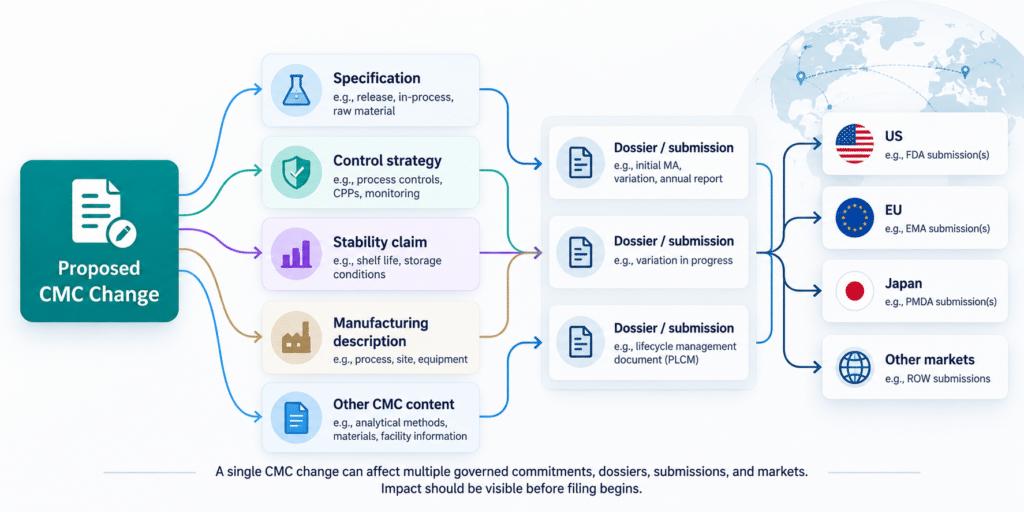
Why CMC change impact analysis comes late
The lateness is built into how CMC content is stored. When an approved statement is text copied into a dossier rather than a governed commitment in its own right, its dependencies are not known to any system. The specification language that appears in Module 3, in a variation, and in three markets’ filings is not one governed thing with known uses. It is several copies, related only by memory and manual cross-reference.
So when a change lands, the work becomes forensic. Teams search for the paragraph used last time, uncover variants that drifted apart, reconcile the differences by hand, and expand review scope defensively because they cannot prove downstream impact with confidence. Structure alone does not fix this and can make it worse. Modularizing narratives raises throughput, throughput accelerates reuse, and reuse without relocated authority spreads the same uncertainty faster. The repository grows while confidence in reuse quietly falls.
The scale of global post-approval change management magnifies the problem. A 2024 industry analysis examined 146,550 prior-approval changes across 156 countries using data from 18 global pharmaceutical companies over 2019–2021.[7]
Regulators have made the stakes of this explicit. ICH Q12, the guideline on technical and regulatory considerations for pharmaceutical product lifecycle management, reached Step 4 on 20 November 2019.[2] FDA issued its final Q12 guidance in May 2021, while the EMA first published its Step 5 guideline in March 2020.[1][3] It introduces Established Conditions, legally binding information considered necessary to assure product quality; a change to an Established Condition requires a regulatory submission.[1][2] It also introduces the Product Lifecycle Management document, which provides a central repository for Established Conditions and their reporting categories and can include Post-Approval Change Management Protocols and post-approval CMC commitments.[2]
The EU framework has also moved forward. The revised Variations Guidelines apply from 15 January 2026.[4] EMA’s revised guidance on Post-Approval Change Management Protocols, or PACMPs, became legally effective on the same date, and its guidance on the Product Lifecycle Management document is also effective from 15 January 2026.[5][6] These tools now sit within the current EU framework for planning and managing post-authorisation change.
Read that intent plainly. The regulatory direction rewards organizations that can identify, in advance, which statements carry binding commitments and what a change to them affects. A document-first estate cannot feed that discipline, because it cannot see its own dependencies until someone goes looking. The framework asks for foresight. The content model can only offer reconstruction.
The answer to what a change touches should already exist when the question is asked. Explore Answer.
What control actually requires
Control means the question “what does this change touch” returns an answer from the system, before the change is filed. That requires authority to sit with the statement rather than the document that carried it.
A governed CMC commitment is owned and bounded in its own right. It carries the validity conditions that say where and when it applies. Its reuse relationships are known, so the system holds a live map of every dossier, submission, product, and market where the statement is in force. When a change to that commitment is proposed, its downstream reach is computed rather than investigated. Impact analysis becomes a property of the system, with review effort concentrated on what actually changed and the dependencies it carries.
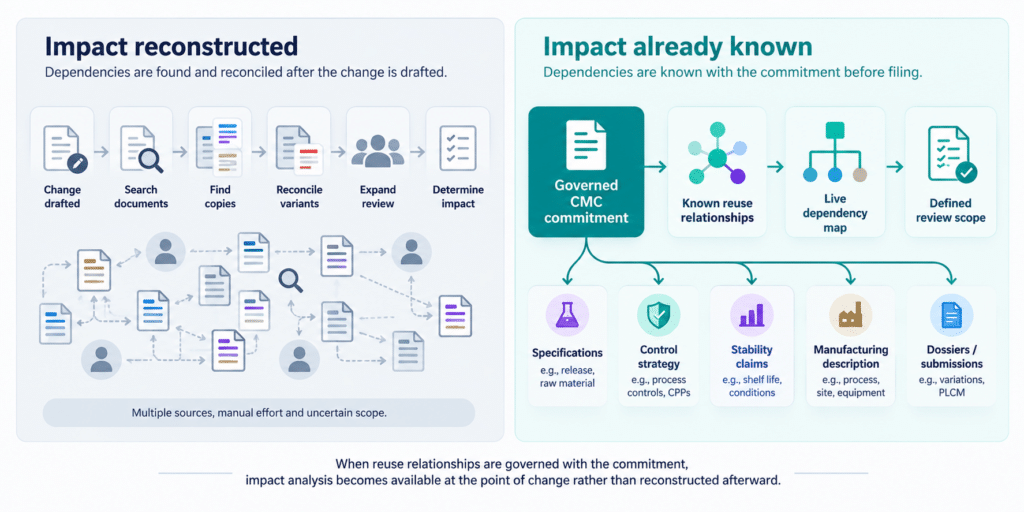
The difference is between assessing impact and absorbing it. An organization that can see a change’s full reach before filing decides deliberately what moves and what holds. An organization that discovers reach afterward absorbs the consequences: expanded scope, extended cycles, and the risk of a commitment left incoherent in a market no one remembered to check.
Impact, known in advance
This is what a governance-first approach to CMC content is built to provide. A governed CMC commitment is owned and bounded in its own right, with its reuse relationships recorded as it is built. A proposed change draws its own reach, every dossier, submission, product, and market where the commitment is in force, so impact is computed rather than investigated.
Resting on the governance layer, that turns impact analysis into system behavior and lets variation review focus on change rather than reconstruction. A companion Docuvera CMC white paper develops the argument in depth, including why relocating authority to the reusable statement is an architectural choice rather than a maturity milestone. AI earns its place in the impact step by enumerating what a change reaches across the governed set for human review and decision.
When the CMC lead is asked what a change affects, there is no investigation to run. The reach is already mapped, and the decision is made with it in view. Control is seeing what moves before you move it.
Answer with Control and see how governed CMC content makes downstream impact visible before the change moves forward.
Frequently Asked Questions
Sources
1. European Medicines Agency. “ICH guideline Q12 on technical and regulatory considerations for pharmaceutical product lifecycle management, Step 5.” Established Conditions and the Product Lifecycle Management document.
2. International Council for Harmonisation. “ICH Q12: Technical and Regulatory Considerations for Pharmaceutical Product Lifecycle Management.” Final version adopted 20 November 2019.
3. U.S. Food and Drug Administration. “Q12 Technical and Regulatory Considerations for Pharmaceutical Product Lifecycle Management Guidance for Industry.” Final guidance, May 2021.
4. European Medicines Agency. “Guidance on the application of the revised variations framework.” Revised Variations Guidelines applicable from 15 January 2026.
5. European Medicines Agency. “Questions and answers on post approval change management protocols (PACMP) — Revision 1.” Legal effective date 15 January 2026.
6. European Medicines Agency. “Questions and answers on the use of Product Lifecycle Management (PLCM) document.” Legal effective date 15 January 2026.
7. Vinther A, Ramnarine E, Gastineau T, et al. “Approaches to Design an Efficient, Predictable Global Post-approval Change Management System that Facilitates Continual Improvement and Drug Product Availability.” Therapeutic Innovation & Regulatory Science. 2024;58:433–442.