FDA’s PQ/CMC FHIR implementation guide now defines Module 3 section by section.
CMC teams that author quality content as governed data will meet each new stage without another conversion pass.
Module 3 has been the last stronghold of narrative in the common technical document (CTD). Specifications, batch formulas, and impurity profiles are data by nature, and CMC teams have spent decades writing them out as sentences and tables inside documents. FDA’s Pharmaceutical Quality/Chemistry, Manufacturing and Controls program is methodically ending that arrangement, one CTD section at a time, by defining structured CMC data standards exchanged through HL7 FHIR.
What FDA’s PQ/CMC Program Covers
FDA’s PQ/CMC pages state the scope plainly. The program develops structured data standards for ICH CTD Modules 2.3 and 3, where that content is amenable to structuring. The agency publishes draft data elements and controlled terminology through Federal Register notices. It began with the 2017 notice on PQ/CMC data elements and terminology, then added draft mappings to HL7 FHIR in a March 2022 notice. A May 2023 notice established an open docket, and FDA now targets quarterly postings to that docket, adding new chapters when content is ready.
The PQ/CMC FHIR Implementation Guide Is Already Specific
The output of that work is an implementation guide, and it is more concrete than the phrase suggests. The HL7 FHIR implementation guide for PQ/CMC submissions to FDA is published at version 2.0.0, a standard for trial use bound to FHIR R5. The HL7 Biomedical Research and Regulation work group develops it with FDA funding.
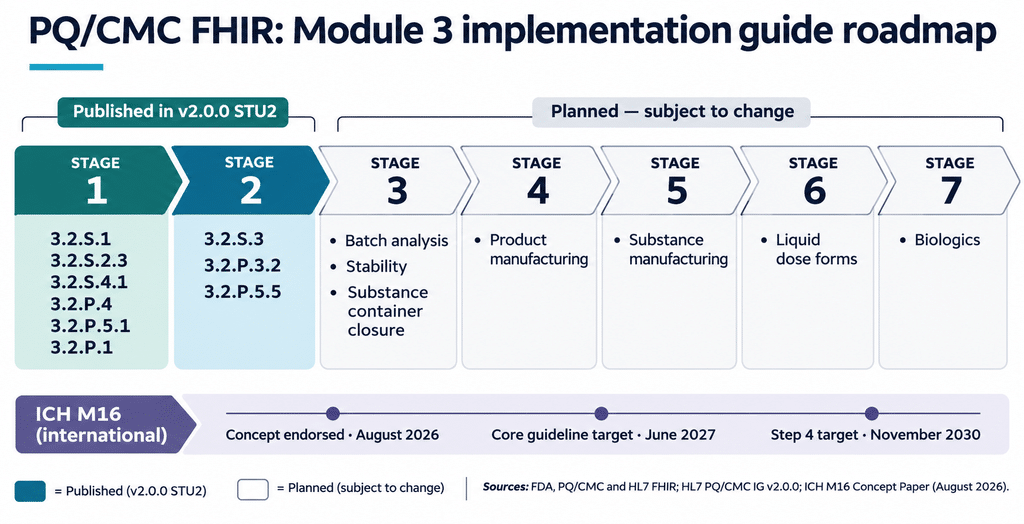
It profiles content by CTD section. Stage 1 covers general information at 3.2.S.1, control of materials at 3.2.S.2.3, and description and composition of the drug product at 3.2.P.1. Stage 1 specifications span 3.2.S.4.1, 3.2.P.4, and 3.2.P.5.1. Stage 2 adds substance characterisation at 3.2.S.3, product batch formula at 3.2.P.3.2, and characterisation of impurities at 3.2.P.5.5. The current editions are limited to solid oral dosage forms, with liquids and large molecules identified as future work. FDA’s published roadmap names what comes next: Stage 3 adds batch analysis, stability, and substance container closure, Stages 4 and 5 add product and substance manufacturing, and later stages extend support to liquid dose forms and biologics. FDA notes that the later stages are subject to change.
Two constraints in the guide matter for planning. The profiles are aligned for use within eCTD version 4.0 or later and may not fit eCTD version 3 headings. And the guide states that when FDA formally announces it, the versions FDA specifies will define the instructions for preparing FHIR-based PQ/CMC data. That announcement has not been made. Use is not mandatory today, and nobody should plan as though a deadline exists that FDA has not set.
What does exist is a published, section-by-section definition of how the agency wants quality content represented. The direction of travel is not ambiguous, and the sections already profiled are the ones every application contains.
The same direction now has an international track. In August 2026, the ICH Management Committee endorsed the concept paper for ICH M16, Structured Product Quality Submissions, which will define harmonised standards for structured quality information in Modules 2.3 and 3 under the M4Q(R2) framework. Its planned annexes draw on existing standards, including ISO IDMP and HL7 FHIR, with the core guideline targeted for June 2027 and Step 4 adoption for November 2030. For companies filing in both the US and EU, that makes structured CMC data a cross-regional planning question.
Converting Narrative Into Structured CMC Data
Most CMC organizations will meet this by conversion. The quality dossier gets written the way it has always been written, and a downstream team reads the finished narrative and populates the structured instance. Each new stage adds another extraction pass over another set of sections.
That model has a specific weakness, and the weakness is authority. A specification limit can exist as a sentence in a document and again as a value in a data instance. The organization then holds two candidate answers and no structural rule about which one governs. Change control has to police both. A post-approval change to a release specification touches the document, the instance, the internal quality records, and every derived summary in Module 2.3. The narrative and the data drift in the interval between them, and the drift is invisible until someone compares them. The ICH M16 concept paper names this problem directly, citing multiple formats for the same quality information as a source of inconsistency and duplicated effort.
CMC content is also where a mismatch costs the most. The values in Module 3 are commitments about how a product is made and tested. An inconsistency there becomes a discrepancy in what the applicant has committed to, discovered by a reviewer with a query tool.
Author Once, Render Twice
The alternative is to make the structured value the authoritative object and the narrative a rendition of it. A specification limit is entered once, with its unit, its test method reference, its controlled term, and its approval state. The Module 3 section renders from that object. The FHIR instance serializes from the same object. Module 2.3 summaries reference it rather than restate it. There is one answer, and both outputs are views of it. ICH M16’s planned core guideline covers the same mechanics, including requirements for rendering structured quality information into human-readable form.
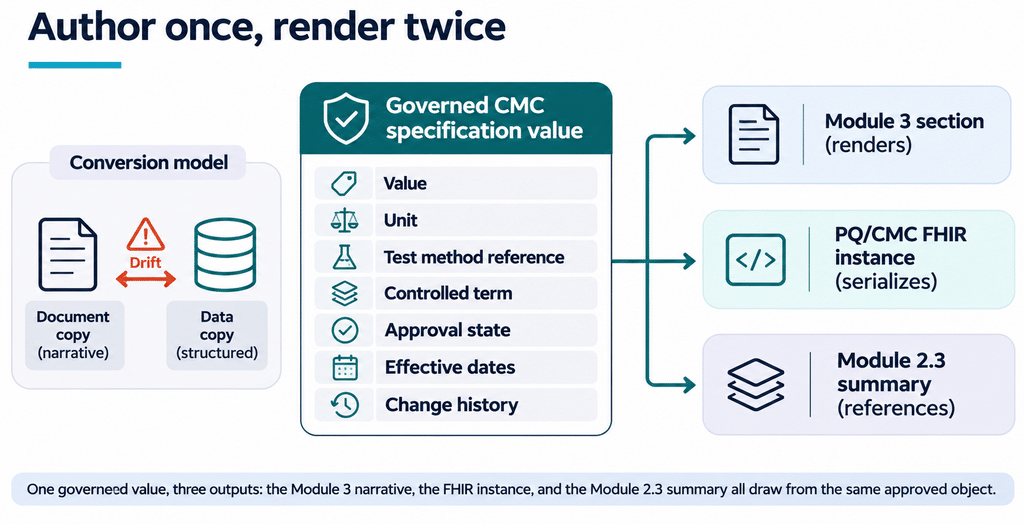
This is the argument Docuvera has been making about quality content specifically. Governance comes first. Every value carries its own approval state, effective dates, and change history, enforced at the component level rather than assigned by the containing document. Structure is the mechanism that makes the value reusable across sections, products, and submission formats. Intelligence follows from both, because a governed structured estate is queryable in a way a folder of documents is not.
Where AI enters, it stays subordinate to that hierarchy. Under the Hierarchy of Intelligence™, Retrieval-Augmented Reuse leads: the system finds the approved value that already exists and is cleared for this context. Retrieval-Augmented Transformation renders or adapts it into the required output. Generation comes last and stays under human authorization, because a quality reviewer is accountable for what the dossier commits to. AI supports provability in CMC, and the quality judgment behind a specification stays with the people accountable for it.
The teams that start authoring Module 3 content as governed data will publish into each new stage as FDA releases it. The teams that keep authoring prose will convert, repeatedly, and carry two versions of the truth while they do.
Docuvera’s white paper on governed structured content for CMC examines how regulators evaluate change, why variations break, and where organizations stall without structural control.
Frequently Asked Questions
Sources
- PQ/CMC Federal Register Notices — U.S. Food and Drug Administration
- PQ/CMC and HL7 FHIR — U.S. Food and Drug Administration
- Pharmaceutical Quality/Chemistry, Manufacturing and Controls (PQ-CMC) Submissions to FDA, v2.0.0 STU2 — HL7 International, Biomedical Research and Regulation work group
- HL7 FHIR Implementation Guide: PQ/CMC Submissions to FDA, Edition 2 (product brief) — HL7 International
- PQ/CMC Data Elements and Controlled Terminology, 2017 Federal Register notice — U.S. Food and Drug Administration
- Federal Register notice establishing the PQ/CMC open docket, 1 May 2023 — U.S. Food and Drug Administration
- ICH M16 Structured Product Quality Submissions, Final Concept Paper, 18 August 2026 — ICH
- ICH M4Q(R2) Guideline on the Common Technical Document: Quality, Step 2b — European Medicines Agency
- Substance, Product, Organisation and Referential (SPOR) Master Data — European Medicines Agency
- Electronic Common Technical Document (eCTD) v4.0 — U.S. Food and Drug Administration
- Governed Structured Content for CMC (white paper) — Docuvera