
CMC structured authoring improves reuse. Statement-level governance controls change
A CMC regulatory affairs director, eighteen months into a modularization initiative, sits with the cycle-time data. Reuse rates are up, yet Type II variation submissions are not moving faster. The saved authoring hours did not vanish. Review absorbed them, and its scope widened. Reviewers do not trust that a component pulled from the library is current and valid for the variation in front of them. Reuse and trust are not the same measure. Reuse counts authoring throughput. Trust asks whether a reused statement holds in the new context. So reviewers re-establish validity themselves, every time. Writers spend the opening hours of each variation hunting for the right version of a reused statement. The library holds several versions of the same content, and nothing structural says which one governs.
The CMC structured authoring initiative did not fail. It revealed a limit. Structure alone cannot close the governance gap, and the gap is where CMC lifecycle work actually lives. That is a different problem than the one the initiative set out to solve, and it calls for a different solution.
What CMC structured authoring delivers, and where it stops
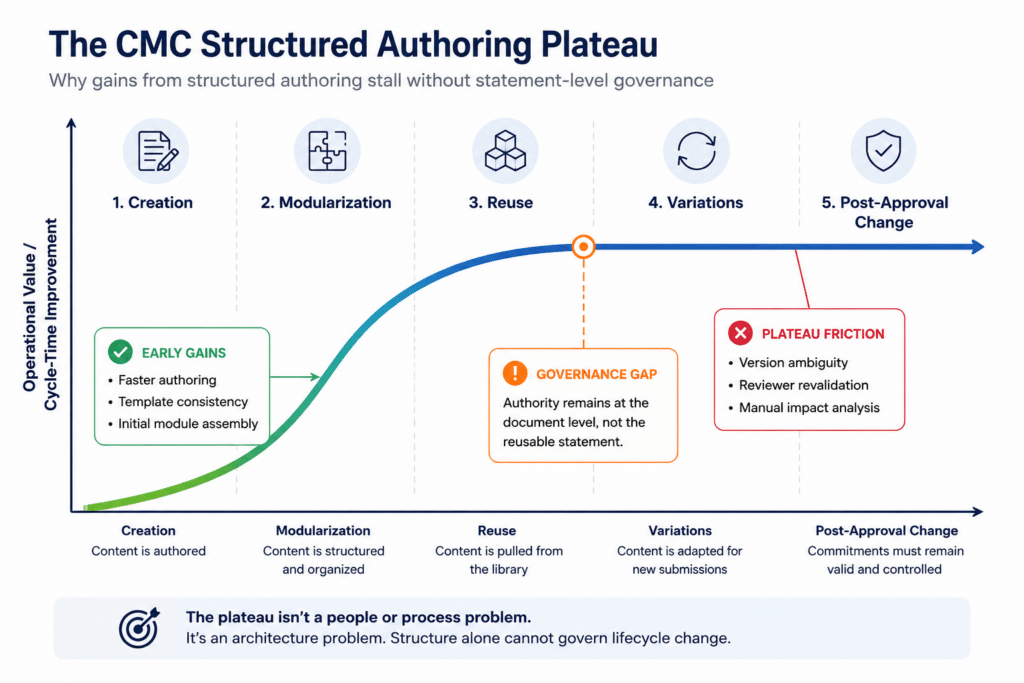
Most CMC structured authoring initiatives deliver real value at the creation stage. They cut blank-page authoring time. They improve consistency through templating. They build a content library that speeds initial module assembly. Those gains are genuine, and teams are right to bank them.
The plateau arrives when the initiative meets the CMC lifecycle. Variation work, post-approval CMC changes, and the standing need to show that a reused statement remains valid in a new context do not respond to faster authoring. Cycle times for variations flatten. Reviewer confidence in reused content does not climb with reuse rates. It often moves the other way.
ICH Q12 frames post-approval CMC change management as a lifecycle-management problem, with the objective of making such changes more predictable and efficient.
The mechanics are specific. Modularization without statement-level governance produces a library of content objects that look controlled but are not. Each variation context generates a slightly adapted version of the same underlying statement. Over time the library accumulates several versions of one piece of knowledge, with no structural way to assert which version governs in a given submission. The “right version” question becomes the dominant friction point in variation work.
This produces a quiet paradox. The more content the team reuses, the more versions accumulate. The more versions accumulate, the harder it becomes to say which one is authoritative. Reuse was supposed to compound confidence. Instead it compounds uncertainty.
None of this is evidence of poor execution. Organizations that hit this plateau did the work correctly. They reached the limit of what structure without governance can deliver, which is a property of the architecture, not the team.
The mechanics of the CMC content governance gap
The governance gap has a precise definition. It is the absence of statement-level authority, the failure to move governance from the assembled document to the reusable statement. Without that move, structure raises throughput without raising trustworthiness. Review scope then expands defensively, because reviewers cannot rely on the system to tell them what is valid. They must re-establish validity by hand, each time a component is used. Three failure modes follow directly.
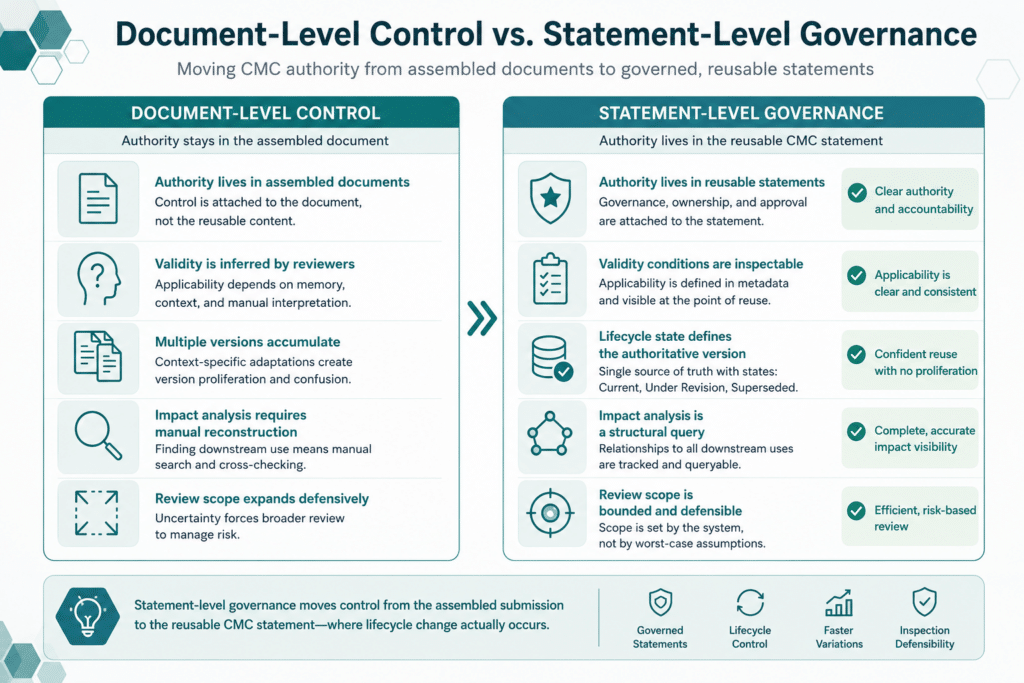
Failure mode 1: Validity ambiguity at reuse. A CMC statement describing a process step may be valid only for a defined site, scale, equipment configuration, control strategy, or established condition. In a document-based or lightly structured environment, those constraints live in the memory of the last reviewer, not in the metadata of the statement. Pull that statement for a variation involving a different site or scale, and the reviewer has to re-establish whether it applies. The science is not unclear. The governance record simply does not carry the conditions. This is a content architecture problem wearing the costume of a content quality problem.
ICH Q12 uses lifecycle-management concepts such as established conditions and post-approval change management to define how CMC commitments should remain controlled under change. FDA training material on ICH Q12 implementation also notes that established conditions can be proposed at different points in the lifecycle, including original applications and post-approval supplements.
Failure mode 2: Version proliferation without resolution. As variations produce context-specific adaptations of shared statements, the library fills with multiple versions of the same knowledge. With no mechanism to identify which version is authoritative in a given context, the library becomes a source of doubt rather than confidence. Writers respond rationally. They re-author from scratch, because a freshly written statement carries a clear authorship and review chain, which the library cannot reliably supply.
Failure mode 3: Impact analysis by reconstruction. When a specification, an established condition, a control strategy statement, or a manufacturing description changes, finding every downstream use means a manual search. In a lightly structured environment, that search is incomplete by design. The library does not hold the relationships between statements and the submissions that reference them. Review scope expands to cover what the system cannot identify, because the organization cannot afford to miss an affected use. The expansion is not waste. It is a rational hedge against an architecture that cannot perform structural impact analysis.
A CMC content architecture problem, not a maturity problem
The plateau is usually misdiagnosed as a maturity issue. The team needs more training. The content model needs more refinement. The governance process needs firmer enforcement. Each diagnosis points inward, at the people and the discipline. Each is wrong. The plateau was set at the outset, by a single architectural choice. Structure was treated as a productivity enhancement, not as a redesign of where control resides.
The distinction matters. Productivity-oriented structure reduces authoring time and improves document consistency. Control-system structure does something else. It relocates authority from the assembled document to the governed statement, with validity conditions, ownership, and change propagation built into the content itself.
For CMC, the distinction is decisive, because CMC content is evaluated twice. It is evaluated at initial submission, and again at every post-approval change. The second evaluation is the harder one. It tests whether commitments stay coherent under change, not whether they read well at creation. Document-centric approaches pass the first evaluation through rigorous authoring and review. They fail the second structurally, because authority stays attached to assembled artifacts rather than to governed statements. Post-approval change management, the domain of ICH Q12’s pharmaceutical product lifecycle management framework, is exactly where that failure shows.
The gap also scales in a particular way. At low variation frequency and small portfolio size, it stays hidden. Heroics, institutional memory, and informal cross-checking absorb it. As the portfolio grows and variations multiply, those compensations fail, and the gap surfaces as the plateau.
So the line between a content architecture that can sustain the CMC lifecycle and one that cannot is not the sophistication of the component model. It is whether approval, ownership, and change authority attach to the reusable statement itself. The same logic drives how CMC content architecture determines regulatory control. That is a governance question, not a structure question.
What statement-level governance changes in CMC variation management
Relocate governance to the reusable statement, and the mechanics of CMC variation management change. Encode validity conditions, ownership, and change authority at the component level, rather than inferring them from the assembled document. The most important shift is not speed. It is boundedness. Review scope becomes defined by what the governance system flags as impacted, rather than by what reviewers can reconstruct from first principles. That same logic is consistent with the industry movement toward structured CMC data: information must be identifiable, comparable, and traceable before it can support lifecycle-aware regulatory review. FDA’s PQ/CMC initiative is tied to structured CMC elements and HL7 FHIR, and the HL7 PQ-CMC implementation guide describes structured and standardized information for FDA submissions. A bounded review is a defensible review. Three operational changes follow, each answering one of the three failure modes above.
Change 1: Validity becomes inspectable, not inferred. A statement can carry explicit validity conditions in its metadata: valid for Site A, small scale, a named stability dataset, a defined development stage. Those conditions are visible to writer and reviewer at the point of reuse. Whether the statement applies in the current variation is answered by the governance record, not by recollection or narrative context. Review effort shifts from re-establishing validity to confirming it.
Change 2: Version authority becomes structural. When each reusable statement has a single authoritative version with explicit lifecycle state, current, under revision, or superseded, the library turns into a source of confidence. Writers pull the current authoritative version, and the governance record confirms it. Proliferation stops accumulating, because adaptation now produces a governed variant with an explicit relationship to its source, not an independent copy.
Change 3: Impact analysis becomes a system function. When the governance layer holds the relationships between statements and every submission that references them, impact analysis at a variation event is a structural query. Enumerate every downstream use of the statement. Confirm which uses the proposed change affects. Trigger review at the appropriate level for each. Scope is set by the system, not inflated to compensate for what the system cannot see.
This is the work a governance-first structured content authoring platform built specifically for regulated pharma content is meant to do. Docuvera treats each reusable CMC statement as a controlled object, with enforceable validity conditions, explicit ownership, lifecycle state, and a traceable change history. Docuvera’s CMC documentation solution is designed for governed, modular content across initial filings, variation updates, and post-approval change management. That is the architectural foundation that converts modularization from a productivity initiative into a control system, which is the thing the lifecycle actually requires.
Frequently Asked Questions
Further reading: Governed Structured Content for CMC, the companion white paper on how regulators evaluate post-approval CMC changes and why variations break without structural control.
Sources
- U.S. Food and Drug Administration Pharmaceutical Quality – Chemistry, Manufacturing & Controls (PQ/CMC).
- U.S. Food and Drug Administration PQ/CMC and HL7 FHIR
- HL7 International Pharmaceutical Quality – Chemistry, Manufacturing and Controls (PQ-CMC) Submissions to FDA
- International Council for Harmonisation ICH Q12: Technical and Regulatory Considerations for Pharmaceutical Product Lifecycle Management
- European Medicines Agency ICH Q12 Technical and Regulatory Considerations for Pharmaceutical Product Lifecycle Management
- U.S. Food and Drug Administration Q12 Technical and Regulatory Considerations for Pharmaceutical Product Lifecycle Management Guidance
- U.S. Food and Drug Administration Knowledge-aided Assessment & Structured Application (KASA): A New Approach that Modernizes FDA’s Quality Assessment of Regulatory Drug Applications
- Docuvera Governed Structured Content for CMC
- Docuvera. PQ-CMC and the Leadership Imperative: Why CMC Content Governance Is Now a Board-Level Risk Decision
- Docuvera Module 3 Insights: CMC Content Architecture & Regulation
- Docuvera CMC Documentation Software for Regulatory Submission Management