

Why ePI Implementation Challenges Are Increasing
ePI is inevitable. Most pharma organizations have accepted that ePI is not optional. According to the European Medicines Agency’s electronic product information initiative, electronic product information is intended to improve access to up-to-date medicinal product information through structured digital formats.
In Europe, implementation efforts are increasingly aligned around the EU ePI Common Standard, a framework that uses HL7 FHIR to support structured, machine-readable medicinal product information.
Yet acceptance and execution are different. Most companies attempting ePI implementation have encountered obstacles that were not obvious in planning.
Many of these obstacles emerge when organizations move from document-centric labeling processes to structured content models required for modern ePI initiatives.
Legacy content systems resist migration. Metadata standards create confusion. Authors resist new workflows. Technical complexity compounds at scale. Multi-market coordination becomes difficult.
These challenges are not unique, and they are not insurmountable. But they require specific, practical solutions. Most organizations address them through ad hoc workarounds, which prolong timelines and increases costs.
This post identifies common ePI implementation challenges and outlines practical approaches to address each one.
While the challenges themselves are often similar across organizations, readiness levels can vary significantly. Some organizations are just beginning their ePI journey, while others are preparing for implementation at scale. Our ePI Readiness Assessment can help identify where your organization stands today and highlight areas that may require additional planning.
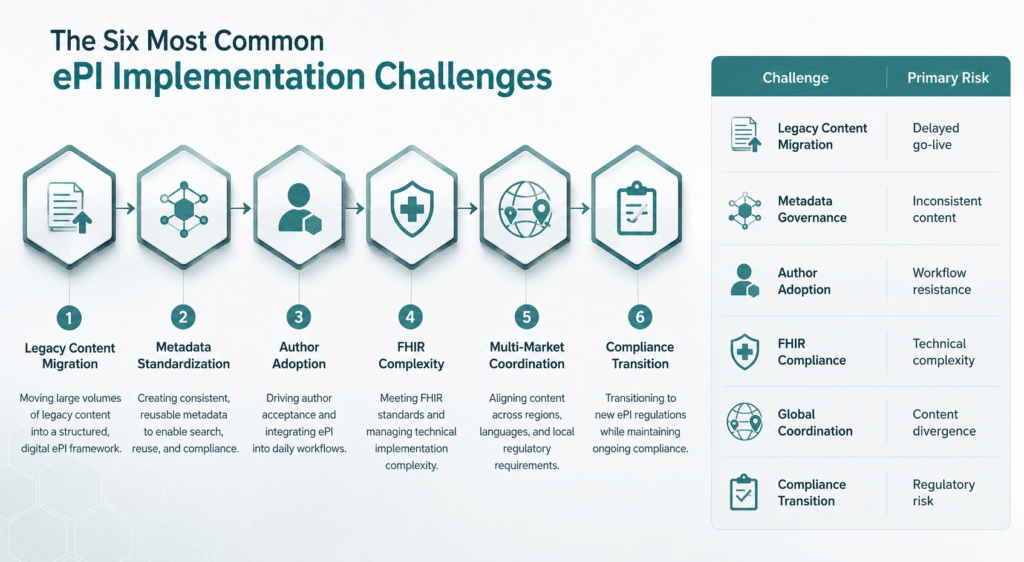
Challenge 1: Legacy Content Migration and Structured Content Readiness
Most pharma organizations have accumulated decades of labeling content across multiple systems. Word documents. InDesign files. Poorly structured databases. Spreadsheets. Legacy labeling management platforms.
ePI requires structured, machine-readable content. Converting hundreds or thousands of documents from unstructured formats into standardized data structures is not simple export.
For many organizations, the transition exposes years of inconsistent content architecture, taxonomy decisions, and metadata practices that remained hidden inside document-based workflows. Regulatory frameworks such as the EU ePI Common Standard rely on structured content models that can be validated, exchanged, and rendered consistently across systems.
The practical solution begins with content discovery. Audit what you have. Identify which content is current, obsolete, or requires revision. Many organizations discover that 20 to 30 percent of archived content is unused.
For content that will migrate, establish a triage process. Identify critical, must-migrate content first. Map unstructured content into standardized metadata and element categories. Plan for automated conversion where possible.
Organizations should also identify content that can be transformed into reusable structured content components rather than migrated as standalone documents.
Organizations that attempt to migrate and clean all legacy content simultaneously delay go-live. Instead, migrate the minimum viable set to launch ePI. Build processes to systematically migrate remaining content over time.
Challenge 2: Metadata Standardization and Governance
ePI requires consistent metadata across all content. Drug name, indication, dosage, formulation, route of administration, regulatory classification, and safety updates must be standardized.
Standardized metadata is foundational to ePI because content elements must be consistently identified, validated, exchanged, and rendered across regulatory systems. The HL7 ePI Implementation Guide emphasizes standardized data structures and metadata to support interoperability and content exchange.
Most legacy systems have loose or inconsistent metadata practices. Drug names vary. Safety information scatters across multiple locations. Regulatory classifications are implied but not explicit. This inconsistency created few problems in PDF-based workflows but becomes critical blockers in ePI.
The practical solution requires establishing a metadata governance framework before implementation. Define the metadata schema. Identify required and optional elements. Create naming conventions and standardized values for categorical fields.
Then conduct a metadata audit of existing content. Where is metadata missing or inconsistent? Create a remediation plan that prioritizes critical gaps.
Governance ownership should be clearly assigned so metadata standards remain consistent as new products, indications, and markets are introduced.
Involve stakeholders from regulatory affairs, quality, and clinical teams. Metadata governance is a business process problem with IT implications, not an IT problem alone.
Challenge 3: Author Resistance and Workflow Change
Content authors and regulatory specialists are accustomed to familiar tools. Word. Email. Spreadsheets. ePI implementation often requires moving authors into new platforms and enforcing standardized submission workflows.
This creates resistance. Authors perceive new workflows as slower and more complex. Early productivity dips.
The practical solution is to invest in change management. Involve authors early in platform selection. Run pilot programs with volunteers before organization-wide rollout. Provide hands-on training and continuous support.
Successful implementations typically establish internal champions who help reinforce new processes and provide peer-level guidance during adoption.
Most importantly, design workflows that actually improve authoring efficiency. Platforms that simply replicate old workflows in new tools create compliance without improvement. Platforms that automate metadata capture, enforce consistency, and reduce manual review demonstrate value and accelerate adoption.
Challenge 4: FHIR Technical Complexity and Interoperability Requirements
FHIR (Fast Healthcare Interoperability Resources) is an interoperability standard developed by HL7 for exchanging healthcare information electronically.
FHIR serves as the foundation for the EU ePI Common Standard and is designed to support interoperability across healthcare, regulatory, and digital health ecosystems.
ePI increasingly requires FHIR compliance. The EU ePI Common Standard is built on HL7 FHIR profiles that define how medicinal product information is structured and exchanged.
FHIR is not simple. The specification is technical. Most pharma organizations lack deep FHIR expertise.
This creates implementation risk when organizations attempt to interpret technical specifications without established governance or platform support.
The practical solution is to not build FHIR implementation from scratch. Work with partners and platforms that have solved FHIR implementation complexity. Establish clear implementation profiles defining which elements your organization will use.
Treat FHIR compliance as a platform concern, not an organization problem. The platform should handle FHIR structure, validation, and serialization. Authors should work in language they understand, with FHIR infrastructure operating invisibly.
Challenge 5: Multi-Market Coordination and Global Governance
Pharma organizations operate globally. The same drug sells in different markets with different regulatory requirements.
As ePI adoption expands globally, organizations must balance regional requirements while maintaining consistency across shared product information assets.
Local regulations may require local content variations.
ePI creates pressure to standardize globally while accommodating local requirements. Regulatory authorities continue to develop market-specific implementation approaches, making governance and content reuse critical for multinational pharmaceutical organizations. Different markets develop local variations. Maintaining consistency and traceability becomes difficult.
The practical solution requires a content architecture that supports a single source of truth with local variations. Establish a global master content source for universal content: drug name, active ingredients, mechanism of action, clinical data, and safety information.
Then enable local market variations for market-specific requirements: language, local regulatory statements, reimbursement information, and market-specific dosing or indications.
This requires clear governance rules defining what can vary locally and what must remain globally standardized.
Without these controls, organizations often create duplicate content variants that increase maintenance costs and compliance risk.
Challenge 6: Maintaining Compliance During Transition
ePI implementation happens while the organization continues to operate. Existing regulatory obligations don’t pause for migration.
The practical solution is a phased approach. Run legacy and ePI systems in parallel during transition. New products move to ePI. Existing products continue through legacy systems until migration completes.
Phased deployment models are commonly used in regulated system implementations because they reduce operational and compliance risk during transition periods.
This approach requires extra effort and cost short term but reduces risk. Organizations that attempt big-bang cutovers often experience compliance failures during transition.
Validation checkpoints should be established throughout the migration process to ensure structured content remains aligned with regulatory expectations and internal quality requirements.
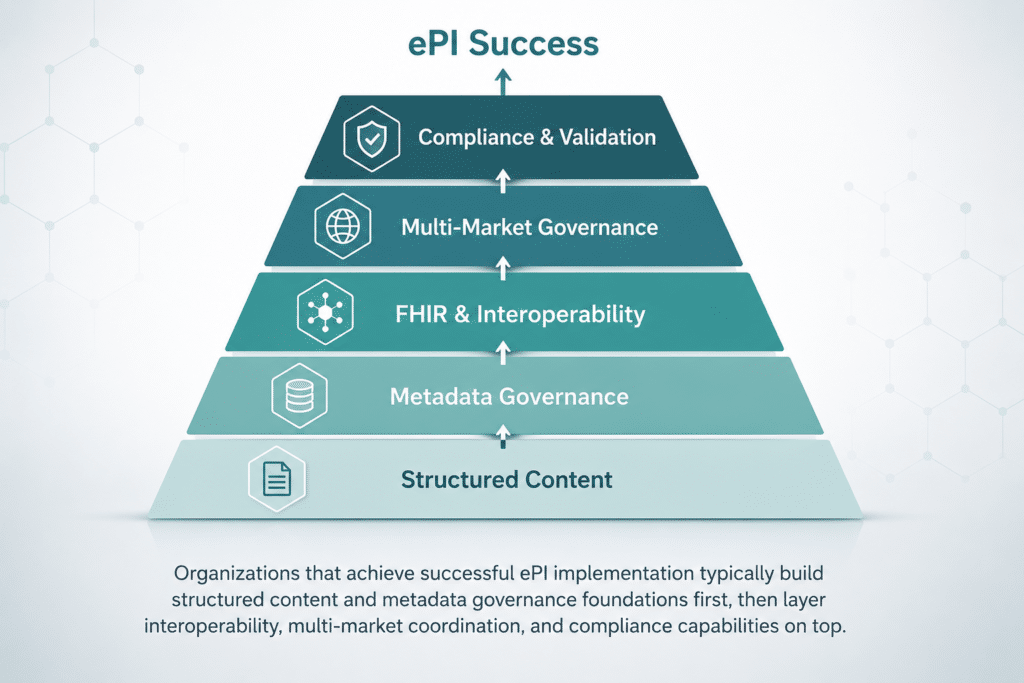
How Prepared Is Your Organization for ePI?
Understanding the challenges is one thing. Determining how prepared your organization is to address them is another.
Take Docuvera’s ePI Readiness Assessment to evaluate your organization’s readiness across content governance, metadata management, structured content maturity, interoperability requirements, and implementation planning.