

How pharmaceutical teams manage CCDS vs local labels while maintaining compliance, traceability, and governance
A Real World Scenario
A multinational pharmaceutical company manufactures a cardiovascular drug approved in the United States, the European Union, Japan, and Australia. The Company Core Data Sheet (CCDS) defines the authoritative labeling language: indications, dosage, contraindications, adverse reactions, and all safety statements.
But the label in Japan cannot match the CCDS exactly.
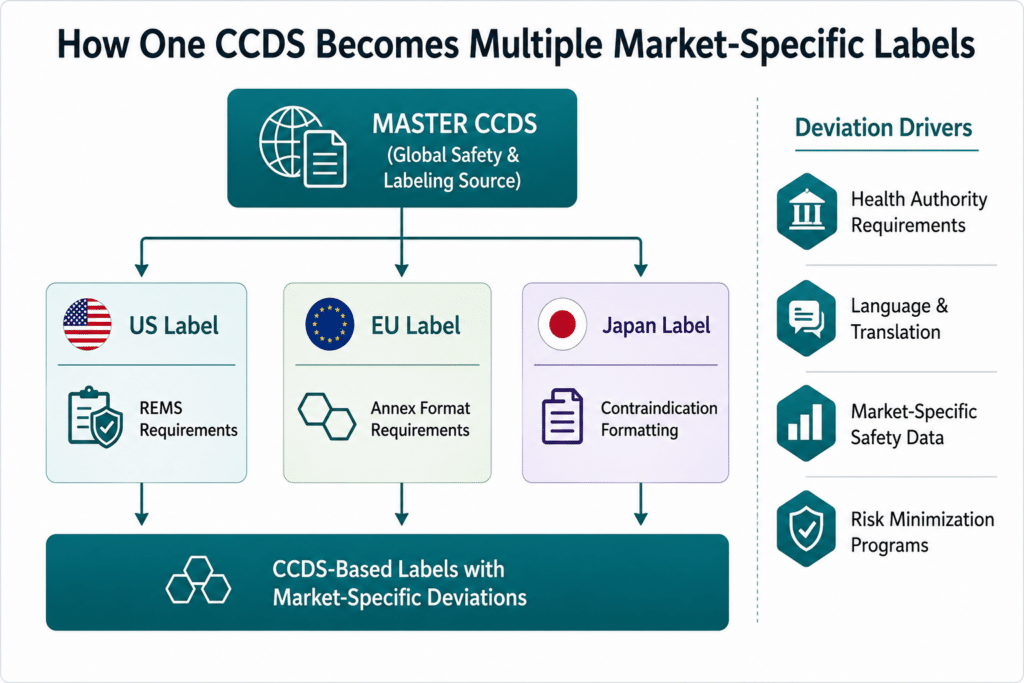
The Japanese health authority may require contraindications to be presented differently. The EU may require specific product information formats through the European Medicines Agency product information requirements. Health Canada applies its own Product Monograph Guidance. Additional safety controls such as Risk Evaluation and Mitigation Strategies (REMS) may also create market-specific labeling requirements.
The CCDS is a reference standard, not a template that produces identical labels across markets.
In many organizations, these market-specific labels are maintained as Local Product Documents (LPDs), creating an ongoing CCDS-to-LPD alignment challenge whenever global labeling content changes. Managing the relationship between the CCDS and its market-specific variants is a governance challenge that most companies address through manual tracking, spreadsheets, and institutional memory. The result is a fragmented, high-risk labeling ecosystem.
The compliance risk is real. Untracked deviations create liability. A deviation that is well-reasoned and documented is compliance. A deviation that is undocumented or lost across market teams is a regulatory violation. Companies that cannot articulate why a local label diverges from the CCDS face inspection findings. Worse, they cannot reliably update all market-specific labels when the CCDS changes.
Why Deviations Occur
CCDS deviations are not failures. They are often necessary and justified. But understanding the source of each deviation is critical to managing it.
Local health authority requirements are the most common driver of deviation. The EMA provides product information requirements for medicines marketed in the European Union. Health Canada maintains its Product Monograph framework. The FDA may impose REMS requirements for specific products. These are not errors or shortcuts. They are compliance requirements that supersede the CCDS template.
Language and translation form a second driver. Regulatory terminology may lack exact equivalents across languages. Local regulatory bodies may have preferred translation standards that diverge from literal CCDS translation. A market regulatory author must ensure compliance in the target language, even if this requires CCDS deviation.
Market-specific safety data is a third factor. A drug approved in Japan may have additional local clinical or post-market safety data informing local safety labeling. Population-specific evidence may justify deviations that better reflect the benefit-risk profile in a particular market.
Pharmacovigilance and risk minimization plans represent a fourth category. The EMA may require specific risk minimization language. The FDA may impose REMS requirements that create deviations. These are post-approval decisions that cannot always be reflected in the CCDS without triggering broader global changes.
Each of these deviation drivers is legitimate. But legitimate deviations create governance burden. A company with products in 10 markets may have 10 CCDS variants, each with multiple intentional deviations from the master. Tracking which deviations are intentional, which are due to market-specific requirements, and which are errors requires systematic governance. Without it, companies lose traceability.
Maintaining traceability between CCDS content and local labeling requirements has become a core component of modern pharmaceutical labeling governance programs.
CCDS Management Requires More Than Version Control
The Tracking Problem: Spreadsheets and Fragmentation
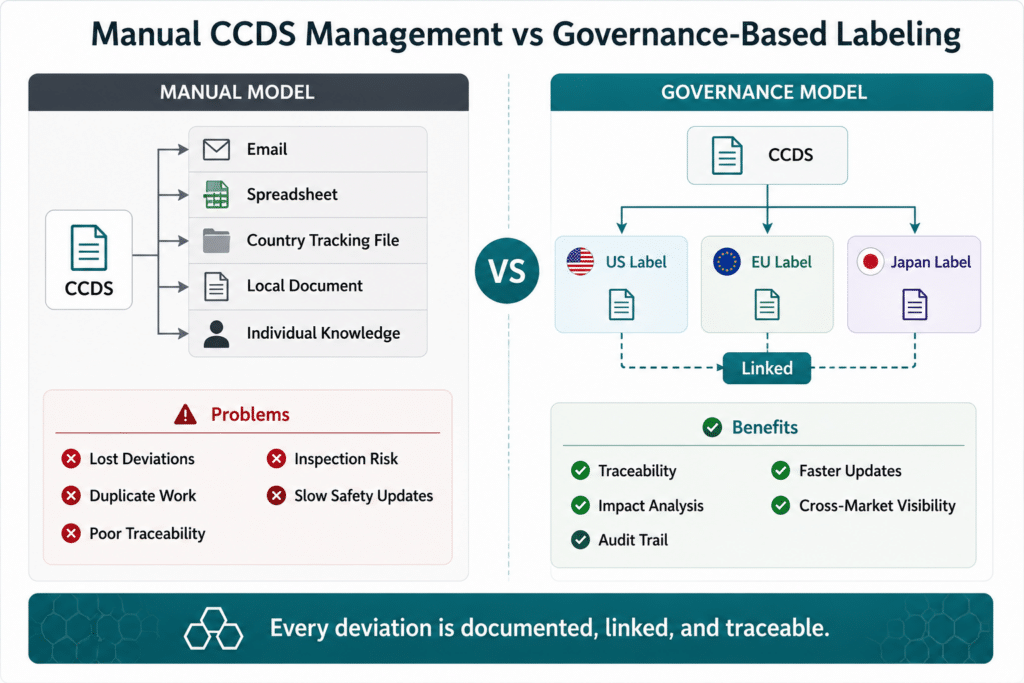
Most companies manage CCDS vs local labels deviations through variation tracking spreadsheets or email. When a CCDS is updated, a regulatory author notifies country teams: “Dosage changed. Update your local labels.” But if a market has a deviation in dosage (due to local regulatory requirements), the country team must decide whether the global change supersedes the local deviation or must be integrated.
Without a central system linking CCDS to local variants and documenting deviation reasons, integration work is fragmented. This lack of global labeling governance limits visibility into how global labeling changes affect local markets. Docuvera’s global labeling page emphasizes high variation, rapid updates, and full traceability across formats and stakeholders.
Teams may miss updates or accidentally overwrite intentional deviations when global changes are applied.
A regulatory inspection may identify CCDS deviations without clear documentation. The company cannot quickly produce evidence that deviations are intentional and compliant. When a critical global safety update is required, the company cannot reliably determine which local labels will be affected or which deviations must be preserved.
Large multinationals manage these challenges through regulatory expertise and institutional knowledge. But expertise is fragile, depending on key individuals. When regulatory authors leave, the knowledge of which deviations are required by regulation versus interpretation leaves with them.
Current State: The Manual Governance Model
Today’s best practice relies on manual tracking. A company maintains a CCDS in a regulatory document management system. Country teams maintain local label versions separately. When the CCDS is updated, country leads manually compare their local labels against the updated CCDS, identify which changes apply, integrate them, reapply deviations, and issue updated labels.
The process is labor-intensive and opaque. For a product in 15 markets, each CCDS update triggers 15 individual label updates requiring manual comparison. If a portfolio contains 30 products with 15 market variants each, and the CCDS updates four times per year, the organization manages approximately 1,800 label revisions annually.
Critically, this model creates organizational blind spots. Country leads are the sole authorities on what their local labels contain. Headquarters cannot identify patterns in deviations or determine whether inconsistency exists where consistency is possible.
As a result, organizations struggle to reuse proven deviation strategies across similar products, markets, and regulatory pathways.
When a new product launches, companies cannot easily reuse deviation patterns from similar products in similar markets. Without central visibility, these decisions are made in isolation.
The Compliance and Operational Risk
The manual governance model creates two distinct risks.
Compliance risk emerges when deviations are not documented or when deviations are lost during updates. A regulatory inspection of labeling documentation may reveal a CCDS deviation without clear evidence of why it exists. A regulator may conclude the deviation is non-compliant, even if it was intentional and justified. Additionally, when the CCDS is updated and changes are applied to local labels, an intentional deviation may be accidentally overwritten if the process is not carefully managed. The updated local label may now contain language that violates local regulatory requirements.
Operational risk emerges from the sheer complexity of managing hundreds of CCDS variants. When a critical safety update is required globally, the company must trace through multiple versions of a label to understand the impact. When a product is being prepared for a new market, the company cannot easily identify which deviations have been applied in similar markets and for what reasons. When regulatory personnel change, organizational knowledge about deviation patterns is lost.
The Solution: Linked, Governance-Based Management
The solution to the CCDS vs local labels challenge to treat the CCDS and each local label as linked components within a structured content governance system.
Rather than separate, unlinked documents, a governance platform provides:
- A master CCDS as the authoritative global source, with all changes versioned and tracked.
- Structured content management enables organizations to reuse approved CCDS content across markets while preserving documented local deviations where required.
- Local label instances explicitly linked to the CCDS, making visible which sections are identical and which deviate.
- A documented reason for each deviation. When a local label diverges, the system requires documentation: local regulatory requirement, language/terminology needs, additional safety data, or local risk minimization plans.
- Automated impact analysis. When the CCDS is updated, the system identifies affected local labels, highlights CCDS-to-local label conflicts, and flags deviations requiring manual regulatory review.
- A clear audit trail. Every version of every local label is tracked with deviation documentation and the CCDS version it was based on. An inspector can see exactly why each label diverged and when.
- Cross-market visibility. The system provides summary views of deviation patterns across the portfolio, enabling companies to identify standardization opportunities, improve labeling governance, and build regulatory guidance from lessons learned.
This governance-based approach transforms deviations from a tracking problem into a managed process. Instead of relying on spreadsheets, email, and institutional memory, organizations gain traceability, consistency, and confidence in how local labels evolve alongside the CCDS.
Conclusion
CCDS deviations are a permanent feature of global pharmaceutical labeling. The question is not whether deviations will occur, but whether they will be managed with governance and traceability or left fragmented across spreadsheets and email.
The compliance and operational stakes are substantial. The solution is a structured content platform that links CCDS to local variants, documents the reason for each deviation, and provides visibility into deviation patterns across the portfolio.
Companies that embed this linked, governance-based approach into their labeling operations will find that global labeling becomes more scalable, more compliant, and more responsive to both regulatory requirements and evolving safety science.
The same governance principles increasingly support electronic product information (ePI) initiatives and broader digital labeling modernization efforts, including structured content for ePI.