

FDA published its draft guidance on ICH M4Q(R2) in January 2026, following ICH Step 2 draft publication and consultation materials released in 2025. The revision updates the quality section of the Common Technical Document, specifically Modules 2 and 3, restructuring how CMC data is organized and presented within a globally harmonized framework for regulatory submission. This is not a routine revision.
M4Q(R2) introduces a standardized framework for organizing quality data within the dossier. Development summaries, control strategies, and lifecycle management information now have designated locations within the revised structure. The revision aligns closely with the broader PQ/CMC structured data direction and an ICH work plan targeting Step 4 adoption in June 2027.
For organizations managing CMC documentation across multiple markets, the planning window is open now. The question is whether current content operations can deliver what structured submissions will require.
This article is intended for informational purposes and does not constitute regulatory or legal advice. Organizations should confirm submission strategy against current regional guidance and implementation timelines.
ICH M4Q(R2): A Revision That Restructures, Not Just Reformats
Most CTD updates address presentation conventions or clarify how existing information should be categorized within the dossier. M4Q(R2) goes further. Its intent is explicit: replace fragmented regional practices with a globally harmonized format that supports simultaneous multi-market submissions.
The connection to PQ/CMC structured data is where the operational impact becomes concrete. FDA’s PQ/CMC initiative is establishing electronic standards for submitting Pharmaceutical Quality and Chemistry, Manufacturing, and Controls data, with published scope covering structured areas such as drug product, drug substance, quality specification, batch analysis, stability, and manufacturing-related content across phased development. At most large pharmaceutical organizations, this content exists as disconnected document artifacts.
Industry and regulators are actively advancing structured data exchange, digital dossier concepts, and harmonized CMC submission models across major markets. ISPE’s Pharmaceutical Engineering has described the single global digital CMC dossier as a vision rapidly transitioning to practical reality. The regulatory infrastructure for more structured CMC submissions is not being discussed only as a future-state concept. It is being actively developed now.
Implementation detail remains a live industry concern, particularly where legacy dossier content, phased PQ/CMC standards development, and future structured submission expectations intersect. That concern reflects a genuine gap between where most organizations are today and the level of structure regulators are moving toward.
The ICH M4Q(R2) Content Architecture Problem
The gap between current CMC practice and M4Q(R2) expectations is not primarily a technology problem. It is a content architecture problem, and that distinction matters significantly when scoping the organizational response.
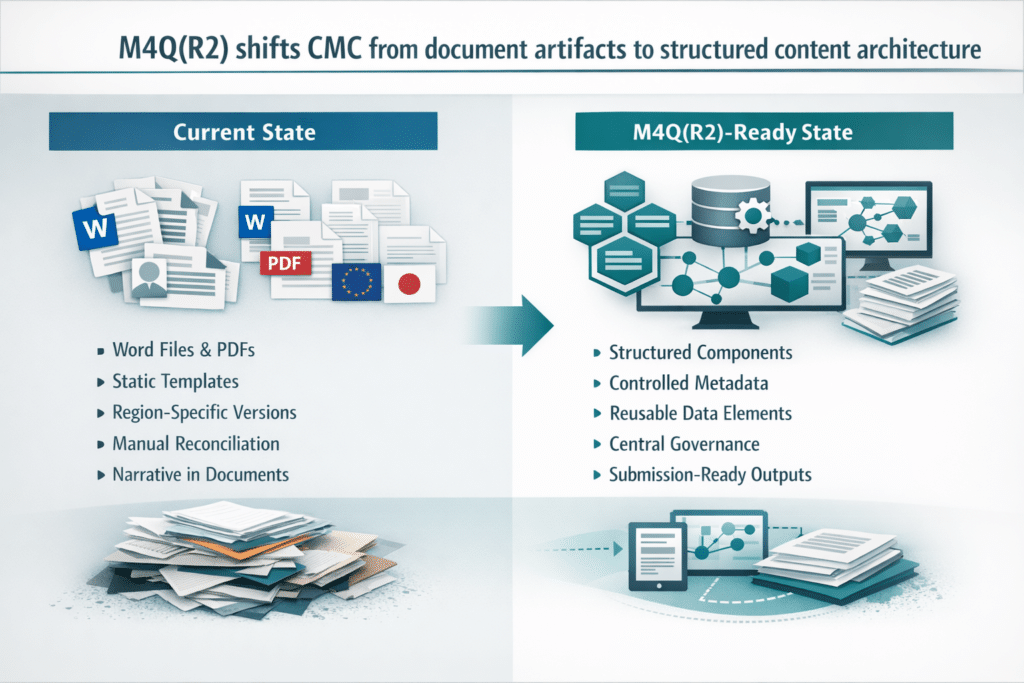
CMC documentation today is largely authored in narrative document formats: Word files, PDFs, and static templates. Process parameters, specification tables, batch records, and stability results exist as prose embedded in files. They are not structured, queryable, or reusable content components.
M4Q(R2) is intended to support a more structured organization of quality information, in a direction consistent with review environments such as KASA. That direction supports review models in which specific data elements can be assessed, compared, and managed more systematically across submissions and products.
Organizations should not assume they can meet emerging structured submission expectations by reformatting legacy documents at submission time. In practice, the necessary structure has to exist at the point of authoring if content is to be reusable, queryable, and aligned with structured review models. A document that contains correct information but only as embedded narrative still behaves like a document artifact, which is precisely the operational model M4Q(R2) and related structured-data initiatives are moving beyond.That is a distinction that authoring teams, regulatory operations leaders, and IT functions all need to understand before scoping a response. The remediation required is not a submission-level fix. It is an upstream authoring problem.
M4Q(R2) Migration at Portfolio Scale
The migration challenge is proportional to portfolio size, geographic reach, and lifecycle complexity. An organization with five marketed products and three geographic filings faces a manageable conversion scope. An organization with 50 products, each filed in 10 or more markets, faces a content remediation effort that will consume regulatory operations capacity for years without structural tooling in place.
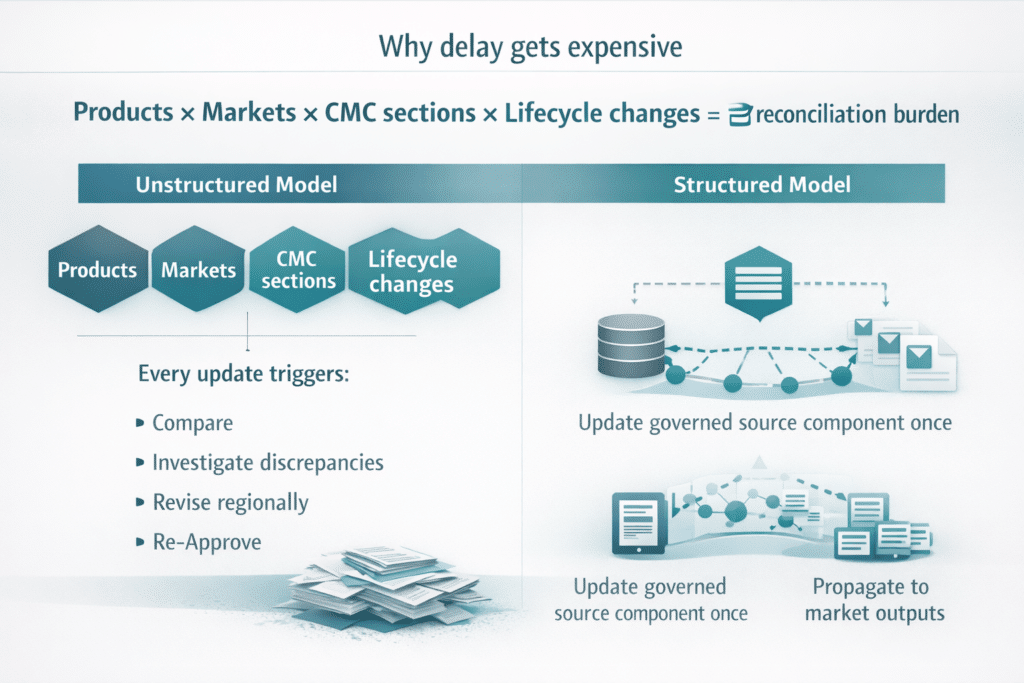
Consider what global CMC reconciliation currently costs. A manufacturing process description authored separately for FDA, EMA, and PMDA submissions must be manually compared at every lifecycle event. Any discrepancy requires investigation, correction, and re-approval across all affected filings. Multiply that across every CMC section, every product, and every geographic market. The result is a permanent operational cost that compounds with every new product, every post-approval change, and every new market entry.
M4Q(R2) does not create this problem. The revision makes it visible by establishing a structured standard that unstructured workflows cannot meet without intervention.
Organizations beginning their CMC architecture assessment now will have time to approach migration deliberately, sequencing by product priority, content type, or filing jurisdiction. Organizations that wait are likely to face a compressed remediation timeline once Step 4 is adopted and regional implementation expectations begin to solidify. The draft guidance is already public. The sequencing decision is available now, and not available indefinitely
What Structured CMC Authoring Delivers Under ICH M4Q(R2)
Organizations investing in structured CMC authoring today are building toward a different submission model. Consistent metadata, reusable content components, and version-controlled source material change the operational calculus materially.
A single CMC component authored once, governed centrally, and rendered into market-specific formats eliminates the reconciliation burden that accompanies every global filing. As structured quality submission expectations mature under M4Q(R2) and related initiatives, the content already exists in a reusable, governed form. The submission becomes a rendering event, not a restructuring project. That distinction represents a meaningful operational difference for organizations managing multi-market portfolios at scale.
Docuvera’s structured content authoring platform addresses this at the architectural level. CMC content is authored in governed, structured components from the outset. Metadata is controlled at creation, not appended after the fact. Version history is traceable at the element level, not the document level. For organizations beginning their M4Q(R2) readiness assessment, Structured Content for Chemistry, Manufacturing, & Controls provides a framework grounded in PQ/CMC and structured submission requirements. Governed Structured Content for CMC offers additional background on content architecture across multi-market CMC filing programs.
Frequently Asked Questions: ICH M4Q(R2) and Structured CMC Authoring
Editorial Note: This article reflects FDA draft guidance, ICH consultation materials, and related structured-submission sources available as of publication.
Sources
- FDA: M4Q(R2) The Common Technical Document for the Registration of Pharmaceuticals for Human Use: Quality (draft guidance)
- ICH: M4Q(R2) Step 2 materials / consultation slides
- ICH: M4Q(R2) EWG work plan
- EMA: ICH M4Q – The Common Technical Document for the Registration of Pharmaceuticals for Human Use – Quality
- FDA: Pharmaceutical Quality – Chemistry, Manufacturing & Controls (PQ/CMC)
- FDA / CDER: Knowledge-Aided Assessment and Structured Application (KASA)
- Federal Register: M4Q(R2) The Common Technical Document for the Registration of Pharmaceuticals for Human Use: Quality
- ISPE Pharmaceutical Engineering: A Cohesive Vision for a Single Global CMC Dossier