

What pharma teams need to know about ePI readiness, structured content, FHIR, and governed AI as EMA moves toward phased implementation
AI can support ePI implementation when it operates on governed content, reliable product data, and human review. That requirement is becoming operational as the European Medicines Agency’s draft ePI implementation roadmap moves electronic product information (ePI) into phased delivery. Voluntary go-live for vaccines is planned for the fourth quarter of 2026, oncology products follow, and remaining centrally authorised products come after that. The draft roadmap also identifies a final version, including go-live timelines for national competent authorities, as a milestone still to come.
The roadmap also creates a recurring content obligation. Once a product’s information is available in electronic format, it remains electronic for all subsequent variations. That recurring workload is where governed AI becomes relevant: helping teams manage approved content, controlled transformations, change impact, and consistency across the product lifecycle.
Every subsequent variation—whether driven by safety or labeling change—has to preserve a compliant electronic output. An organization that treats the first ePI as a conversion project will discover the recurring obligation at the second variation. The operational question becomes whether AI is connected closely enough to governed source content and product data to reduce that work while preserving traceability.
What ePI implementation actually asks of content operations
Four requirements sit underneath the roadmap, and each one lands on content rather than on IT.
Two representations, one truth. Applicants are asked to author or upload ePI at the PLM Portal as an extra step in the process, alongside the current Word and PDF submission. For the duration of the transition, the same approved product information exists in two forms at once. Any divergence between them is a finding waiting to happen.
Structure first, languages scale with the rollout. The draft roadmap describes initial implementation for centrally authorised products as English-first, with other languages optional and full multilingual capability arriving later. EMA’s current ePI FAQ also states that ePI introduces no new language requirements: the same languages required for the Word and PDF product information are required for ePI. The translation and localization burden therefore remains part of the operating model even while the first rollout is staged.
Product data has to be right. ePI is authored against the EU ePI Common Standard and linked to the authorised product in PMS. SPOR supplies master data used in ePI, including organization and authority data. Master data quality, identifiers, and referential alignment therefore sit directly inside ePI readiness. Content accuracy alone does not clear that bar.
The standard is FHIR, and only here. ePI runs on HL7 FHIR. The submission rail does not. eCTD version 4.0 is built on HL7 version 3 Regulated Product Submission, which is a different architecture entirely. Treating the two as one interoperability program is a common planning error, and it produces roadmaps that do not survive contact with either standard.
Where document-based operations break
In a document-centric environment, the response to ePI is conversion. Take the approved SmPC and package leaflet, extract the content, and produce a structured output for upload.
That works once. It does not scale across a portfolio, and it does not survive the lifecycle rule.
Conversion is performed on an artifact, so it has to be repeated whenever the artifact changes. Nothing links the structured output back to the source content, which means the two drift apart between variations. When a safety statement changes, the question of which electronic outputs are affected is answered by a manual review of the portfolio. Teams handle the first product this way and then discover that the effort per product is close to constant.
The requirement that follows is structural. The electronic output has to be generated from governed content rather than reconstructed from an approved document. That is what makes the second variation cheaper than the first.
Four jobs AI can do inside that boundary
AI is useful in an ePI program in proportion to how governed the underlying content already is. Applied to a document library, it accelerates the production of outputs nobody can trace. Applied to governed components, it removes specific, bounded workloads.
Docuvera orders those workloads through its Hierarchy of Intelligence™, which sets the sequence in which AI is permitted to act: reuse first, transformation second, generation last. RARe, retrieval-augmented reuse, applies approved and human-reviewed components verbatim, so lineage and approvals travel with the content. RAT, retrieval-augmented transformation, produces controlled and visible modifications where adaptation is required, and RAG, retrieval-augmented generation, produces new text only where neither prior tier applies.
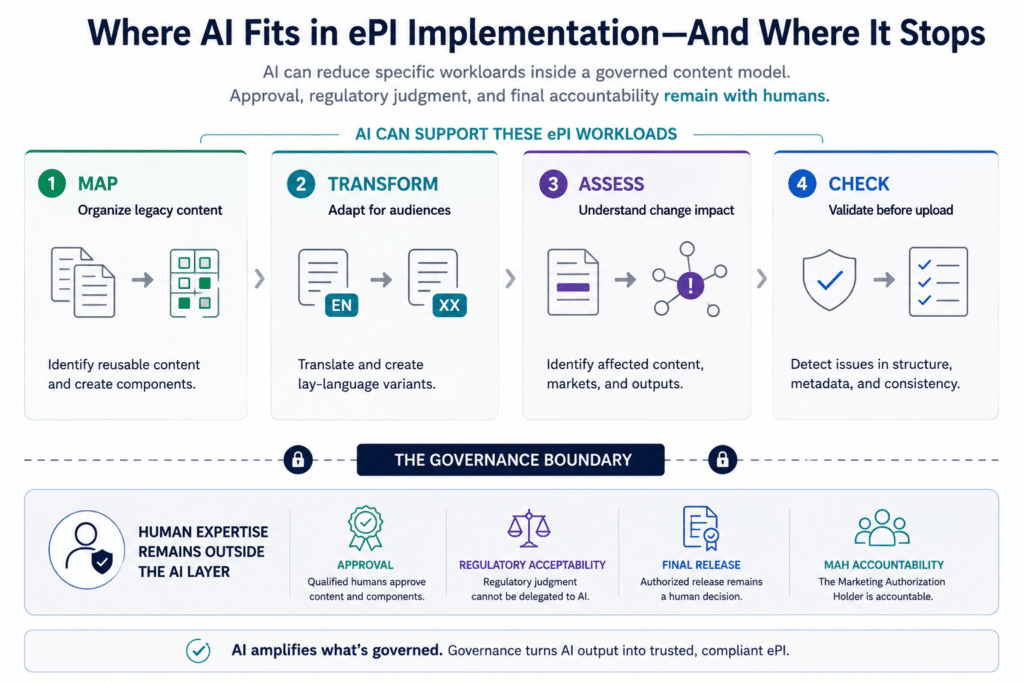
Four jobs are worth naming.
Mapping legacy content into components. A major one-time cost in an ePI program is the migration of existing product information into a structured model. AI can identify recurring statements and variants across source files, flag candidates for reuse, and help classify the resulting components. Every proposal arrives as a suggestion a human accepts, revises, or rejects, with the source visible. The judgment about what constitutes an approved statement stays with the regulatory owner.
Language and audience transformation. The multilingual phase and the patient-facing nature of the package leaflet both create transformation work at volume. AI can produce controlled translations and lay-language variants derived from an approved source component, with the derivation recorded. This is RAT applied at scale. Docuvera describes these transformations as governed outputs with explicit source lineage. Human review remains a condition of release in every case.
Change impact analysis. When an upstream statement changes, the operationally expensive question is scope. AI can assist in identifying affected components, downstream instances, market variants, and electronic outputs, then present that set for review. The value is the completeness of the set rather than the speed of the search.
Validation and consistency checks before upload. Structural errors, missing metadata, and divergence between the document representation and the electronic one can all be checked before submission. AI can surface consistency issues for review, while FHIR conformance is validated against the applicable ePI implementation rules.
What AI does not do in any of these cases is decide. It does not approve content, it does not determine regulatory acceptability, and it does not substitute for the marketing authorization holder’s accountability. Each output is traceable to an approved source, and each carries an audit trail.
The same discipline downstream: regulatory information management
On the regulatory information management side, the bounded jobs are different. AI can help retrieve, summarize, translate, and compare regulatory correspondence and product or activity data. Product master data still has to be maintained against controlled terminology and agency records, with business-rule validation applied before submission. EXTEDO’s MPDmanager connects product data with EMA SPOR and PMS, while AIxpt supports auditable search, document review, translation, and comparison across managed information.
The precondition, and the two halves of the chain
None of the jobs above is safe without governance underneath it. Components need approval status, version lineage, and usage context attached at the point of authoring. Without that layer, AI accelerates the production of content whose provenance cannot be demonstrated, which is the opposite of what an ePI program needs.
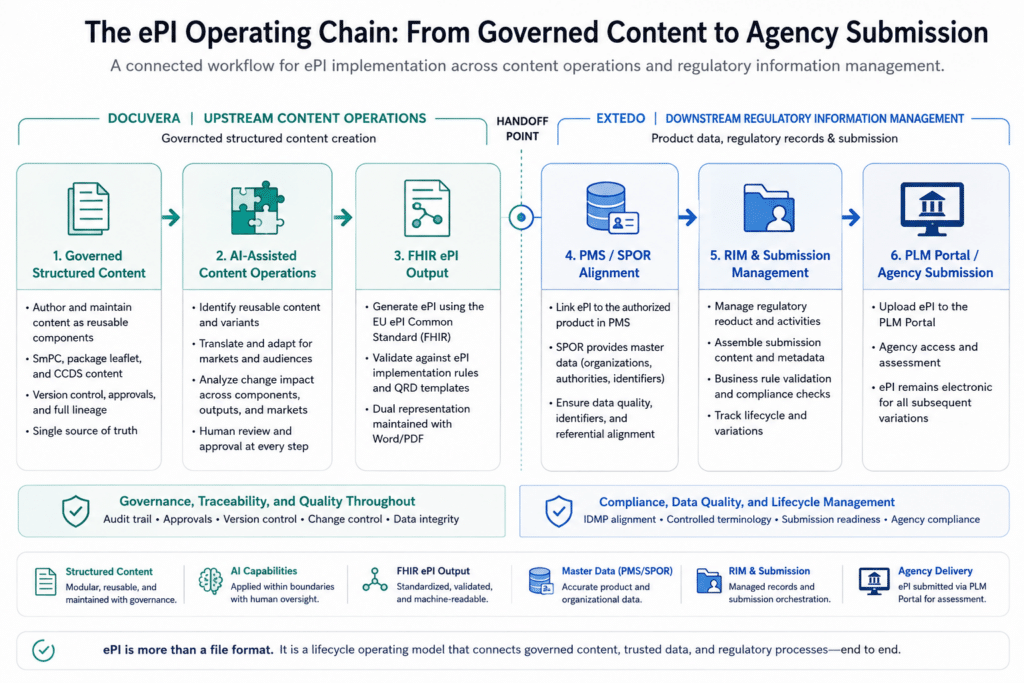
The ePI dataflow also spans two capabilities that are often owned by different teams and different systems. Upstream sits the governed authoring of product information content, where the CCDS, SmPC, and package leaflet are maintained as reusable components that can generate an electronic output natively. Downstream sits regulatory information management: product master data aligned to IDMP and SPOR, registration records, and the submission and publishing path into the PLM Portal.
An ePI program that solves only one half stalls. Governed content that cannot be submitted with correct product identifiers does not clear. Accurate master data attached to content that was rebuilt by hand for each variation carries the recurring cost forward.
Both halves sit within cormeo. Docuvera provides the governed structured authoring layer, where product information is maintained as components and the electronic output is generated rather than converted. EXTEDO provides the regulatory information management, master data, and submission capabilities that carry that output through to the agency. Both are developed with the same dataflow in view, which is why the handoff between authored content and submitted content is treated as a design question rather than an integration afterthought.
What to do before the final ePI roadmap lands
The final roadmap will add national competent authority timelines to a picture that currently covers centrally authorised products. Organizations that wait for it will be planning against a shorter runway than the one available now.
Three things are worth doing in the meantime. Establish which of your products fall into the early therapeutic areas, and confirm whether any variation is likely during the voluntary window. Assess whether your current authoring environment can generate a compliant electronic output from approved content, or whether it can only convert a finished document. And decide where product master data and content governance meet, because unresolved ownership or data alignment at that seam can stall an ePI program.
On the downstream side, confirm that the product record selected for ePI can be reconciled against current PMS/SPOR data, that the right PLM Portal roles and access are in place, and that FHIR import and validation have been tested before the relevant voluntary window. Map the ePI step into the existing procedure as an additional activity alongside the current Word/PDF product information.
The organizations that reach the mandatory phase comfortably will be the ones already generating electronic output as a byproduct of how they author. That sequence is also the one cormeo is building its joint work around across Docuvera and EXTEDO.
For a broader view of the transition, visit cormeo’s ePI Resource Hub, which brings together ePI guidance, masterclasses, infographics, and regulatory resources in one place.
Teams that want to benchmark those capabilities can use Docuvera’s EU ePI Readiness Self-Assessment.
Frequently Asked Questions
Sources
- European Medicines Agency. Electronic product information (ePI).
- European Medicines Agency. Electronic product information (ePI) implementation roadmap. Draft, March 2026.
- European Medicines Agency, PLM Portal. ePI Frequently Asked Questions.
- European Medicines Agency. Successful pilot paves the way for implementation of ePI.
- European Medicines Regulatory Network. Electronic Product Information (ePI) Implementation Guide v1.0.0.
- European Medicines Agency. eCTD v4.0.
- Docuvera. AI-Powered Structured Content Authoring.
- EXTEDO. Registration Management Hub.
- cormeo. Who We Are.
- European Medicines Agency. Reform of the EU pharmaceutical legislation.