

Answer with Confidence. A hedge is the most expensive answer a regulated organization can give
Somewhere between a confirmed safety signal and a fully updated global label, there is an interval in pharmacovigilance safety labeling. During it, the same product carries the new safety position in some markets and the old one in others, and every hour of it is exposure the organization is accountable for. The length of that interval is a safety outcome, not an administrative detail.
Ask the safety lead, mid-interval, whether the update has reached every market, and the honest answer is often a hedge. We’re checking. It sounds careful. It sounds responsible. In a regulated environment, it is neither. It is an admission that at the moment the answer matters most, the organization cannot state where its own approved safety position is live and where it is not. The hedge is not caution. It is the visible symptom of an estate the organization cannot see all at once.
Why a hedge carries a cost in safety labeling
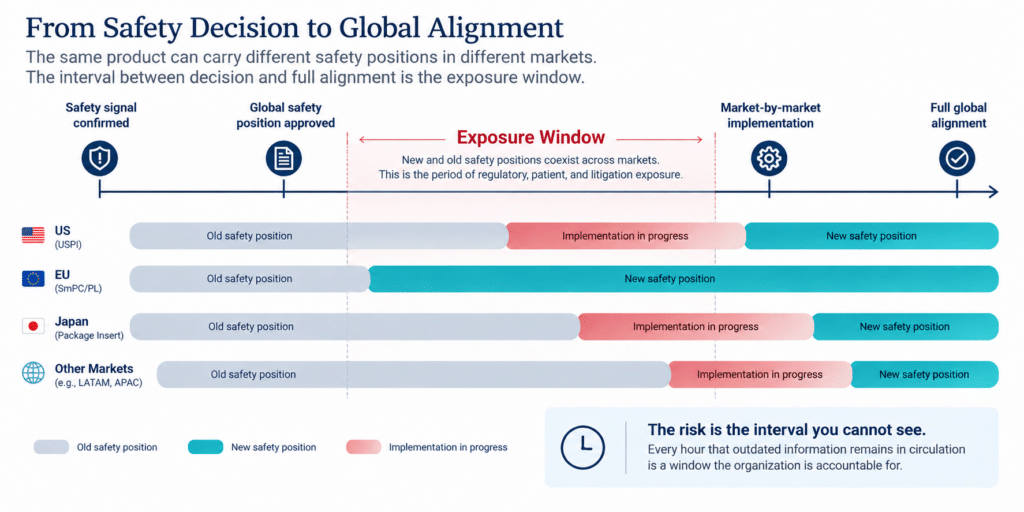
That interval is not neutral time. In pharmacovigilance safety labeling, the gap between a safety decision and full implementation has to remain visible and controlled. Regulatory frameworks attach defined processes and timelines to safety-driven labeling and product-information changes. That makes the interval between decision and full alignment a window the organization has to be able to document and control. FDA’s section 505(o)(4) process establishes defined procedures for post-approval safety labeling changes, while EMA’s signal-management process can result in recommended changes to product information.
That currency is not discretionary. Under section 505(o)(4) of the Federal Food, Drug, and Cosmetic Act, added by the 2007 FDA Amendments Act, the FDA can require application holders to make safety labeling changes based on new safety information that emerges after approval. The statute imposes time frames for holders to submit those changes. Keeping labeling current with emerging safety information is a legal obligation, backed by enforcement, on a clock.
FDA reissued its section 505(o)(4) implementation guidance in draft in September 2025 to reflect current Agency processes and other statutory changes. The July 2013 guidance remains the final guidance unless and until the revised draft is finalized; FDA states that the 2025 draft will replace the 2013 guidance when finalized.
In the EU, PRAC safety-signal recommendations can include updates to product information. EMA publishes new product-information wording arising from PRAC signal recommendations in multiple EU languages, connecting the safety-signal process directly to changes in regulated product information.
So the hedge lands harder than it sounds. When the honest answer is that alignment cannot be confirmed, the organization is describing an open exposure window it cannot yet measure. Confidence, in this setting, is not a tone of voice. It is the demonstrable ability to say where the current safety position is live, everywhere it is required, and to show when it got there.
Why document-first safety labeling forces the hedge
The hedge is not a personal failing of the person giving it. It is what a document-first operating model produces under time pressure.
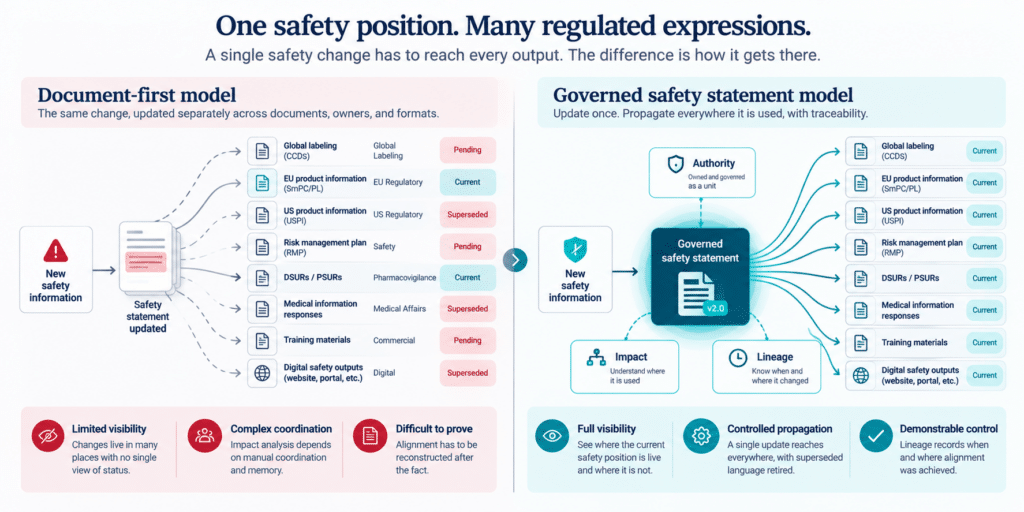
When a safety statement lives inside documents rather than as a governed unit, a single change sets off parallel, manual work across pharmacovigilance safety labeling. Global and local labeling, including CCDS, SmPC, and USPI content, risk management plans, DSURs and PSURs, medical information responses, training materials, and digital safety outputs each have to be updated on their own clock, by their own owners, in their own formats. Alignment across all of them rarely happens at once. During the interval, several versions of the safety position coexist in circulation.
Three things break in that interval. Visibility into what has changed lags, because the change lives in many places and no single system holds them together. Impact analysis depends on coordination and memory rather than system logic, so no one can say with confidence everywhere the statement appears. And proof that alignment was achieved has to be reconstructed after the fact, from records that were never designed to answer the question. Additional reviews can eventually restore consistency. They do nothing to shorten the window during which outdated information stayed live.
This is why the same question keeps producing the same hedge. The answer exists in fragments across the estate. Assembling it takes longer than the moment allows.
What confidence actually rests on
Confidence is manufactured well before the question arrives, in how content is governed. It rests on three conditions that either hold or do not.
There must be a single authoritative version of each safety statement, owned and governed as a unit in its own right, carrying the metadata that defines where it applies and when it is valid. A change must propagate from that one source to everywhere the statement is used, with superseded language explicitly and provably retired, so old wording does not linger in a corner of the estate. And there must be lineage that records when and where alignment was achieved, so the organization can demonstrate its safety position rather than describe its intentions.
When those conditions hold, the daily reality of a safety team changes. Alignment latency becomes measurable. Impact analysis becomes a system behavior rather than a coordination exercise. Inspection readiness shifts from reconstruction to demonstration. The team can see where the current safety position is live, and, just as important, where it is not yet.
Know before the question arrives. See the critical questions a governed content foundation should let your organization answer. Find the Answer
Built before the question
This is the gap a governed pharmacovigilance model is built to close. Docuvera treats safety statements as governed assets, independent of the documents that render them. A change updates the component once and propagates everywhere it is used. Superseded language is retired deterministically. Lineage shows when and where alignment occurred. Documents become expressions of the current safety state, and that state is observable rather than inferred.
The same discipline governs the labeling cascade, where one safety change has to reach every market’s product information without drift, and it rests on the governance layer that holds authority, reuse, and lineage together across the lifecycle. In Europe, that direction is increasingly concrete as EMA advances electronic product information (ePI). EMA defines ePI as authorised product information adapted for electronic handling and dissemination, and the EU ePI Common Standard is based on Fast Healthcare Interoperability Resources (FHIR). The European Medicines Regulatory Network released version 1.0.0 of its ePI Implementation Guide on September 17, 2026, defining the FHIR resources used to create ePI according to that common standard. AI works only inside those governed bounds, running impact analysis when a safety statement changes and flagging any output still showing superseded language. It speeds a control model that already exists; it cannot create one.
When the safety lead is asked whether the update has reached every market, the reply is no longer a hedge. It names where the current position is live, with lineage that proves it. Confidence is having that answer before the question is asked.
Answer with confidence across the content lifecycle. See how governed, reusable content supports change across teams, geographies, and output formats. Answer with Confidence
Frequently Asked Questions
Sources
- U.S. Food and Drug Administration. “Safety Labeling Changes—Implementation of Section 505(o)(4) of the FD&C Act.” Draft Guidance for Industry, September 2025. FDA states that the draft revises and, when finalized, will replace its July 2013 guidance.
- U.S. Food and Drug Administration. “Safety Labeling Changes—Implementation of Section 505(o)(4) of the FD&C Act.” Draft Guidance for Industry, Revision 1, September 2025.
- European Medicines Agency. “PRAC recommendations on safety signals.” Includes current PRAC recommendations and associated new product-information wording.
- European Medicines Agency. “Electronic product information (ePI).” Describes ePI and the FHIR-based EU ePI Common Standard.
- European Medicines Regulatory Network. “Electronic Product Information (ePI) Implementation Guide v1.0.0.” First release active September 17, 2026.