

What FDA asks sponsors to include in a CMC development plan, and how to keep its statements aligned through filing
The CMC Development and Readiness Pilot (CDRP) addresses a quiet asymmetry in accelerated clinical programs. Clinical timelines compress, but the approval standard for manufacturing does not. A marketing application on an expedited path still has to meet FDA’s quality requirements, including current good manufacturing practice at every facility named in it.
FDA’s Sept. 21 Federal Register notice (91 FR 59783, Docket No. FDA-2022-N-2396) opens year five of the Chemistry, Manufacturing, and Controls Development and Readiness Pilot (CDRP). Starting Oct. 1, 2026, the agency will accept requests continuously through the fiscal year. It will select no more than nine proposals, with roughly two-thirds CBER-regulated products and one-third CDER-regulated products.
The pilot supports products already on expedited clinical timelines. CBER candidates need Breakthrough Therapy or Regenerative Medicine Advanced Therapy designation. CDER candidates need an expedited clinical timeframe, which includes Breakthrough Therapy and Fast Track designations, as well as other qualifying programs determined by FDA. Applicants need an active commercial IND submitted in eCTD format, unless the IND qualifies for an eCTD waiver. Sponsors submit the request as an amendment to that IND. The CMC development plan is central to the request.
What the CMC Development Plan Has to Show
The notice asks for a brief plan, but a brief plan is not a light one. It should list the remaining CMC tasks with estimated timeframes, aligned to when clinical development is expected to finish. It should cover a defined set of areas:
- Current product characterization and preliminary identification of critical quality attributes
- The current drug substance and drug product process and control strategy, including assays still under development
- The proposed commercial-scale manufacturing and control strategy, including any microbial control strategy, focused on differences from clinical scale
- Potential commercial facilities, including contract sites, or at least the type of facility anticipated
- Plans for product availability at approval
- The drug substance and drug product stability assessment plan
- The process validation strategy
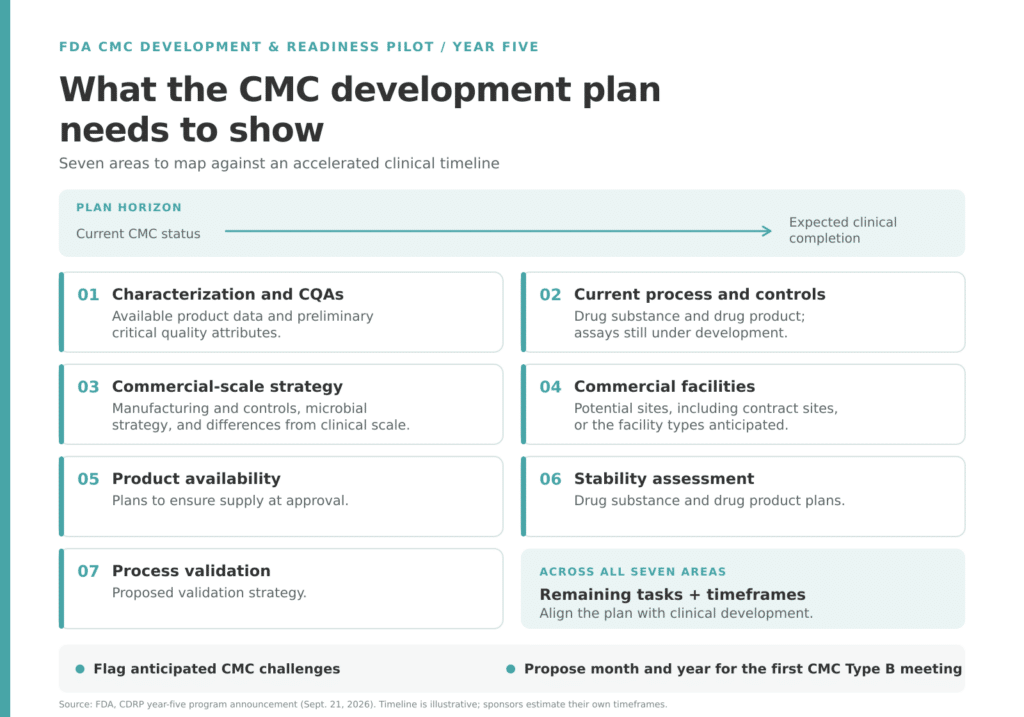
The plan should also flag anticipated CMC challenges and propose a month and year for the first CMC-focused Type B meeting. FDA intends to issue a selection or denial letter within 90 days of receipt. Selection weighs anticipated clinical benefit, product novelty, manufacturing complexity, and the CMC challenges the sponsor identifies.
Read closely, the list describes the backbone of a future quality dossier. Characterization, control strategy, facilities, stability, and validation are the claims a Module 3 will eventually have to support. The plan is a prospective version of those claims, written years before they are final. For more on why those claims need to remain controlled across the product lifecycle, see From Module 3 to Managed Risk.
Where the Plan Starts to Drift
Admission is the easy part to picture. The harder part is what happens to the plan’s statements afterward.
Participants receive two additional CMC-focused Type B meetings and further CMC discussions with an expanded IND quality assessment team. FDA states the purpose plainly. The interactions aim at a shared view of what information belongs at NDA or BLA submission, before the review cycle ends, or post-approval. Enrollment continues until the marketing application is filed.
That creates a long chain of related content. The plan feeds a first briefing package. Agreements from that meeting shape IND amendments, a second briefing package, and eventually the marketing application. Along the way, a control strategy tightens, an assay is validated, or a contract manufacturer changes. Each change touches statements that already live in several documents.
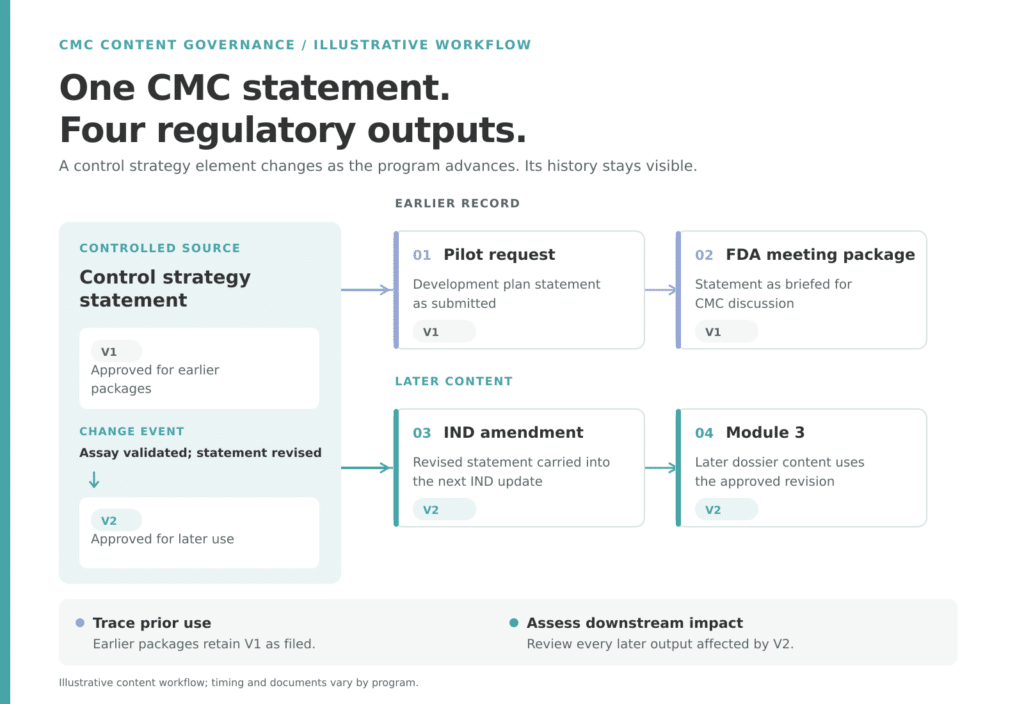
In a document-centric model, each of those documents is authored and reviewed separately. The same critical quality attribute can be described three ways across three packages. An agreement about timing, such as data deferred to post-approval, can sit in meeting minutes and never reach the dossier as a governed commitment. The risk is a set of documents that no longer say the same thing. Docuvera examines this wider statement-level governance gap in CMC authoring.
FDA’s July 23 CMC readiness strategy document frames the underlying problem from the agency’s side. It notes that products on accelerated clinical timelines often face challenges aligning CMC development with those timelines. Enhanced communication helps only if what was communicated stays consistent with what is later filed.
Governing the Statements, Not the Files
The requirement follows from the pilot’s design. Each CMC statement needs a single controlled source, a version history, and a clear record of its status. Status includes the timepoint FDA and the sponsor agreed for it. A statement’s reuse in a briefing package or Module 3 section should inherit that source rather than copy it.
This is where governed structured content earns its place in CMC operations. Docuvera treats each CMC statement as a governed component with ownership, approval history, and traceable reuse. A control strategy element authored for the development plan can flow into briefing packages and modular Module 3 content without being retyped. When that element changes, impact awareness shows every place it appears before anyone signs off. See how Docuvera supports governed CMC documentation.
Governance comes first because the consistency argument depends on it. Structure is the mechanism that lets one approved statement serve many outputs. Intelligence is the result, and it stays bounded. Within Docuvera’s Hierarchy of Intelligence™, Retrieval Augmented Reuse (RARe) surfaces previously approved statements for a new briefing package. Retrieval Augmented Transformation (RAT) can adapt approved content to a new context. Retrieval Augmented Generation (RAG) sits last. CMC subject matter experts and regulatory reviewers remain the authority on every statement that reaches FDA.
FDA’s requirements and the scientific work of CMC development remain with the sponsor. Governed content helps the sponsor show, at any point, that its plan, its meeting commitments, and its dossier agree.
Readiness Is a Content Question Too
The CDRP asks sponsors to prove they can match manufacturing readiness to a compressed clinical clock. The development plan is the first test, and it is a test of content as much as science. Sponsors that govern CMC statements from the start carry a coherent record from request through filing. Sponsors that govern documents end up reconciling them later. That is the CMC expression of Answer with Control: knowing which statement governs, where it appears, and what must change when manufacturing plans evolve
For sponsors developing a product for both the US and EU, the CDRP remains an FDA program. The related content challenge crosses markets. EMA’s PRIME scheme includes development advice and a submission readiness meeting focused on dossier maturity and remaining evidence gaps. FDA and EMA have also published joint questions and answers on quality and GMP aspects of their early access programs. A traceable account of CMC decisions helps teams prepare each region’s submission against its own requirements.
For a closer look at how regulators evaluate CMC change and where document-based processes stall, read Governed Structured Content for CMC.
Frequently Asked Questions
Sources
- FDA, “Chemistry, Manufacturing, and Controls Development and Readiness Pilot Program; Program Announcement,” Sept. 21, 2026
- FDA, Strategy Document on Facilitating CMC Readiness for Products With Accelerated Clinical Development, July 2026
- ICH, The Common Technical Document for the Registration of Pharmaceuticals for Human Use: Quality, M4Q(R1)
- EMA, “PRIME: priority medicines”
- FDA and EMA, joint questions and answers on quality and GMP aspects of PRIME and Breakthrough Therapy applications