

How pharma teams can prepare for structured product information, FHIR readiness, and EU ePI standards
Your organization has spent decades perfecting the Summary of Product Characteristics. The SmPC is a familiar document. It has a structure your teams know intimately: indications, dosage, contraindications, adverse effects, each in its place. Your regulatory submissions are built around it. Your processes are built around it. Your systems are built around it.
The European Medicines Agency and the European medicines regulatory network are moving toward ePI implementation. Electronic product information. The SmPC will remain part of authorised product information, but it is increasingly being represented within an electronic, structured model that also includes the package leaflet and labelling.
This is not a minor format change. It is a structural shift from document-based labeling to structured product information that can be created, validated, exchanged, and maintained more consistently across systems. Understanding what is changing, why, and what your organization must do will determine whether your transition is smooth or chaotic.
What is an SmPC?
An SmPC is a comprehensive document containing all essential information about a medicinal product. It includes clinical data, dosage instructions, safety information, storage requirements, and regulatory approvals. A single SmPC file is typically twenty to forty pages, with sections in a defined order.
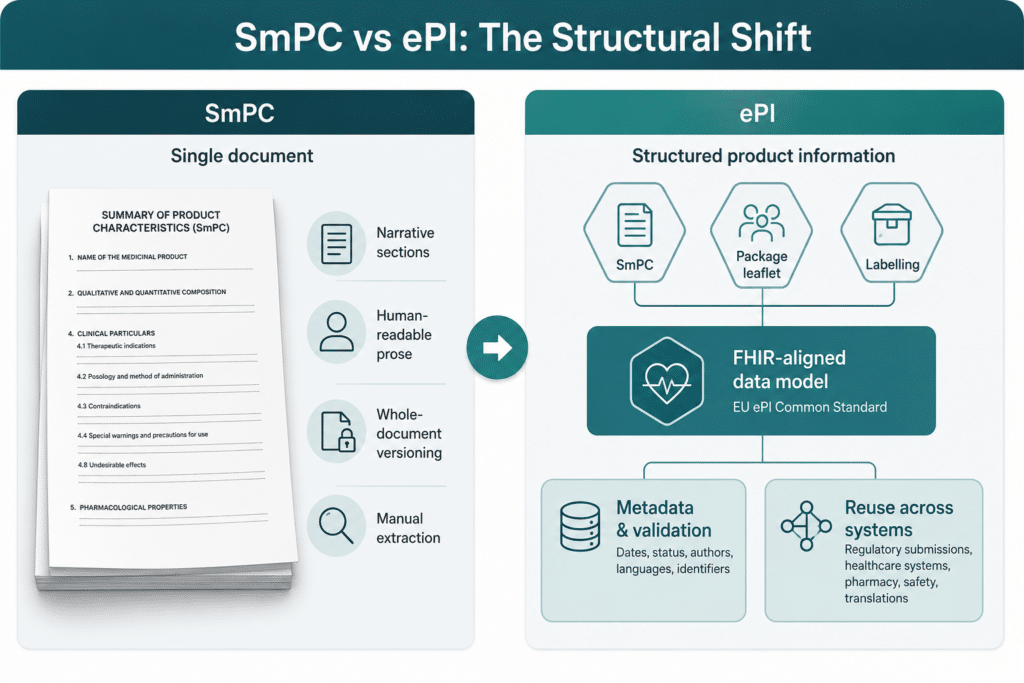
The SmPC format was designed for human readers: physicians, pharmacists, healthcare professionals. It prioritizes readable narrative and flow. Sections are written as prose. Information is organized hierarchically. A clinician reads the SmPC to understand how to use the drug safely and effectively.
The SmPC has served this purpose well. It is readable, comprehensive, and proven. But it has a fundamental limitation: it is a document, not data.
When you need to extract specific information from an SmPC, such as all contraindications for a specific population, you must read the document. A computer cannot reliably extract this because it is embedded in flowing text, not structured as data.
The SmPC is also version-controlled as a whole. When a single dosage recommendation changes, the entire SmPC is revised, re-versioned, and re-submitted. This works for documents but is inefficient for content management.
Why ePI Implementation Matters
The EMA is moving toward ePI because electronic product information can improve access to up-to-date medicines information and make authorised product information easier to search, distribute, and maintain across digital channels.
In an ePI environment, labeling information is represented as structured product information rather than as a static document alone. Dosage information, contraindications, adverse effects, package leaflet content, and labelling can be handled in more discrete, machine-readable ways, which creates a foundation for cleaner reuse, validation, and downstream distribution.
Structured ePI can also improve searchability and interoperability. Over time, healthcare systems, pharmacy systems, and safety teams may be able to use structured product information more effectively than static PDFs. This is the practical promise of the EU ePI Common Standard: harmonised electronic product information that can support access, consistency, and digital use across the EU.
The Regulatory Timeline for ePI Implementation
EMA and several national competent authorities ran a one-year ePI pilot from July 2023 to August 2024, testing the creation and use of ePI in real regulatory procedures. EMA reported that the pilot showed the EU regulatory system is generally prepared to move toward phased implementation, while noting that more development is still needed, including additional functionality and integration with current IT systems. Early preparation gives regulatory, labeling, and content teams time to build expertise before phased requirements create operational pressure.
What Changes for Content Authors?
The shift from SmPC to ePI requires different authoring practices.
In an SmPC, an author writes a dosage section. It flows: “The usual dose is X. In patients with renal impairment, reduce dose to Y. In patients over 65 years, use caution at reduced doses.” One flowing section captures dosage for multiple populations.
In an ePI environment, dosage content must be prepared for structured representation. Standard dose, renal impairment adjustments, age-related precautions, administration route, frequency, and special population warnings need to be clear enough to map into structured product information.
This requires different authoring discipline. Authors must think in terms of components and attributes, not narrative flow. Some writers find this constraining. Others find it clarifying: there is no ambiguity about which field contains which information.
Authors must also embrace component-level governance. When you update one piece of information, systems and workflows should support precise change tracking, reuse, and traceability rather than forcing teams to manage every change as a disconnected document exercise. Docuvera’s structured content authoring approach is built around governed components that can be reused across regulatory submissions, global labeling artifacts, safety and clinical content, and patient communication documents.
What Changes for Regulatory Teams?
For Regulatory Affairs, ePI implementation changes submission readiness. Teams need to prepare for product information that aligns with the EU ePI Common Standard and the ePI FHIR Implementation Guide, which describes how HL7 FHIR is used to generate ePI. The EMRN ePI FHIR Implementation Guide includes validated examples for SmPC, Annex II, labelling, and package leaflet documents.
ePI readiness also depends on metadata discipline: effective dates, change status, authoring dates, approver information, language versions, and product identifiers. This metadata must flow from authoring systems into downstream regulatory and publication processes. Regulatory teams typically own the transition strategy, ensuring ePI requirements are understood by labeling, medical, safety, IT, and content operations teams.
SmPC vs ePI: Structural Differences
The significant difference is granularity. An SmPC is a document. An ePI is a collection of components.
An SmPC has indications and usage. In ePI implementation, that information must be clear enough to map into structured product information using the relevant FHIR resources and profiles defined by the EU ePI Common Standard.
An SmPC has a dosage section. For ePI, dosage content must be structured consistently enough to support validation, reuse, and exchange. Dose adjustments for renal impairment, hepatic impairment, age, and drug interactions need to be explicit rather than buried in prose.
Traditional product information often describes packaging, storage, and handling in document form. In ePI, this information must be prepared for structured, standards-based representation so it can remain consistent across the SmPC, package leaflet, and labelling.
This structural difference drives the biggest change for authors: thinking in components rather than documents.
Common Transition Pitfalls
Organizations commonly underestimate the scope of content conversion. Mapping SmPC content to ePI components requires decomposing and restructuring information, often revealing ambiguities in existing labeling.
Treating ePI as a writing exercise rather than a systems change is a second pitfall. ePI demands changes to authoring tools, governance processes, version control, metadata management, QRD template discipline, and PLM Portal readiness. Insufficient training for authoring teams compounds the problem. Teams need training on component-based thinking.
Finally, poor governance during transition creates divergent or conflicting components. Version control and coordination become critical when multiple teams convert content simultaneously. For labeling organizations, this is where structured labeling and product information becomes operationally important: teams need a governed content model that supports consistency, traceability, and regulatory compliance across markets.
Before Starting Your ePI Implementation
Many organizations begin by evaluating technology or publication formats. In practice, successful ePI implementation starts with understanding your current level of readiness across people, processes, governance, and structured content.
Assessing your current capabilities can help prioritize implementation efforts, reduce rework, and establish a more effective roadmap for ePI adoption.
If you’re planning your transition, our EU ePI Readiness Self-Assessment can help benchmark your readiness and identify areas that may require attention.
Positioning for the Transition
The shift toward ePI implementation is advancing. The direction is clear. Organizations that prepare strategically, invest in systems and training, and establish clear governance will transition smoothly. Those that treat it as compliance checkbox will face friction and quality risks.
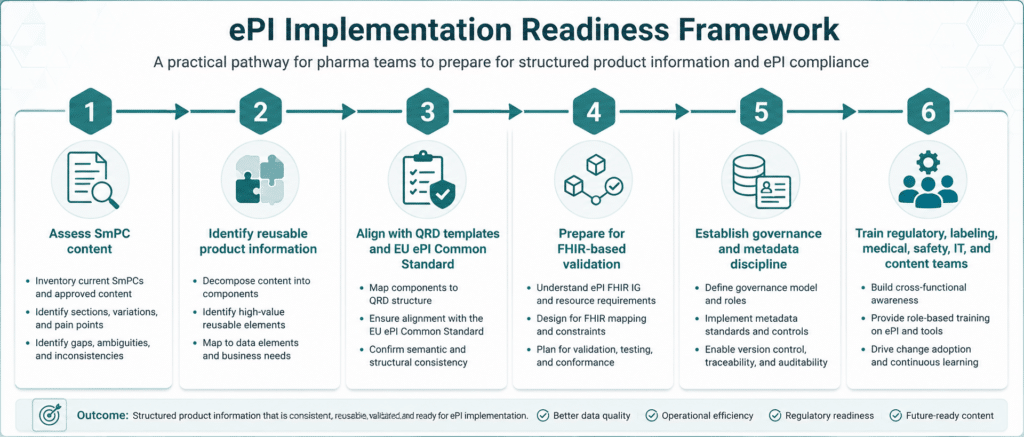
Your transition strategy should begin now: assess SmPC content, identify reusable product information, align with QRD templates and the EU ePI Common Standard, prepare for FHIR-based validation, select systems, train teams, and establish governance. These steps deliver lasting improvements.
Docuvera helps life sciences organizations move from document-based content to governed, reusable components for global labeling, regulatory submissions, medical information, and other regulated content workflows. For teams preparing for SmPC to ePI transition planning and ePI implementation readiness, Docuvera’s global labeling solution and global standards support provide a practical foundation for structured product information, component reuse, and regulatory modernization.
Frequently Asked Questions
1. What is the difference between SmPC and ePI?
An SmPC is the Summary of Product Characteristics: a regulatory document intended for healthcare professionals. ePI is authorised statutory product information adapted for electronic handling and dissemination. It includes the SmPC, package leaflet, and labelling.
2. Is ePI replacing the SmPC?
No. ePI does not eliminate the SmPC. It changes how authorised product information, including the SmPC, can be structured, handled, and distributed electronically. The SmPC remains part of the authorised product information set, alongside the package leaflet and labelling.
3. What is the EU ePI Common Standard?
The EU ePI Common Standard is the harmonised standard adopted by the European medicines regulatory network for creating electronic product information. It supports consistent, structured ePI across the EU.
4. What is the ePI FHIR Implementation Guide?
The ePI FHIR Implementation Guide explains how HL7 FHIR resources are used for ePI. It includes validated examples for SmPC, Annex II, labelling, and package leaflet documents.
5.When is ePI implementation happening?
EMA and several national competent authorities ran an ePI pilot from July 2023 to August 2024 using real regulatory procedures. EMA reported that the pilot showed the EU regulatory system is generally prepared to move toward phased implementation, while additional development and IT integration are still needed.
6.What should pharma teams do now to prepare for ePI?
Pharma teams should assess current SmPC content, identify reusable product information, improve metadata discipline, align authoring practices with QRD templates and the EU ePI Common Standard, and prepare systems for FHIR-based validation and structured product information workflows. For organizations still operating in document-first environments, regulatory compliance and risk mitigation starts with stronger traceability, auditability, and controlled reuse.
7. Why does ePI matter for regulatory labeling teams?
ePI matters because it moves product information closer to structured, searchable, interoperable content. That affects authoring, review, approval, metadata, validation, publishing, and governance. EMA notes that ePI can improve accessibility, searchability, multilingual capabilities, and integration with electronic healthcare systems.