

A closer look at how governed clinical content reduces duplicated edits, downstream misalignment, and amendment review burden across the protocol lifecycle.
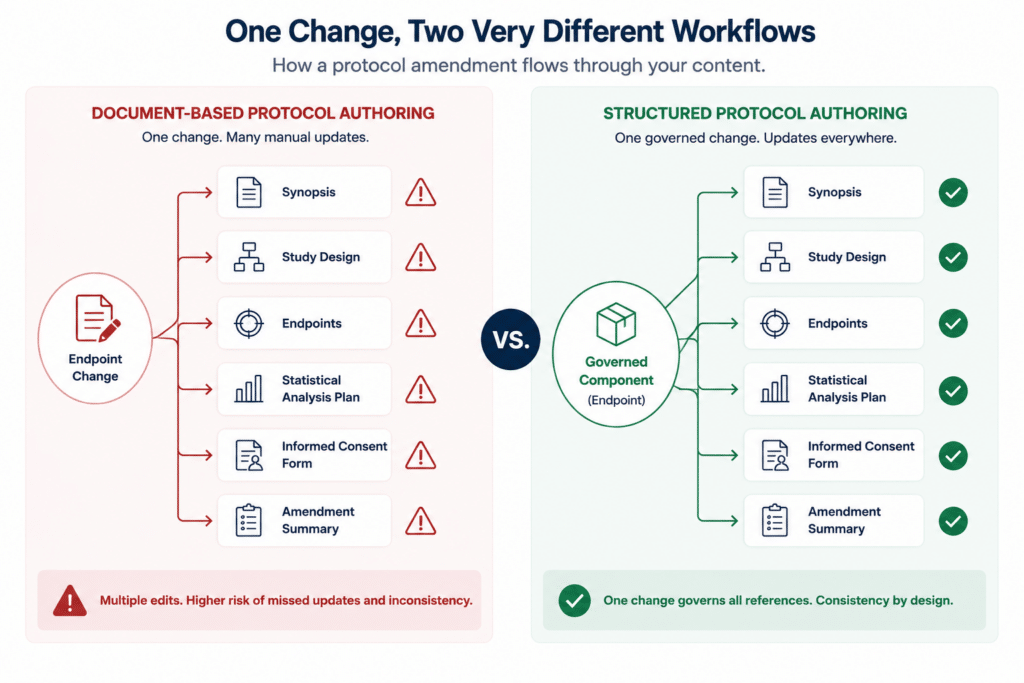
A clinical document specialist opens an amendment request on a Tuesday morning. The change is small. A primary endpoint now includes a secondary time point that was not in the original specification. The specialist begins finding every place the endpoint appears. The synopsis. Section 4, study design. Section 6, endpoints and objectives. Section 10, the statistical analysis plan. The informed consent form template. The amendment summary that will accompany the filing. Each was written by a different team member. Each states the endpoint in language tuned to its own section. The specialist now updates each instance independently and confirms they agree. Then comes a review cycle for a document being revised in six places at once, for a change that originated in one.
Routine amendments often create disproportionate rework because the protocol was authored in a document-based model rather than through structured protocol authoring.
Where protocol inconsistency originates in document-based protocol authoring
Protocol inconsistency often begins with document architecture, even when the authoring and subject matter expertise are strong. That architecture requires the same clinical concept to be expressed independently in several sections of the same document. An eligibility criterion, an endpoint definition, a dosing parameter, a visit schedule: each is written more than once. Each instance is authored by a different person and tuned to the narrative context of its section.
Consider the standard shape of a protocol. A synopsis, multiple body sections covering the study design, statistical analysis elements, operational guidance, and administrative sections. Different clinical functions or medical writing teams author different parts. The primary endpoint alone often appears in multiple sections of a typical Phase II or III protocol. In a document-based model, each appearance is independent text. The pattern is familiar to anyone who has watched the same content authored repeatedly across a clinical document set.
Those instances are consistent the day the document passes review, because a skilled reviewer confirms their alignment. They can fall out of alignment the moment any one of them is revised without the others. That is the structural fault line. Consistency depends on review attention because the architecture of the content does not enforce it.
At amendment, the fault line opens. A change to the endpoint must be applied to every independent instance. The review must then confirm that every instance was updated. Under time pressure, some are missed. The missed instances survive into the approved document. They surface later, in a regulatory question, an audit, or a downstream system that was configured from a section that no one updated.
Why protocol amendment rework scales with portfolio size
A single amendment in a single trial is a manageable coordination task. The same amendment across a portfolio is a different animal. That matters because amendment burden is not rare: a 2024 Tufts CSDD benchmark analyzed 950 protocols and 2,188 amendments across 16 pharmaceutical companies and CROs. Three situations make this concrete. The same study design elements appear across multiple protocols in a program. A safety-driven change must reach several active studies at once. An authority requests consistency across a program submission. In each, the rework scales with the number of protocols, not with the complexity of the change.
Start with cross-protocol consistency. The same eligibility criterion often appears in two protocols in one program, because earlier-phase designs inform later-phase ones. A change to that criterion must be applied to both protocols independently. Nothing links the criterion in Protocol A to the criterion in Protocol B. The two are related only in the minds of the people who remember they are related.
Take the safety amendment. When a signal requires changes to monitoring procedures or stopping rules across several active studies, the amendment is applied to each protocol separately. The coordination burden grows with each active study. Then the regulatory consistency request. When a health authority asks for consistent terminology across protocols for a shared endpoint definition, the work multiplies. The team must find every protocol that uses the term, assess each one, and revise them in coordination, all without a shared governance layer.
The arithmetic is unforgiving. Picture an organization with twenty active Phase II and Phase III trials, managing one safety-driven amendment across all twenty. It is managing twenty related amendment events independently, instead of one governed change that can propagate through shared content architecture. The gap between those two is an architectural distinction.
The downstream alignment cost amendment rework creates
Protocol amendments do not stay inside the protocol. They must reach every system and document built from the original protocol. The EDC was configured from the original eligibility criteria. The CTMS was built on the original visit schedule. Site training rests on the original procedures. Informed consent forms rest on the original risk and benefit descriptions. In a document-based model, each of those propagations is a separate event. It is triggered by the amendment, managed on its own, and confirmed through project tracking rather than a governance record.
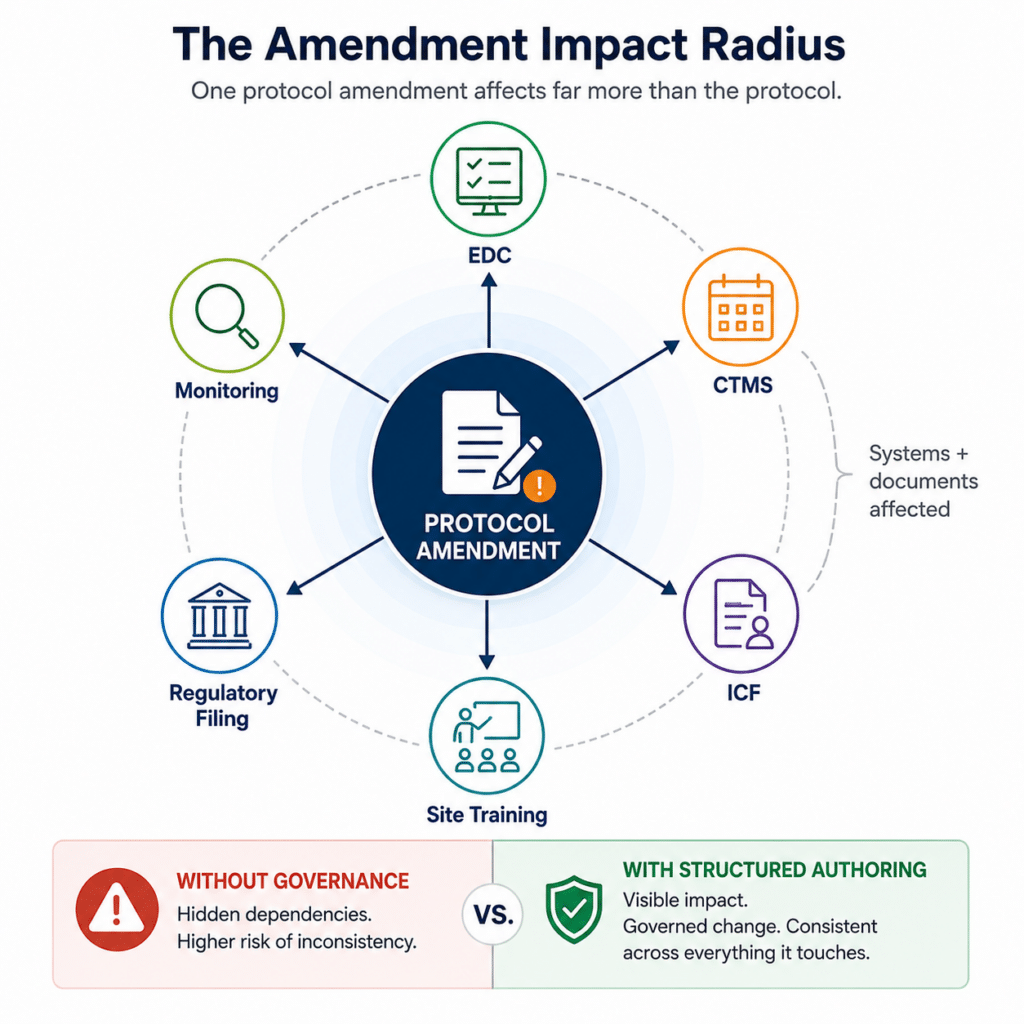
When an eligibility criterion changes in the protocol, the EDC inclusion and exclusion logic must change in step. In a document-based model, those two changes are coordinated through project communication, not through a structural link between protocol content and EDC configuration. If the EDC update lags the amendment, sites can screen patients against criteria that no longer match the approved protocol. In large programs, that kind of mismatch can create deviation exposure; FDA guidance on protocol deviations addresses how sponsors, clinical investigators, and IRBs should define, identify, document, and report protocol deviations in clinical investigations.
The visit schedule carries the same exposure. Change it in the protocol, and the CTMS must change with it, through the same coordination-without-structure. The informed consent form is more sensitive still. When a risk statement or procedure changes, the ICF must be updated and re-consented where applicable. Managing that across many active sites means knowing exactly which protocol sections drive which ICF elements. That relationship does not exist structurally in a document-based model.
This is the problem the Digital Data Flow initiative and CDISC’s Unified Study Definitions Model were designed to solve. CDISC describes USDM as a standard model for conformant study definition technologies, and TransCelerate describes Digital Data Flow as a mechanism to digitize clinical study components for automation, interoperability, and reuse across the study lifecycle. The downstream cost of amendments in document-based models is precisely the operational burden these initiatives aim to eliminate. It also explains why platform alignment across the regulatory ecosystem now has to be addressed at the content-architecture level.
For a broader view of why document-based clinical authoring is becoming harder to sustain, see Docuvera’s Clinical Documentation Guide.
What structured, component-based protocol authoring changes
Author clinical protocols as governed, component-based content, and the three failure modes change at the root. In this model, each clinical concept exists as a single governed component. The eligibility criterion, the endpoint definition, the dosing parameter, the visit schedule element: each is one component, referenced everywhere the protocol uses it, rather than retyped in each section.
Change 1: Protocol consistency becomes architectural, not review-dependent. Picture the endpoint definition as a single governed component, referenced in the synopsis, Section 4, Section 6, and the statistical analysis. An amendment to it is made once, at the component level. Every section that references it reflects the change. The review confirms that the change is scientifically and operationally correct. It does not have to confirm that six text instances were each updated, because there are no independent instances. The architecture carries the consistency burden that review teams otherwise have to manage manually.
Change 2: Cross-protocol propagation becomes a governance function. Say the same eligibility criterion is a governed component referenced in several protocols in a program. A change to it triggers impact analysis across every protocol that references it. The amendment is applied once, at the component level, and propagates through the governance layer to each dependent protocol. The review confirms scientific and regulatory appropriateness. The content architecture carries more of the coordination burden across protocols, reducing reliance on project communication alone.
Change 3: Downstream alignment becomes structural. When protocol content is authored as structured, machine-readable components aligned to CDISC USDM and exchangeable through open formats such as FHIR and JSON, downstream systems can consume it more directly. FDA’s M11 Technical Specification describes the use of an open, nonproprietary standard to enable electronic exchange of clinical protocol information. That includes EDC, CTMS, and regulatory platforms, with less manual translation. An amendment at the component level propagates to the EDC configuration, the CTMS visit schedule, and downstream documents through the governance and integration layer. The amendment is made once. The downstream state reflects it. The version mismatch risk is eliminated by the architecture, not managed through project tracking.
This is what the model looks like in practice. Docuvera’s clinical solution is designed for structured protocol authoring in ICH M11-, CDISC USDM-, and TransCelerate-aligned environments. Docuvera’s clinical trial documentation software supports controlled authoring, review workflows, and efficient creation of clinical study and regulatory content. With approved product documentation, this is where Docuvera can substantiate direct Open Study Builder integration, automated FHIR and JSON exports, and dynamic amendment impact analysis that identifies every component and system a change will touch before the amendment is executed.
Frequently Asked Questions
Further reading: Docuvera’s Clinical Documentation Guide, on how escalating trial complexity and interoperability demands make document-based clinical authoring unsustainable. For related clinical use cases, see Docuvera’s clinical trial documentation software and structured content in clinical trials
Editorial note
This article is intended for clinical operations, regulatory operations, medical writing, and digital transformation leaders evaluating structured protocol authoring, ICH M11 readiness, CDISC USDM alignment, and amendment rework reduction. External references are drawn from ICH, FDA, CDISC, TransCelerate, and Tufts CSDD. Product-specific claims should be validated against approved Docuvera product documentation before publication.
Sources
- International Council for Harmonisation. ICH M11: Clinical Electronic Structured Harmonised Protocol (CeSHarP). 2025.
- International Council for Harmonisation. ICH M11: Clinical Electronic Structured Harmonised Protocol (CeSHarP) Explainer. 2026.
- U.S. Food and Drug Administration. M11 Clinical Electronic Structured Harmonized Protocol (CeSHarP). 2026.
- U.S. Food and Drug Administration. M11 Technical Specification: Clinical Electronic Structured Harmonised Protocol.
- CDISC. Digital Data Flow and the Unified Study Definitions Model (USDM).
- TransCelerate BioPharma. Digital Data Flow Initiative.
- Tufts Center for the Study of Drug Development. New Benchmarks on Protocol Amendment Practices, Trends and their Impact on Clinical Trial Performance. 2024.
- U.S. Food and Drug Administration. Protocol Deviations for Clinical Investigations of Drugs, Biological Products, and Devices.
- Docuvera. Clinical Documentation Guide.
- Docuvera. Clinical Protocol Modernization with ICH M11 and USDM.
- Docuvera. Clinical Trial Documentation Software.