

By Kenneth Gutiérrez, Director of Product
How EU ePI and FDA SPL Create Parallel Labeling Workflows
A director of Regulatory Affairs at a mid-sized pharma company receives EU approval. The company must prepare electronic product information in a structured format aligned to the EU ePI Common Standard. Simultaneously, a US submission requires FDA Structured Product Labeling in XML. Both formats define what must be communicated, but neither is compatible with the other. The same drug, efficacy data, and safety profile requires two completely different technical representations.
This is the operational reality for companies filing in both the US and EU. Understanding the standards, their origins, and their implications is no longer optional. It is a strategic requirement.
ePI and SPL are structured labeling standards used to make regulated medicine information easier to submit, manage, publish, and reuse. ePI refers to the EU’s electronic Product Information model, while SPL refers to FDA Structured Product Labeling in the US. The key difference is that ePI is aligned to the EU ePI Common Standard and HL7 FHIR implementation approach, while SPL is an FDA XML-based structured labeling standard.
Can Your Current Labeling Environment Support Both Standards?
Managing both EU ePI and FDA Structured Product Labeling is not simply a matter of publishing different output formats. Organizations also need governed content, structured authoring, reusable labeling components, metadata discipline, and lifecycle traceability to support multiple regulatory requirements from a single content foundation.
If you’re beginning your ePI journey, the EU ePI Readiness Self-Assessment helps regulatory and labeling teams evaluate their current readiness across these operational capabilities before implementation planning begins.
→ Take the EU ePI Readiness Self-Assessment
ePI: The EU Electronic Product Information Standard
The EU’s electronic Product Information, or ePI, is the authorised statutory product information for medicines, including the Summary of Product Characteristics, package leaflet, and labeling, adapted for electronic handling and dissemination. The European Medicines Regulatory Network adopted the EU ePI Common Standard to support harmonised electronic medicine information across the EU.
The EU ePI Implementation Guide describes how HL7 FHIR is used to generate ePI according to the EU ePI Common Standard. FHIR is designed for interoperability: the same data structure can power a pharmacy system, a hospital portal, or a patient app.
Under the EU regulation, product information moves toward a structured, machine-readable format. A patient leaflet can be generated from that source. A pharmacy system can consume the same structured data. Regional language variants can exist as content variants within the same FHIR structure, not separate documents. Claims, adverse events, contraindications, and dosage information are stored as discrete, tagged data elements, not narrative paragraphs.
The FHIR approach enforces several operational requirements. Terminology and structure must be governed against applicable controlled standards and implementation rules. Relationships between content elements are explicit in the data model. A dosage adjustment for renal impairment is linked programmatically to the patient population it applies to, not buried in prose. Search and reuse become systematic: a pharmacy system queries for all drugs contraindicated in pregnancy by accessing FHIR codes, not by parsing PDFs.
The submission timeline for ePI is significant. Companies will need to prepare ePI files that can be validated against the EU ePI Common Standard and submitted through the relevant EU regulatory process. Variations approved for different markets are represented as content variants within the same FHIR file. A company approves one source, submits one file, and the regulator controls the regulatory variations.
SPL: The US Structured Product Labeling Standard
The FDA’s Structured Product Labeling, or SPL, is an HL7-approved document markup standard adopted by FDA for exchanging product and facility information. SPL predates the EU’s FHIR-based ePI implementation approach and is built on HL7 Clinical Document Architecture, an older XML structure designed for document exchange.
SPL enforces similar organizational principles to ePI: claims must be tagged, sections must be ordered in a required sequence, and content must be machine-readable. However, SPL is narrower in scope. It focuses on the label document itself, not on broader interoperability with pharmacy systems or patient apps. SPL files are submitted to FDA and support downstream public access through resources such as DailyMed, which provides Structured Product Labeling resources and downloadable drug label data.
The standard specifies the order and nesting of sections: Indications and Usage, Dosage and Administration, Contraindications, Warnings and Precautions, and more. One critical difference: SPL is a submission format, but it does not prevent narrative prose within sections. A company can submit an SPL file with an Adverse Reactions section containing paragraph text, not coded data. Terminology standardization is less enforced in SPL than in ePI. An adverse event description can exist as free text alongside structured elements. This flexibility reduced initial compliance burden but has created long-term interoperability challenges.
SPL also has a different approval workflow. After FDA approval, SPL labeling content becomes part of the US public labeling ecosystem through FDA and DailyMed resources. Regional variants do not exist in the US: one label is approved for the entire US market.
Key Operational Differences
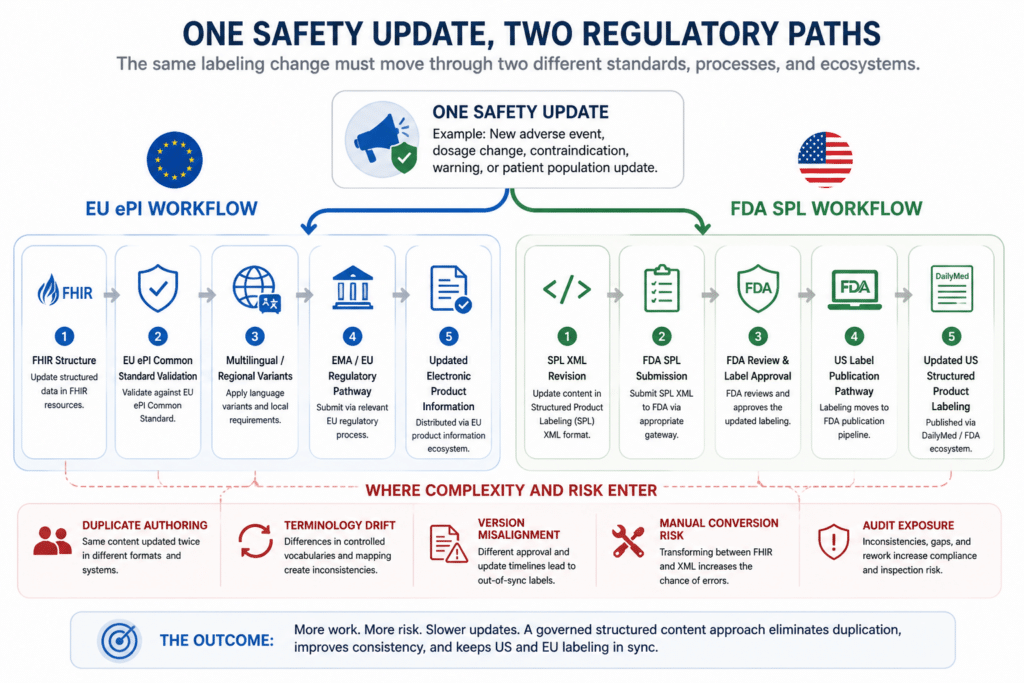
When a company updates safety information, the authoring and approval timelines diverge.
At a high level, the ePI vs SPL comparison looks like this:
| Dimension | EU ePI | FDA SPL |
|---|---|---|
| Primary purpose | Electronic product information for EU medicines | Structured product and facility information exchange with FDA |
| Core format | HL7 FHIR implementation approach under the EU ePI Common Standard | XML-based HL7-approved document markup standard |
| Primary content scope | SmPC, package leaflet, and labeling adapted for electronic dissemination | FDA labeling content organized in structured product labeling form |
| Regulatory ecosystem | EMA / European Medicines Regulatory Network | FDA, SPL resources, and DailyMed publication ecosystem |
| Operating challenge | Harmonised, multilingual, structured EU product information | US-specific structured labeling submission and public labeling access |
In the EU ePI system, the company updates the FHIR structured data, applies the required controlled structure, and submits the revised file through the relevant EU process. The ePI is updated through the EU-controlled distribution and product information pathway.
In the US SPL system, the company revises the SPL XML file, submits it to FDA, and the updated label becomes available through the FDA and DailyMed labeling ecosystem. The operational challenge is not that one standard is simply “faster” than the other. The challenge is that each market uses a different structured format, validation model, terminology approach, and publication pathway.
For a company with products in both markets, this means parallel submission workflows, dual governance processes, and two separate approval timelines. A safety update may therefore require parallel preparation, review, validation, and publication steps before the same underlying change is fully reflected across both markets.
What Pharma Companies Operating in Both Markets Need
Organizations filing in both the US and EU must establish dual authoring processes or build integration layers between them. Some companies maintain separate labeling teams: one for ePI preparation, one for SPL preparation. Others invest in conversion tools that translate FHIR structures into SPL XML or vice versa. Both approaches add cost and introduce risk: translations may be incomplete, terminology may be missed, and regulatory interpretation may diverge between the two files.
The optimal approach is to author once in a governed source structure, then generate both ePI and SPL as output. This requires a platform that understands both standards deeply: FHIR’s coded data model, SPL’s required section structure, terminology mapping across systems, and regional content variance requirements. DocuVera’s structured labeling and product information capabilities are designed to support FDA SPL, ePI, EMA DADI, HL7 FHIR, and global variant control from governed structured content.
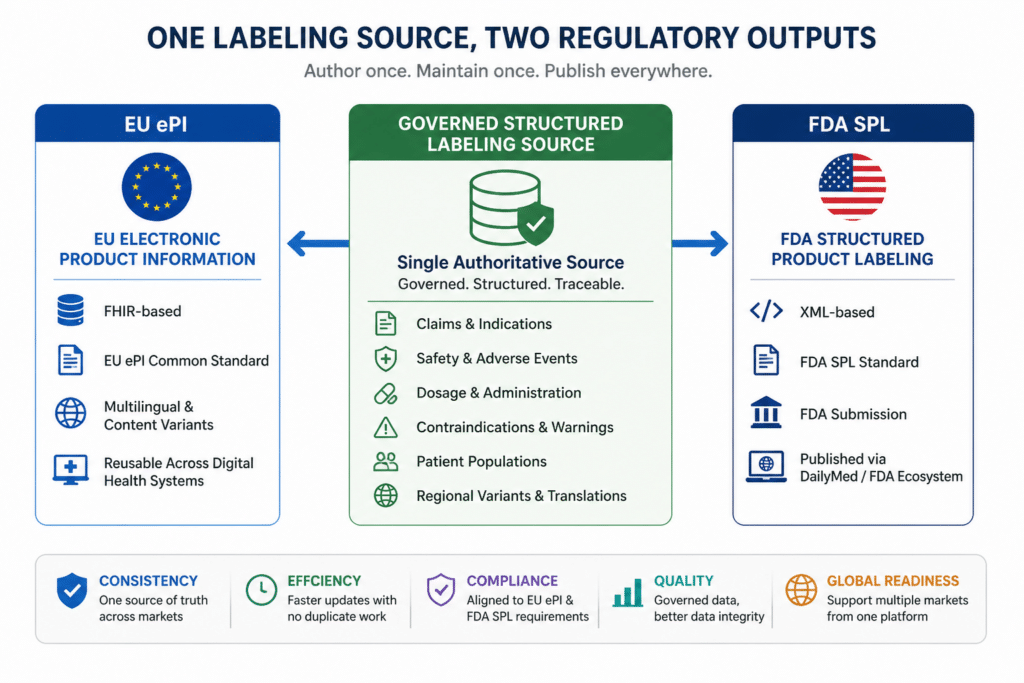
Such a platform becomes the governance backbone for global labeling. A Regulatory Affairs director approves a claim once. Clinical Affairs cites backing data once. Compliance rules enforce consistency across both submission formats automatically. Timelines compress because rework and translation effort disappear. DocuVera’s global labeling solution supports structured content authoring for high-variation labeling, rapid updates, and traceability across formats and stakeholders.
Learn how DocuVera manages both EU ePI and FDA SPL from a single structured source, helping global labeling teams reduce duplicate authoring, improve consistency, and lower audit risk across US and EU submissions. Download our comparison guide to ePI, SPL, and regional labeling standards.
Written by

Kenneth Gutiérrez
Director of Product | Docuvera
Read more from Kenneth →
View all blogs →
Connect on LinkedIn