

By Murali Menon, Chief Revenue Officer
Regulatory data trust is an outcome of regulatory data management behavior, not intent
Pharmaceutical organizations often think about regulatory trust as a relationship issue. Trust is built through transparency, responsiveness, and a history of good interactions. While these factors matter, they are not the foundation of trust. Regulators ultimately trust what they can verify. In regulated industries, regulatory data trust is established not through assurances, but through repeatable, observable data behavior over time — the practical output of disciplined regulatory data management.
When information is consistent, traceable, and explainable across contexts, trust follows. When data behaves unpredictably—appearing differently in different submissions, markets, or lifecycle stages—trust erodes, regardless of intent. This dynamic is sharpened by evolving FDA and EU expectations around data integrity, inspection readiness, and digital-first regulatory interaction, including expectations reflected in FDA’s Data Integrity and Compliance With Drug CGMP Q&A.
What regulators actually expect from data
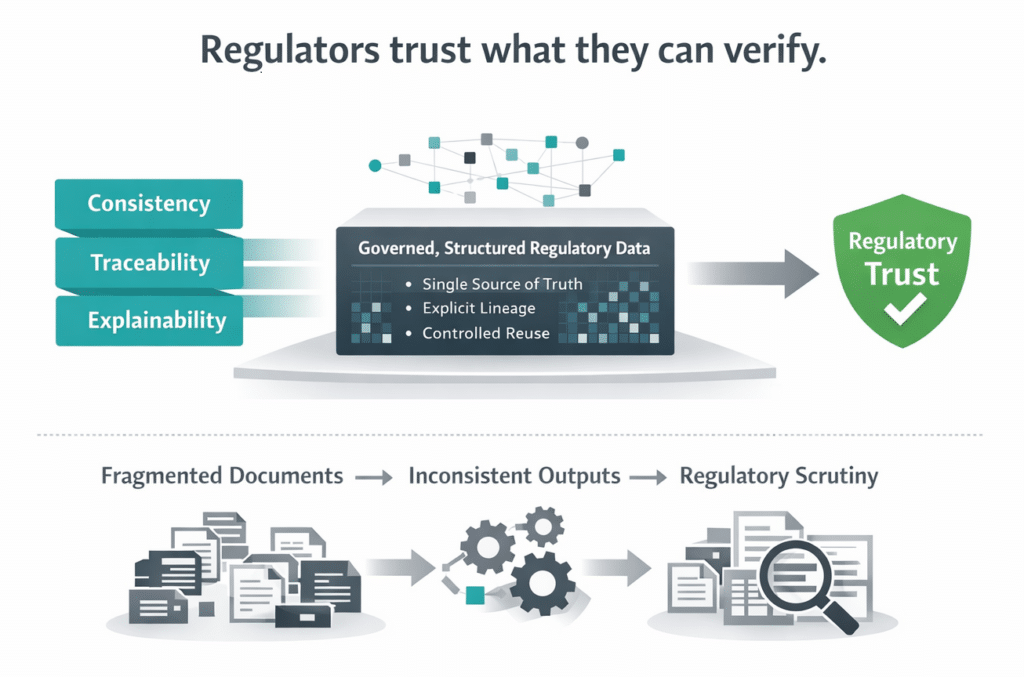
At a fundamental level, regulators expect three things from regulated information: consistency, traceability, and explainability across the regulatory data lifecycle.
Consistency
Consistency ensures that the same data conveys the same meaning wherever it appears. It is the baseline against which regulatory submission consistency is measured — the degree to which the same information holds the same form, terminology, and meaning across submissions, markets, product information, and lifecycle updates.
Traceability
Traceability allows regulators to understand where information came from and how it has changed. Under the ALCOA+ framework — Attributable, Legible, Contemporaneous, Original, and Accurate — regulatory data traceability is a foundational data integrity requirement codified in FDA guidance and EU GMP Annex 11 alike.
Explain-ability
Explainability makes it possible to answer questions quickly and confidently. When data is structured and governed rather than scattered across disconnected documents, explainability is a property of the system — not a function of individual recall.
These expectations are not new, but they are becoming more explicit. They are also reflected in frameworks governing both US and EU regulated environments: 21 CFR Part 11 establishes criteria for electronic records and electronic signatures to be considered trustworthy and reliable, while EU GMP Annex 11 establishes expectations for computerized systems, including audit trails that allow reconstruction of record creation, modification, or deletion. As submissions grow more complex and updates occur more frequently, regulators rely on data behavior as a proxy for organizational control. When data behaves well, confidence increases. When it does not, scrutiny intensifies.
Why document-based regulatory data management undermines trust over time
Document-centric regulatory data management makes it difficult to meet these expectations consistently. Documents are static snapshots, not living records. They obscure lineage. In document-centric regulatory systems, data lineage, audit trails, and governance signals are implicit rather than explicit, increasing reliance on manual reconciliation and institutional knowledge. Documents encourage duplication. Over time, the connection between authoritative source data and downstream outputs weakens.
FDA has repeatedly emphasized audit trails, record control, and data reliability as core data integrity concerns in drug CGMP environments; inadequate audit trails, uncontrolled changes, and poor traceability are common failure patterns when regulated information depends on document-centric management, as reflected in FDA’s Data Integrity and Compliance With Drug CGMP Q&A.
When questions arise, teams are forced to reconstruct history manually. Which version was approved? Where else does this information appear? Has it been updated everywhere? These questions consume time and introduce uncertainty, even when answers ultimately exist.
Trust suffers not because teams lack discipline, but because the system makes disciplined behavior difficult to sustain.
Regulatory data traceability as a signal of control
Traceability is more than an audit requirement. It is a signal of organizational control. When data lineage is clear — when it is easy to see how information has evolved, who approved it, and where it is used — regulators gain confidence that the organization understands and governs its information effectively.
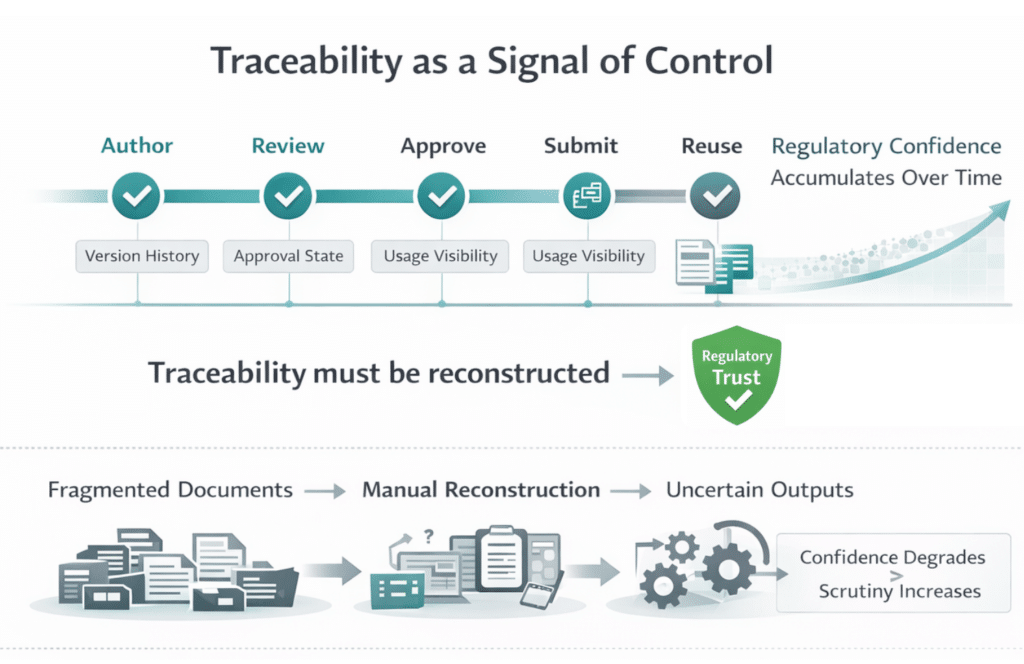
Conversely, when traceability must be reconstructed through emails, spreadsheets, or manual comparison, confidence declines. Each clarification request slows the process and reinforces the perception that data behavior is unpredictable.
Traceability must be inherent, not reconstructed.
Why regulatory submission consistency accelerates regulatory interaction
Consistency reduces friction. Regulatory submission consistency — presenting the same structured information in the same form across submissions, markets, product information, and lifecycle updates — reduces review burden and supports more efficient interaction with FDA, EMA, and national competent authorities. When regulators see the same information presented the same way across submissions and markets, review becomes more efficient. Review cycles shorten, clarification requests decrease, and downstream inspection risk is reduced. Interactions become more predictable. The organization spends less time explaining alignment and more time progressing work.
Consistency is not about rigidity. It is about ensuring that variation is intentional and controlled. When differences exist, they are explained by design, not discovered by accident.
The role of centralized regulatory data management in building trust
Centralized regulatory data management is essential to achieving consistency and traceability at scale. Without a single authoritative foundation for structured regulatory data, organizations rely on distributed copies and manual coordination. Trust becomes fragile because alignment depends on individual effort.
Pharmaceutical data governance — the policies, processes, and systems that define how regulated information is created, controlled, reused, and maintained across its lifecycle — cannot function reliably in a fragmented environment. Centralized regulatory data provides the infrastructure governance requires to be enforceable rather than aspirational.
Centralization ensures that there is one source of truth, changes propagate predictably, lineage is visible, and governance is enforceable.
Inspection readiness is a direct byproduct. When regulatory data is centralized and governed, organizations can respond to agency queries and inspection requests without manual reconstruction — because the information is already structured, traceable, attributable, and auditable. Under 21 CFR Part 11 Subpart B, controls for closed systems include the ability to generate accurate and complete copies of records suitable for inspection, review, and copying by the agency.
This foundation allows trust to be built systematically rather than earned repeatedly.
How Docuvera engineers regulatory data trust through data transparency
Docuvera is designed to support a governance-first, centralized, transparent regulatory data management approach in regulated environments. Instead of treating trust as a downstream outcome of review, Docuvera embeds trust into the data itself.
By maintaining regulated information in a single, governed foundation, Docuvera helps ensure that consistency is preserved across every context. Lineage is explicit. Approval history is clear. Usage is visible. When regulators ask questions, answers are readily available because the data tells its own story.
This approach reflects a broader industry shift away from document-centric regulatory processes toward structured, governed regulatory data foundations that allow information to behave predictably across submissions, markets, product information, and lifecycle stages.
Importantly, Docuvera complements existing regulatory systems rather than replacing them. It provides a shared centralized regulatory data backbone that helps information behave consistently as it moves across submissions, markets, product information, and lifecycle stages.
The cumulative effect of predictable regulatory data behavior
Trust is not built in a single interaction. It accumulates over time as regulators observe predictable data behavior across multiple submissions and updates. Organizations that demonstrate consistency and traceability repeatedly earn confidence that extends beyond individual projects.
This confidence has tangible effects. Reviews can move faster. Follow-up questions can decrease. Regulatory interactions become less reactive and more collaborative. Predictability improves for both sides.
Inspection readiness compounds this effect. Organizations that maintain traceable, governed regulatory data are better positioned to respond to unplanned agency requests — without the disruption that typically accompanies reactive document reconstruction.
Trust as a strategic advantage
In an environment of increasing regulatory complexity, trust is a strategic asset. For executive teams, regulatory data trust can translate into speed to market, reduced compliance drag, and organizational resilience. Organizations that build trust through disciplined data management gain more than compliance. They gain speed, flexibility, and resilience.
Trust reduces the need for conservative buffers and redundant checks. It enables faster response to change. It supports pharmaceutical data governance maturity, creating the conditions for product lifecycle agility and innovation without triggering unnecessary regulatory scrutiny.
Regulatory data trust is engineered, not negotiated
Regulatory trust cannot be negotiated or accelerated through intent alone. It must be engineered through systems that ensure data behaves consistently over time. Centralized, governed regulatory data management provides the foundation for that engineering effort by making consistency, traceability, explainability, and auditability repeatable across the regulatory data lifecycle.
Docuvera enables organizations to build trust where it matters most…inside the data itself. By ensuring consistency, traceability, and transparency across the lifecycle, it allows trust to accumulate naturally.
In a regulated industry, trust is one of the most valuable currencies an organization holds. Those that invest in the data foundations that sustain trust gain advantages that extend far beyond individual submissions.
Key Takeaways
Written by

Murali Menon
Chief Revenue Officer | Docuvera
Read more from Murali →
View all blogs →
Connect on LinkedIn