

A closer look at how governed clinical content reduces duplicated edits, downstream misalignment, and amendment review burden across the protocol lifecycle.
A modern top-pharma IT estate often contains an excess of content tools. Regulated content is authored, stored, reviewed, and assembled across a portfolio that can span dozens to hundreds of GxP applications: document management systems, submission publishing tools, Word-based authoring add-ons, and function-specific point solutions for labeling, clinical, CMC, safety, and quality. Each was adopted to solve a local problem. Together, they create a global one.
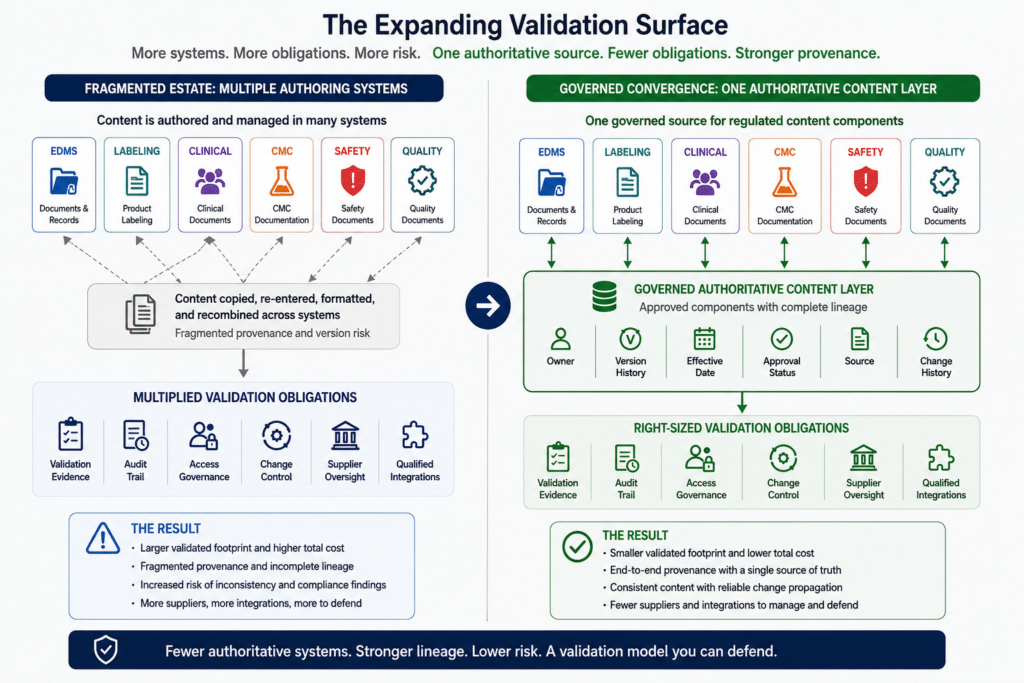
For the IT and validation function, every GxP-relevant system enters the validated landscape. Depending on its intended use and risk, it may carry user requirements, specifications, qualification or assurance testing, and documented evidence that it performs as intended. It carries change control, periodic review, an audit trail, and an integration surface that must itself be qualified. GxP content management sprawl therefore shows up in the validation budget, as an expanding validated footprint the IT organization is accountable for defending.
Redundancy is the sharpest edge of this. Within a single function, the same content is often authored in one system, managed in another, and assembled for output in a third. In a GxP environment, that redundancy carries compliance exposure, because overlapping copies erode the single authoritative version of a statement.
Where the Cost Actually Lands
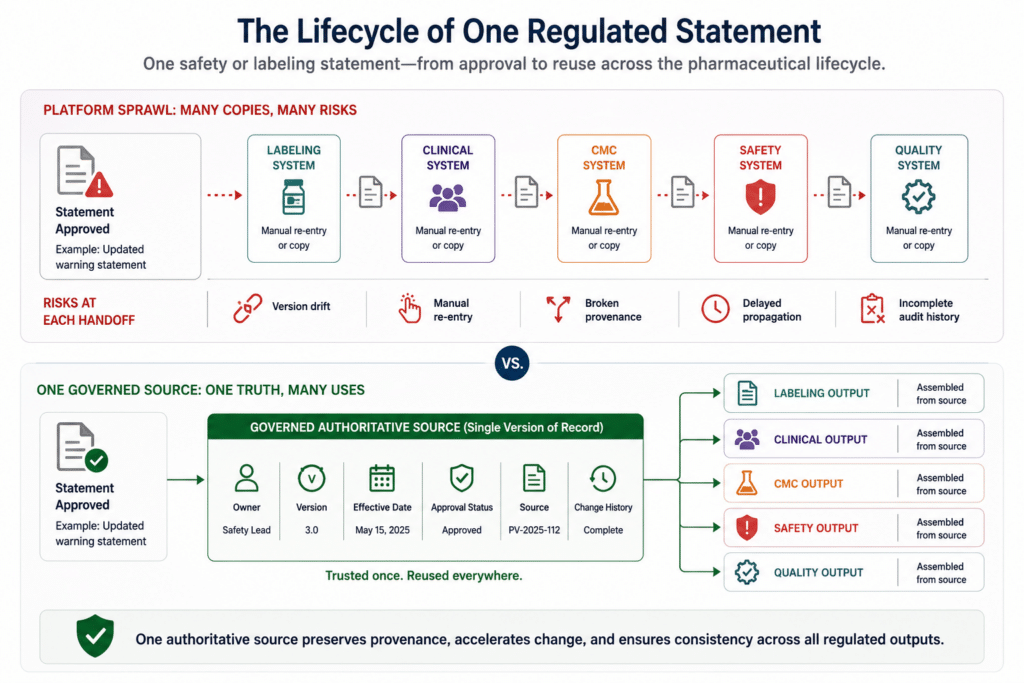
The visible cost of sprawl is duplicated validation effort. The less visible cost is duplicated content. When the same indication, warning, dosing statement, or specification exists in several systems, the organization loses the ability to assert which instance is authoritative. Approval no longer resolves risk. It begins propagation, as content is copied, localized, reformatted, and recombined across system boundaries.
This is where content provenance and traceability fragment. During an inspection, teams must explain where a statement originated, why it exists, and how it changed over time. That explanation becomes difficult when lineage crosses several validated systems, each with its own audit trail and none with a complete one. A single upstream safety change can affect dozens of downstream artifacts, and when propagation depends on manual coordination across platforms, small changes cascade into inconsistency. Interface controls, regression testing, and downstream synchronization then become part of the assurance burden.
Ownership erodes in parallel. Governance is often strong up to approval and weak afterward. When content lives in many systems, stewardship after release becomes diffuse, and unmanaged exposure accumulates in the areas that were previously secondary.
The Regulatory Direction Raises the Stakes
Two regulatory signals make platform sprawl more consequential.
In the European Union, the draft revision of EU GMP Annex 11, Computerised Systems, expands the guideline from five pages to nineteen. It was published for consultation in July 2025, and the consultation closed in October 2025. At the time of publication, the revised text remains a draft, so organizations should monitor the European Commission’s EudraLex Volume 4 updates for its final status and implementation timeline.[1][2] It strengthens expectations for computerized-system lifecycle management, risk management, supplier and service-provider oversight, identity and access management, data integrity, electronic records, audit trails, business continuity, and system security.[1] A companion draft Annex 22 on Artificial Intelligence addresses artificial intelligence for the first time.[3]
Annex 11 is GMP-scoped, though the 2025 draft notes its principles can extend to other GxP domains. Much regulated content authoring also sits under 21 CFR Part 11 and other predicate rules rather than GMP alone. The direction is common across them: each additional computerized system multiplies the supplier oversight, access governance, and validation evidence that must be maintained.
In the United States, FDA’s February 2026 draft guidance on Computer Software Assurance points in a complementary direction. FDA issued final guidance in September 2025 and superseded it on February 3, 2026, with revised draft guidance titled Computer Software Assurance for Production and Quality Management System Software.[4] It endorses a risk-based, right-sized approach and allows manufacturers to consider and leverage relevant supplier activities, assessments, and records when establishing assurance, rather than automatically duplicating all supplier testing.[4] The guidance addresses assurance at the individual software level: scale activities to risk and use credible supplier evidence where it supports the assurance conclusion. Extending that logic across an estate is where fewer, well-evidenced authoritative systems become the efficient choice.
Ungoverned AI compounds the problem. Where content is fragmented and weakly traceable, automation accelerates reuse without context and increases the volume of output that must later be defended. AI accelerates whatever control model already sits beneath it. Layered onto sprawl, it widens the surface that inspectors will examine.
What Reducing GxP Content Management Sprawl Should Mean
For IT, tool count alone provides an incomplete metric. Validated systems cannot be removed overnight, and an incumbent EDMS often remains essential infrastructure. The meaningful objective is a single authoritative source for regulated content, which reduces the number of places that content originates and the lineage that must be traced across systems.
Concentration has its own cost, and this reader knows it. A converged authoring platform carries higher individual criticality, greater concentration risk, and integrations that must be assessed and qualified with care. The tradeoff is deliberate. Duplicated qualification effort falls, fragmented lineage resolves into one traceable source, and provenance stops crossing boundaries that no single audit trail spans. Compliance surface concentrates where it can be governed, rather than spreading thin where it cannot.
This is the practical meaning of the “one truth” model: fewer authoritative origins for regulated content, with success measured through validation burden, traceability, and defensibility. It also serves data integrity directly. A single authoritative source supports the Original, Accurate, Complete, Consistent, Enduring, and Available expectations of ALCOA+, while controlled metadata and audit history strengthen attribution and traceability.[5]
How Docuvera Fits
Docuvera is a governance-first GxP content management and structured content authoring platform purpose-built for regulated life sciences.[6] It governs content at the component level, with explicit lineage, ownership, and lifecycle accountability.[7] A single approved statement can then be reused across labeling, clinical, CMC, safety, and quality outputs. This is the “one truth” model: one authoritative source, assembled into many outputs, rather than many copies maintained in parallel.
Docuvera has been purpose-built for regulated life sciences content and has been adopted by global pharmaceutical organizations, grounding the perspective in implementation experience.[6][8][9]
For the IT and validation function, three properties matter. First, the platform is designed to reduce total compliance surface area by consolidating the authoritative content layer within the existing technology estate. Second, it provides role-based access, version history, audit trails, and validation support mapped to Annex 11 and 21 CFR Part 11 expectations. Vendor documentation is intended to reduce internal qualification effort. Third, the platform supports regulatory content interoperability across existing platforms, so convergence happens at the content layer while incumbent RIM, QMS, and EDMS infrastructure remains in place.[10]
On security posture, Docuvera reports SOC 2 Type 2 and ISO 27001 certification.[11] These certifications complement the GxP electronic-records controls of 21 CFR Part 11 and Annex 11. This audience should evaluate security certification and GxP control suitability through their respective criteria.
AI operates within the same boundaries. Within the described governance model, AI operates inside structured workflows with human review, drawing from authoritative, approved sources while preserving provenance.[12] Its purpose is to accelerate governed content under the same lifecycle controls applied to other content. In this model, AI functions as a stress test the content environment can pass.
Customer experience reflects the pattern. Boehringer Ingelheim adopted the platform after an earlier tool proved inflexible, and valued that it was, in the words of Senior IT Project Manager Holger Christein, “expandable to multiple functional areas.”[9] A global clinical operations leader at a top-20 pharmaceutical company described a comparable path: “We started with labeling, the most complex use case. Adding new functions in Docuvera is now straightforward.”[13] Both begin where complexity is highest, then extend from one governed source.
The Governance-First Takeaway
Platform sprawl creates a governance problem with direct cost consequences. Every additional system that authors regulated content adds a validated surface, an audit trail, and a place where provenance can fracture. Reducing that sprawl means establishing one authoritative source for regulated content, and letting governance persist as that content is reused, localized, and updated. Structure. Govern. Scale.
Frequently Asked Questions
Editorial note
This article reflects Docuvera’s experience supporting structured content programs in regulated life sciences. Regulatory interpretations are based on the cited source materials and should be assessed against each organization’s products, intended uses, quality system, and applicable predicate requirements.
Sources
- European Commission. Draft Annex 11: Computerised Systems. July 2025.
- European Commission. Stakeholders’ Consultation on EudraLex Volume 4 GMP Guidelines: Chapter 4, Annex 11 and New Annex 22. July 2025.
- European Commission. Draft Annex 22: Artificial Intelligence. July 2025.
- U.S. Food and Drug Administration. Computer Software Assurance for Production and Quality Management System Software. Draft guidance issued February 3, 2026; supersedes the final guidance issued September 24, 2025.
- Medicines and Healthcare products Regulatory Agency. Guidance on GxP Data Integrity. March 2018; updated September 2021.
- Docuvera. Structured Content Authoring for Regulated Life Sciences.
- Docuvera. Regulatory Compliance and Risk Mitigation.
- Docuvera. Implementation Support.
- Docuvera. Boehringer Ingelheim: Leading Life Sciences Innovation Through Structured Component Authoring.
- Docuvera. Regulatory Content Interoperability: Aligning Platforms in the Regulatory Ecosystem.
- Docuvera. Technology and Security.
- Docuvera. AI-Powered Structured Content Authoring.
- Docuvera. Global Labeling.
- Docuvera. Structured Content Solutions for Pharma Teams.