Answer with Readiness. Regulatory standards keep moving toward structured content. A governed foundation gives every function a stronger starting point for what comes next.
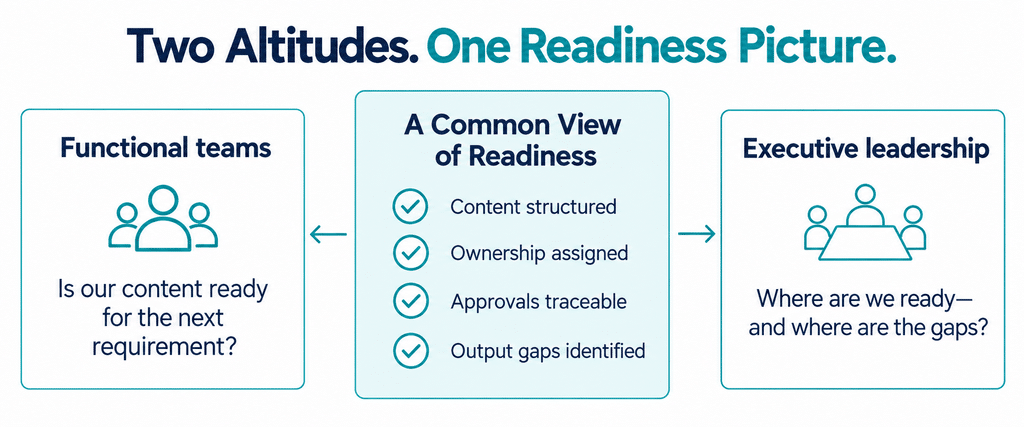
The readiness question travels through the organization in two forms. On the regulatory floor it is specific. Is labeling ready for ePI? Is clinical ready for the structured protocol? Is the CMC data in the shape the agencies expect? In the boardroom it is broad. Are we keeping pace with regulatory change, and could any of it disrupt a launch or a supply chain?
The specific questions belong to the leaders who own each standard. The broad one belongs to the executives accountable for the whole. They are the same question about readiness, asked at two altitudes. An organization needs answers that hold together at both.
The trouble is that the two altitudes often do not share an answer. The executive hears confidence from one function and hesitation from another, because each is preparing for its own requirements on its own foundation. That gap is the real readiness problem, and it helps explain why structured content in pharma has become an enterprise concern.
The direction of structured content in pharma is unmistakable
Step back from any single deadline and the pattern is clear. Across labeling, clinical protocols, and medicinal product data, regulatory initiatives increasingly support structured information and interoperable exchange.
In the EU, electronic product information is moving from pilot to implementation. EMA published its draft ePI implementation roadmap in March 2026, proposing phased voluntary submission for vaccines, followed by oncology products and then all centrally authorised products. These remain draft implementation milestones.
In its March 2026 Management Board highlights, EMA also states that ePI will become mandatory for all newly authorised medicines once the new EU pharmaceutical legislation enters into application. That future obligation has a different status from the voluntary rollout.
The EU ePI Common Standard uses a semi-structured format based on HL7 FHIR, supporting electronic exchange and interoperability. Producing ePI therefore requires more than exporting the current leaflet as a PDF.
The operational implications extend into authoring, metadata, and lifecycle management, as explored in what EMA ePI requirements mean for content operations.
Clinical protocols are moving in a similar direction. ICH M11, the Clinical Electronic Structured Harmonised Protocol, reached Step 4 adoption in November 2025. FDA issued final M11 guidance, a template, and technical specifications in May 2026. Together, these support consistent protocol structure and the electronic exchange of protocol information.
Alongside these developments, EMA is implementing ISO IDMP medicinal product data standards through its SPOR programme in phases.
For a closer look at how these initiatives relate, see electronic product information and ISO IDMP.
These initiatives differ in scope, maturity, and legal status. Taken together, they point toward a growing need to manage regulated information in forms that can be exchanged, compared, and updated across systems. For companies operating across the US and EU, readiness means tracking those regional requirements while building content practices that can support both.
Why per-mandate remediation keeps organizations behind
A document-first organization can meet each of these as a separate project. When ePI arrives, it launches an ePI programme. When the structured protocol arrives, it launches another. Each programme converts documents into the required structure, establishes a workflow for that output, and works toward its own implementation date.
Then the next standard arrives and the cycle repeats, because the last project left the underlying content largely unchanged.
That is the trap. A conversion completed for one requirement can produce a usable output while leaving its source dependent on files, manual reconciliation, and repeated extraction. The next initiative encounters the same foundation and demands much of the same work again.
Effort grows with the number of standards. Teams spend their time preparing individual outputs, and the organization keeps answering the board’s question with another project plan.
This also explains why the readiness question produces different answers from different functions. Labeling has one view shaped by its ePI programme. Clinical has another shaped by its protocol work. Each may be making progress, but leadership has limited visibility into whether that progress creates a capability the rest of the organization can use.
The questions keep coming across functions. Give your teams a foundation for answering them with confidence, traceability, and readiness.
What regulatory readiness actually requires
Readiness begins with content held as governed, structured, machine-readable information, with clear ownership, approval status, metadata, and lineage. That gives each new standard an established source to draw from.
When the source is already structured and governed, teams can focus on the requirements of the new representation: its data fields, terminology, mappings, validation rules, and review process. Teams can then identify which approved components meet the new requirements, where information is missing, and which changes need review. The approved content and its history remain available as that work proceeds.
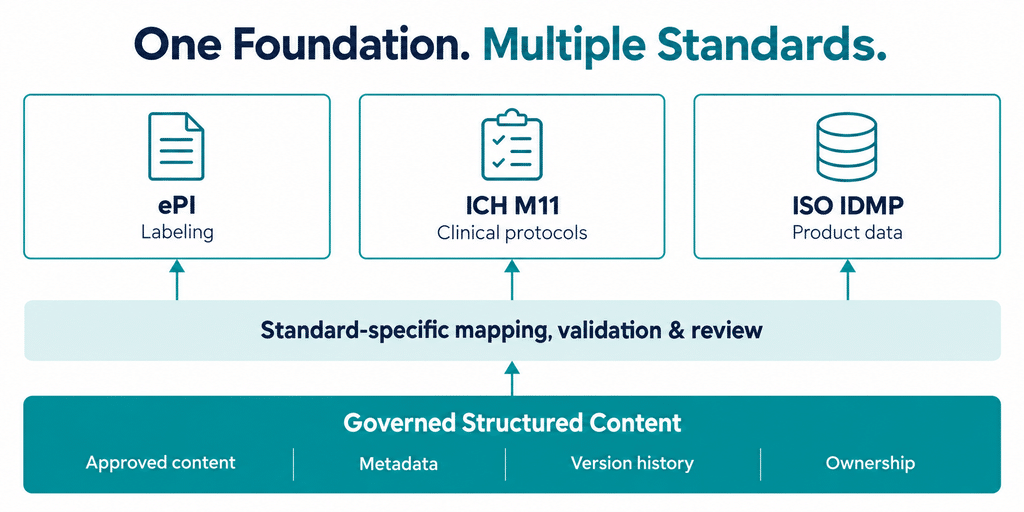
A shared foundation still needs to accommodate the differences between domains. An ePI dataset and a clinical protocol have distinct purposes and content models. Each requires appropriate scientific input, regulatory review, and technical validation. The opportunity lies in carrying governance and reusable information across those activities, reducing how much teams must reconstruct.
For the executive and the strategic buyer, that is the value. The investment creates a capability that can support successive requirements, with progress assessed through the extent of governed content reuse, the time needed to prepare a new output, and the amount of manual reconciliation still required. Teams retain their specialist responsibilities while working from a foundation that preserves content, context, and control.
Readiness becomes something leadership can assess through evidence: which content is structured, who owns it, how its approval is recorded, and whether it can move into the required output without losing its meaning or history. Those answers give functional leaders and executives a common basis for judging readiness and prioritizing the remaining work.
One core, every rendering
A governance-first structured content foundation supports this approach through component-level version control, metadata, review workflows, and traceable content lineage. These controls help preserve the standing of approved information as it moves into use.
A shared core can hold reusable content alongside domain-specific components. Through structured content across labeling, clinical, CMC, safety, medical information, and quality, teams can maintain common governance while using authoring tools and workflows appropriate to their function.
As an illustrative example, consider an approved warning in a product’s labeling. If it is held as a governed component, a team preparing ePI can work from that source and retain its version and approval history. If the warning changes, the team can identify where that component is used and review the affected outputs. Market-specific wording, translations, and additional approvals remain part of the work, with a traceable source behind each decision.
That is how preparedness for structured product information can contribute to a broader capability. The organization builds experience in structuring and governing content that remains useful as requirements evolve.
AI can assist with finding and suggesting relevant components within this foundation. Teams still need to verify that the selected content is current, approved, and appropriate for the intended use.
When the readiness question comes, from the floor or the boardroom, the answer can draw on the same evidence. Each function knows the condition of its content. Leadership can see how that work supports the organization’s ability to respond.
The next standard will still require decisions. A governed foundation gives the people making them a stronger place to begin.
Answer with Readiness. Build the content foundation that helps your organization adapt as regulatory requirements evolve. See how Docuvera supports regulatory digital transformation.
Frequently Asked Questions
Sources
- European Medicines Agency. Electronic product information: draft roadmap, EU Common Standard, and implementation guidance.
- European Medicines Agency. EMA Management Board: highlights of March 2026 meeting.
- International Council for Harmonisation. November 2025 Assembly meeting press release: M11 Step 4 adoption.
- US Food and Drug Administration. M11 Clinical Electronic Structured Harmonised Protocol: final guidance, template, and technical specifications.
- European Medicines Agency. Substance and product data management services: phased ISO IDMP implementation.