

By Michele Furlan, Head of AI Technology
The joint good AI practices principles released in January 2026 set a clear standard for AI in regulated contexts: AI systems should maintain evidence proportionate to their context of use, including
relevant data provenance, lifecycle controls, performance assessment, and human
oversight.
The harder question is whether current content infrastructure can actually meet it.
The January 2026 joint statement from FDA and EMA on good AI practice (formally titled the Guiding Principles of Good AI Practice in Drug Development) did not arrive as formal guidance. It arrived as a signal, and in regulatory affairs; signals from both agencies arriving simultaneously carry weight that formal guidance sometimes does not.
The document sets out ten principles spanning the full medicines lifecycle, from early research through post-market safety surveillance. For teams working in regulatory content operations, one requirement runs through all of them. AI in GxP contexts must produce a defensible, auditable record of what happened, why it happened, and who authorized it. This is crucial for ensuring compliance with auditable AI pharma regulatory submissions and maintaining high standards in the industry.
That requirement is not new as a concept. What is new is that both agencies have now articulated it explicitly, and together.
What the Principles Establish
The ten principles address a broad range of governance considerations: ethical alignment, risk-based approaches, data quality, multidisciplinary oversight, and lifecycle management of AI systems. Two carry particular operational weight for regulatory content teams.
The first requires developers to maintain traceable records of data sources used to train AI models, including the processing steps applied to that data. The second requires AI systems to follow software engineering practices aligned with GxP requirements. Both principles are discussed in detail by Applied Clinical Trials and in the McGuireWoods regulatory briefing issued shortly after publication. The software engineering requirement aligns directly with existing electronic records and computer system validation frameworks: 21 CFR Part 11 in the US and EU GMP Annex 11 in the EU, may apply depending on the system’s intended use, the regulated activities it supports, and the electronic records involved.
The principles provide broad, non-binding direction for the responsible and risk-
based use of AI across the medicines lifecycle. AI in regulated contexts is not evaluated on output quality alone. It is evaluated on whether the pathway from input to output is documented, governed, and reproducible.
The principles also reaffirm that human oversight is non-negotiable. AI may assist qualified professionals, but accountability for content decisions stays with those professionals. This has direct implications for how organizations design AI-assisted authoring workflows and who retains decision authority at each stage.
One point worth stating plainly: the principles are expected to inform future guidance, although their eventual legal status and detailed requirements cannot yet be assumed.
The Gap Between AI Capability and Regulatory Defensibility
The pharma industry’s adoption of AI-assisted content tools has accelerated considerably over the past two years. Authoring assistance, translation, review optimization, and content reuse are active use cases across regulatory, labeling, clinical, and CMC functions. The capability exists. The governance infrastructure around that capability often does not.
Consider a practical example. A regulatory submissions team uses an AI tool to assist with drafting a clinical study report section; content that will ultimately form part of an eCTD regulatory submission. Under the joint principles, an auditor could reasonably ask four questions:
Many document-based workflows may struggle to answer these questions consistently
where AI interactions occur outside established governance processes. The AI operates outside the governance boundary of the content management system. Prompts, inputs, outputs, and editorial decisions live in email threads, local files, and undocumented conversations. The AI may have performed well. The audit trail says nothing.
This is not a theoretical risk. It is a growing compliance exposure as AI adoption accelerates ahead of the governance structures required to make that adoption defensible. The governance and evidentiary risk can increase as AI-assisted content is reused across documents, markets, and lifecycle activities.
Governance Has to Come Before AI
That distinction points to a broader principle the joint guidelines reinforce: governance is a prerequisite for AI, not a feature to be added afterward.
Regulatory content operations teams have been living this reality for years, often without calling it that. Global labeling managers synchronizing Company Core Data Sheet (CCDS), Summary of Product Characteristics (SmPC), and United States Prescribing Information (USPI) content across dozens of markets know that a single safety update can cascade into country-specific revisions across a product’s entire global market footprint. Pharmacovigilance (PV) leads management RIsk Management Plans (RMPs), Development Safety Update Reports (DSURs), and periodic safety updates know that content consistency across markets is not a preference but an obligation. CMC writers maintaining ICH M4-aligned Module 3 documentation across a product lifecycle know that post-approval change volume far exceeds the initial submission effort.
In each of these contexts, AI adds value only when the content it operates on is already governed. Version-controlled, traceable, and structured at the component level, not just the document level. AI applied to unstructured, document-centric environments does not solve the governance problem. It accelerates it.
This is the failure mode the joint principles are designed to prevent. AI that produces outputs no one can fully reconstruct is not compliant AI assistance. It is a new category of documentation risk dressed up as productivity.
What a Governance-First Content Architecture Provides
Docuvera’s Hierarchy of Intelligence framework structures AI assistance by risk and traceability, not by capability alone. The three tiers reflect a deliberate prioritization.
RARe (Retrieval Augmented Reuse) is the preferred mode. It surfaces approved, version-controlled content for direct reuse. Content reused through RARe already carries its metadata, lineage, and approvals. Review burden is minimal. The audit trail is complete. The workflow is designed to support source traceability, version history, and the recording of material AI-assisted actions.
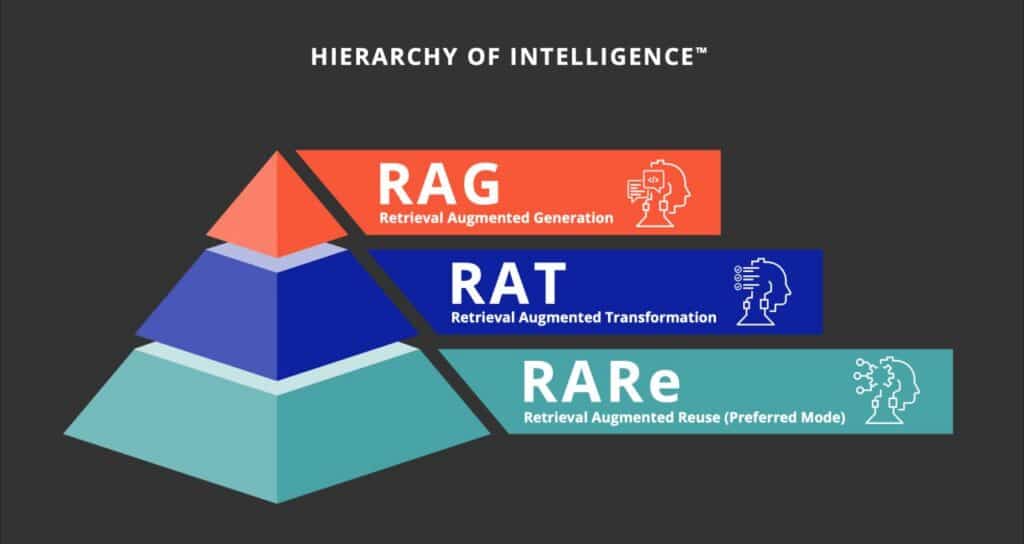
RAT (Retrieval Augmented Transformation) applies controlled, track-change-visible modifications to governed source material. RAT can preserve stronger source-level traceability where transformations remain bounded and meaningfully comparable with the source.
RAG (Retrieval Augmented Generation) creates new or substantially re-authored content grounded in retrieved sources, including governed content where available.
In a structured content authoring environment built on this framework, every component is version-controlled and every reuse event is traceable. Material AI-assisted actions should be logged according to the intended use, configured workflow, and applicable record requirements.
The architecture is designed to support these principles, subject to implementation, configuration, validation, and operational evidence.
For organizations evaluating where their AI investments sit relative to these expectations, the Governance-First AI for Pharma white paper provides a detailed treatment of the architectural and regulatory alignment rationale.
The Operational Takeaway
The joint principles are voluntary today. Based on the direction both agencies have signaled, they will not remain so. Organizations deploying AI in regulatory content workflows (including those managing eCTD submissions, global labeling, and pharmacovigilance documentation) have a window to align their infrastructure with where regulatory expectation is heading.
The alternative is building AI capabilities on content environments that cannot produce the audit trail both agencies have now described in writing. That gap grows more expensive to close with every AI-assisted document produced outside a governed framework.
The question is not whether your organization is using AI for regulatory content. The question is whether the record that use produces would satisfy an auditor asking the four questions above.
Get in touch with our team to learn more.

Michele Furlan
Head of AI Technology | Docuvera
Read more from Michele →
View all blogs →
Connect on LinkedIn
Frequently Asked Questions:
References
- EMA and FDA Set Common Principles for AI in Medicine Development. European Medicines Agency. January 2026. https://www.ema.europa.eu/en/news/ema-fda-set-common-principles-ai-medicine-development
- FDA and EMA Align on Ten Principles. Applied Clinical Trials. January 2026.
- FDA and EMA Provide Guiding Principles for AI in Drug Development. McGuireWoods. January 2026.
- EMA, FDA Issue Joint AI Guiding Principles for Drug Developers. RAPS. January 2026. https://www.raps.org
- Computer Software Assurance for Production and Quality System Software. U.S. Food and Drug Administration. September 2025. https://www.fda.gov/regulatory-information/search-fda-guidance-documents/computer-software-assurance-production-and-quality-management-system-software